Not until last Friday morning, shortly before going to my cycling class, did I remember that Peggy Noonan still existed. She churns out things for the Wall Street Journal, but somehow I’ve missed all these in my occasional glances at their website until a few days ago. One forgotten corpse just as improbably dug up another: Her latest op-ed exhumed Rex Reed, who died last week.
To me the late film critic was two things. He was, firstly, the generator of catchy blurbs printed on the VHS covers of the most execrable films you can imagine, excelling in a profession where he seemed rivaled only by Jim Svejda (whose musical acumen, thankfully, permits one to forgive him his transgressions against le cinéma). Secondly, and perhaps more relevant to my interests, Reed was the film critic who in February 2000 got caught shoplifting CDs from a Tower Records store in Manhattan. Among others, he apparently tried to boost discs of Mel Tormé’s California Suite and Peggy Lee’s Songs from Pete Kelly's Blues. (The latter was apparently so flattered that she sent Reed her entire discography. Which tempted me at the time to try my luck with some Leonard Bernstein CDs. Maybe his estate would’ve rewarded me with a free copy of one of his Mahler cycles.) At the time Reed said his episode was the product of a “senior moment.” He also criticized his treatment by Tower Records loss prevention staff, whom he likened to Beavis and Butthead, in a reference as witty as it was doomed to obscurity. (Imagine if Pauline Kael got arrested in the 1960s for stealing LP reissues of Rudy Valleé and Annette Hanshaw, then upbraided store staff with an I’m Dickens, He’s Fenster reference.)
Reed disappeared for me after that, but thanks to Noonan I discovered that he was still working right up until his death. Speaking of Lenny, Reed wrote about the Bradley Cooper biopic-cum-soap opera Maestro that it was “the closest thing to perfection” he had seen in “a very long time.” I guess that he didn’t get out much in his last years. Whatever the case, Serge Daney this guy was not.
Noonan mentioned little that was substantive about Reed in her op-ed, which soon forgot him entirely after a few paragraphs. Instead it devolved into a spirited, if quixotic lambasting of the Soviet Union, a state now defunct for nearly 40 years. Likewise, my post will also cast Reed aside, in order to give a spirited, if quixotic lambasting of Noonan, who if not defunct, has been nearly as irrelevant as the professional Kremlinologists her boss helped to make permanently unemployed.
At any rate, she brought up something that caught my attention:
State socialism has always been constrictive, heavy, static. It has trouble creating anything, it isn’t fizzy and alive. What it does is allocate. But allocators always and inevitably favor their own interests and networks. In the Soviet Union the governing class, those who held the party posts — there’s always someone in power, in every system — tended to be mediocre and hackish at best, utterly corrupt at worst. Their system didn’t work and couldn’t grow, and the geniuses were denied a stage.
It is beyond the scope of my interests to defend or criticize any economic system. (Although considering that there are armies of scribes like Noonan who are paid by the powerful to shill for their pet ideologies, I’m wondering whether musical criticism was the right choice of career to follow after all.) Her argument, nonetheless, merits some discussion.
Whatever the very real and terrible faults of the Soviet Union, it was perplexingly also about as rich in artistic creation as any Western country of its time. This was as true at its inception in 1917 as it was when the Red Banner was lowered for the final time at the Kremlin in 1991. Noonan’s observation that the mediocre tend to rule over the talented isn’t restricted to the Soviet Union. Michelangelo, who lived in post-medieval Italy half a millennium ago, wrote a sonnet on that very topic (which was later beautifully set by Shostakovich). Yet, as a brief look at the USSR Union of Composers demonstrates, even Soviet mediocrities tried to foster an atmosphere that rewarded more than just toadies.
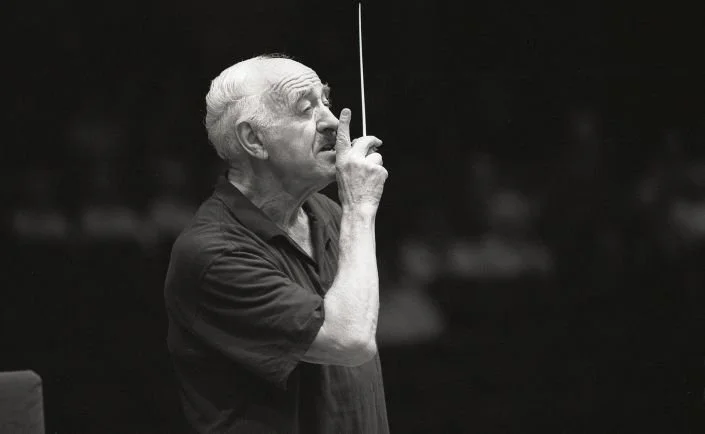
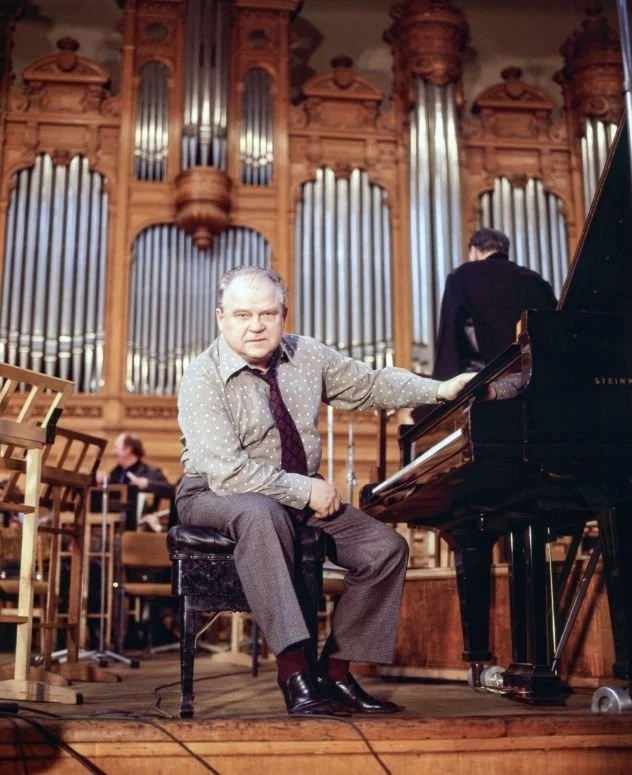
Tikhon Khrennikov was already a respected composer by the time he established himself at the vanguard of the Zhdanovshchina of the late 1940s. In doing so, he had to walk a fine line between artistic considerations, dictates from above, and his own conscience. Khrennikov undoubtedly hectored Prokofiev into a stroke, but he also was a bulwark against the pernicious anti-Semitism of the late Stalinist period, for which he was anonymously denounced by several members of the Union of Composers. His defense wasn’t entirely successful, as the arrest of Mieczysław Weinberg in early 1953 proves. Even in that case, Khrennikov appeared to have attempted making amends by permitting Weinberg to resume work after his release, promoting his music during his “stellar years,” and vigorously lobbying the Politburo to permit a staging of the opera The Passenger.
In later years Khrennikov presided over a period of great prosperity and even a degree of artistic plurality for the Union. Shostakovich’s late music would’ve been unthinkable had it not been so. Even Khrennikov dabbled in twelve-tone play. Far from keeping its geniuses from the front ranks, he also ensured they were featured prominently, all the better to foster goodwill for Soviet culture domestically and abroad.
Not everyone was happy. Georgy Sviridov privately complained that Khrennikov’s system benefited the older and established over the young and unknown. Not that the former’s privileges were cost-free. With increased privileges came increased responsibilities, leading to the dramatic dwindling in output from Kabalevsky, Khachaturian, and Khrennikov himself, to name a few. And some of those in the latter category eventually ventured so far artistically that indeed they were marginalized, then suppressed by the Union. (Which only reinforced their taboo appeal, while it diminished the relevancy of the Union.)
During the span of its existence, the USSR Union of Composers, as well as its affiliate unions in the individual Soviet republics, fostered the careers of established figures, as well as those whose careers were still on the rise. To members it provided a wide range of support and resources that were (and still are) beyond the reach of the average Western composer in the West. Members, however, were expected to concede, especially on matters of ideology and public service. Those that didn’t — like Andrei Volkonsky and Alexander Lokshin, the latter of whom was denied professional opportunities and even the basic tools to compose — paid a steep price. For most Soviet composers, the alternatives were possibly worse. Weinberg, for example, could dedicate himself entirely to composition, without need of teaching. The Union provided work, an extensive network of retreats in picturesque regions, healthcare, and most importantly a guaranteed income. When these all vanished after the fall of the Soviet Union, composers like Weinberg, whose life was certainly cut short by the sudden withdrawal of state healthcare, suffered tremendously. Even former renegades like Denisov were left scratching their heads over whether the transition from one way of life to another had been ultimately worthwhile.
When the Soviet Union was teetering, Gorbachev petitioned the Gipper for a $4 billion loan to save his country, arguing that its collapse would prove to be worse for the world in the long run. Whether or not Gorby was right about that, it is undeniable that a dozen wars and dozens of other conflicts and skirmishes have occurred in post-Soviet countries since 1991. The most serious of them, the ongoing Russo-Ukrainian War, has resulted in tens of thousands of deaths on both sides, and has cost the United States alone approximately $190 billion. (That doesn’t include indirect costs borne by the average person through increases on the prices of fuels, essential food staples, overall inflation, etc., not to mention other kinds of unintended blowback.)
I suspect that Noonan, who was one of Reagan’s speechwriters, is neither aware of all that nor cares to be. Factual accuracy is certainly not a concern of hers. I don’t blame her. If my job was to produce slanted blather on demand for the Wall Street Journal, I also wouldn’t want to jeopardize an easy source of revenue. Being “mediocre and hackish at best” has its benefits.