
• Featured Articles
  • Blog
  • Essays/Reviews
  • Interviews
  • Reseñas y artículos selectos en castellano
  • Other Things
  • Contact
Menu

echorrhea

Street Address
los angeles
Phone Number

Your Custom Text Here

echorrhea

  • Featured Articles
  • Blog
  • Essays/Reviews
  • Interviews
  • Reseñas y artículos selectos en castellano
  • Other Things
  • Contact

"A talent second only to Shostakovich"

February 16, 2026 Néstor Castiglione

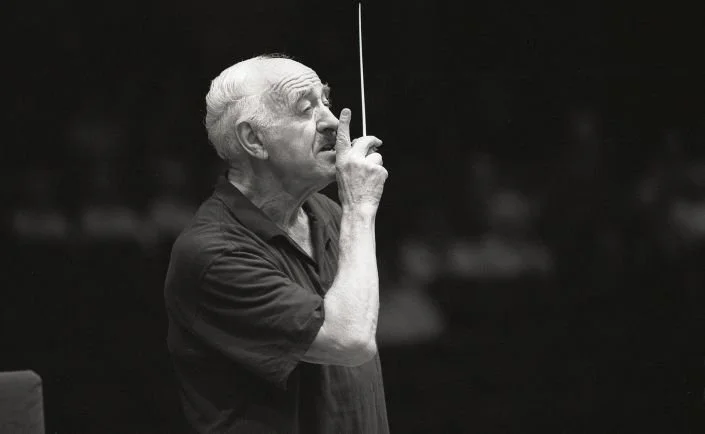
Rudolf Barshai in 1996 [Image:Wikimedia Commons/User:Derbrauni/Frank Höhler]

Last Saturday, my copy of Mieczysław Weinberg: Between East and West arrived and it has scarcely left my grasp since.

While on my second reading of the book, I took notice of a detail that escaped my previous reading of Tommy Persson’s essay, “Meeting and Promoting Weinberg”. Namely, that in 1990 he petitioned Rudolf Barshai to conduct some of Weinberg’s music in future Gothenburg Symphony concerts. The conductor never replied.

Considering that Barshai and Weinberg had been friends back in the Soviet Union, the conductor’s slight seems especially hurtful. Or had he forgotten his old friend after all?

A few weeks ago, I mentioned how Barshai in 1984 had declared his intention to introduce Canadian audiences to Weinberg’s music. (Which he was not able to do for reasons explained in that post.)

A month after that interview with the Canadian Press, an article by Ilya Gerol, a Russian émigré turned Canadian Kremlinologist, appeared in The Province that contained Barshai’s extensive reminiscences of Soviet life. According to the byline, the article was an excerpt from a forthcoming book. If it was ever published, I’ve not been able to find it. The most extensive recollection is devoted to a composer only referred to as “N”. Although it differs in a number of details, it’s unlikely that Barshai was referring to anyone else but Weinberg. (Perhaps he obscured certain things so as to stymie potential overseas informants.) The opera at the end of Barshai’s anecdote likely corresponds to Weinberg’s Pozdravlyayem!, which had been completed in 1975, two years before Barshai emigrated to Israel.

Below is the full text of this passage:

This story’s about a Soviet composer whose talent is second only to Shostakovich. We'll call him “N”, for reasons that will be clear as the story unfolds. He's still living in Moscow.

In 1952, Stalin had started a crackdown on the Jews in the Soviet Union.

Jewish doctors were accused of trying to poison the Soviet leadership. Jewish writers, musicians, and actors were said to be the agents of the CIA and world Zionism. Jews in general were said to be responsible for food shortages and everything else that was bad.

“N” was too occupied with his music to notice this. He had just completed his symphony and Shostakovich had told him that its first performance would be the musical event of the century.

Late one night in 1953, “N” was arrested by the KGB and locked up in the Lubyanka prison. All the interrogators wanted him to do was sign a confession that he was a liaison officer between the CIA, MOSSAD, and Zionists in Moscow. He did not sign, because he thought it was all a misunderstanding. He explained to his interrogators that he didn't know what the word Zionist meant. And the names CIA and MOSSAD he learned first from his interrogators.

After two weeks of sleepless nights and endless interrogation, he was put naked in a cell full of hungry rats. He was put in the cell at midnight. At six o'clock in the morning he signed the confession. For the next two months he signed confession after confession describing his participation in a plot to overthrow the Soviet government and to make the USSR a colony of the United States and Israel.

Then, suddenly, everything stopped. No more interrogations. No more visits to the prosecutor's office in the middle of the night. No more learning by heart the role he had to play at the show trial coming up soon.

When a new interrogator one day offered “N” a comfortable seat in his office, “N’s” terror was greater than ever. What else were they going to do with him? But the interrogator told “N” that all the charges against him were to be dropped and that he had to sign a document stating that all his confessions were null and void. Then he would be free to go, with the apologies of the KGB.

But “N” remembered the rats too well. “I was a liaison officer between the CIA, MOSSAD, and the Zionists”, he insisted. “I plotted to overthrow the government”.

This went on for days, until the interrogator asked “N’s” wife to help. She sent her husband a note with only two words on it: “Stalin died”.

Then he signed the paper repudiating his confessions, was freed and received the official apologies. His rights and privileges were restored. He was free to compose and his compositions could be performed in public.

But he was never the same man. He was too frightened to talk to even close friends, rarely allowed his work to be performed and categorically forbade performances outside the USSR.

“Don't tell me about audiences and fame”, he once told Barshai, “You say fame and I see rats. That’s the difference between you and me”.

Just before he left the USSR, Barshai went to see “N”, who showed him a new folk opera he had composed, based on Jewish themes. “It's a work of genius”, Barshai told “N”. “Give it to me and I will see that it is performed in the West and it will be your masterpiece. I will say that you didn't give it to me and that I smuggled it out”.

“I would rather burn it”, replied “N”. “Better that it dies with me”.

He went to the window and saw the militiamen guarding the area reserved for composers, actors, and writers. He was looking at the militiamen, but he saw rats.
Tags mieczysław weinberg, rudolf barshai, vancouver symphony, ilya gerol, tommy persson
Comment

Barshai on the Rocks

January 5, 2026 Néstor Castiglione

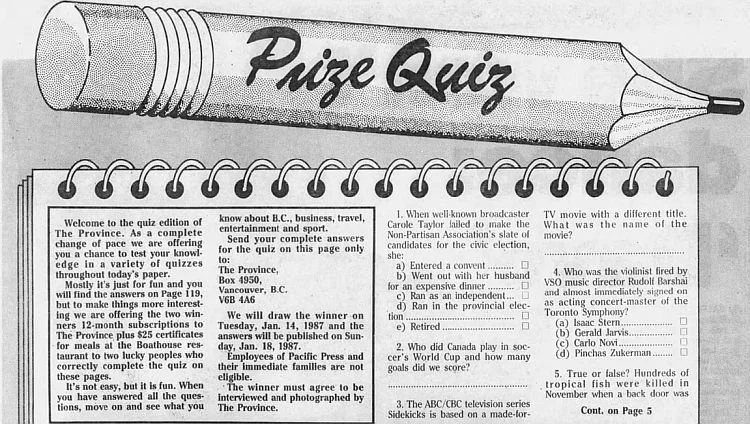
A contemporary newspaper quiz referencing the Vancouver Symphony/Barshai fracas

It wasn’t until sometime early last year that I learned a recording of Shostakovich’s First and Ninth symphonies played by the Vancouver Symphony Orchestra conducted by Rudolf Barshai existed. His cycle with the WDR Symphony Orchestra of Cologne is well known and remains competitive, even nearly 30 years since it was first issued. Perhaps because it has long been available at budget price (although it was recently reissued on SACD in Japan) and frequently packaged as part of various Shostakovich omnibuses aimed at entry level collectors, the stature of Barshai's cycle may have diminished somewhat. At least I haven't heard critics mention it as much as they did in the 2000s, when it was practically a default recommendation. Admittedly, with the fecundity of the Shostakovich discography this century, I've also contributed to this relative neglect, although in the last few years I've renewed my delight in Barshai’s Shostakovich. Aside from his WDR cycle, Barshai also made live recordings of Shostakovich’s Fourth, Fifth, and Seventh symphonies with German and Swiss orchestras that are worth hearing. (Not to mention his studio Eighth for EMI.)

This Canadian recording is no less rewarding. Barshai draws rich tone from the Vancouver strings, as well as spirited playing from the winds. Just listen to the trombonist in the first movement of the Ninth, whose constant interjections sound satisfyingly and appropriately “out of pocket”, to use the Gen-Z parlance. I’ve listened to this Ninth several times in the past month and, each time, it reinforces my opinion that it’s one of the best in the discography. Good recordings of this symphony aren’t hard to come by, but this Ninth in Vancouver is really special.

Barshai’s Vancouver Shostakovich First is quite good, too, although not on the same level. The first movement starts off well enough, with characterful winds, especially trumpet and clarinet, but the gait of the second theme drags a bit, and when the climaxes arrive later the mood never breaks free from a general stolidity at odds with the score’s mood. Youthful energy is also lacking in the scherzo, though the Vancouver Symphony played it with impressive clarity of articulation, and the piano climax here has a fearsomeness that is not too often heard. Where the performance really grabs one’s ears is in the “Lento”, which Barshai convincingly directs with an implacable gravitas suggestive of Tchaikovsky or Mahler. Young man’s music it is not, at least in this recording.

This CBC disc is so good overall that one would never guess that by the time it was made the Vancouver/Barshai relationship was not only already on the rocks, but on the verge of ending acrimoniously. 

It had begun auspiciously enough back in 1984, when Barshai was selected by the Vancouver Symphony to succeed Akiyama Kazuyoshi (another excellent conductor I’ll probably write about some day). Echoing a well known quote by Shostakovich, Barshai told the press that the Vancouver Symphony would play “everything from Bach to Offenbach and more, including 20th-century composers”. Among those composers he hoped to program were Alexander Lokshin and Mieczysław Weinberg — esoteric music for a mid-tier North American orchestra of the 1980s. “Are Vancouver audiences ready for such introductions?”, a writer for the Canadian Press wondered.

Apparently not, as it turned out, but that would be the least of Barshai’s problems.

Even before the upbeat was signaled on the first, hesitant notes of Mahler’s Ninth Symphony at Barshai's Vancouver debut as music director, troubles were mounting. The orchestra was operating with a deficit of over US$600,000 (approximately US$2 million in 2026); an auditor projected an additional six-figure loss for the 1985–1986 season. A dramatic decline for an orchestra that a decade before had boasted the largest subscription base of any North American orchestra. According to another audit from 1982, management was bloated far in excess of the orchestra’s needs. On top of that, it reported that they squandered funds on expenses and interest-free personal loans. The revelations provoked the musicians of the Vancouver Symphony to threaten a strike, their second in less than five years. Management responded by locking the musicians out. Calm was restored after Barshai offered to take a pay cut in order to aid the orchestra, which led to a compromise that allowed operations to continue. It was a gesture as noble as it was timely — and went unreciprocated by management.

Barshai outwardly continued to maintain his resolve to make the Vancouver Symphony a “world-class ensemble”, in spite of the challenges. He might have succeeded had he not committed a misstep of his own: firing the orchestra’s concertmaster and one of its horn players, both well liked by personnel. Whatever feelings of goodwill that existed were poisoned once and for all. The feuding between Barshai and the orchestra’s musicians soon made local, then national headlines, capped by the publication of an internal poll that was effectively a vote of no-confidence against Barshai.

Amidst this chaos, the number of subscribers to the Vancouver Symphony continued to plummet and its deficit widened to nearly US$2 million (approximately US$6 million in 2026). In 1988, when their CBC CD of Shostakovich symphonies was issued, matters reached a point of no return. After months of grumbling, the orchestra’s board voted to refuse Barshai an extension of his contract, with the majority largely blaming him for the orchestra’s budget shortfall, despite audits that stated otherwise.

Barshai had his supporters and they took to the press to rally for his cause. One of them was Dennis Culver, the orchestra board’s president. In an interview with the music critic of the Toronto Star, Culver disagreed with his view that Barshai “failed to exert a charismatic presence during his three years in [Vancouver]”. Whatever issues the conductor may have had, Culver said, were nothing but “a pimple on the face of the world”. Instead, he cited ongoing economic problems in British Columbia, aging subscribers, and the failure of the orchestra’s marketing team to cultivate new listeners.

While the ink of the interview was still wet, the Vancouver Symphony declared bankruptcy, laid off its employees, and canceled the remainder of its season. Barshai retracted his initial threats of litigation against the orchestra, saying later through his attorney that he didn't want to inflict any harm on the ailing institution.

A few months later, the Vancouver Symphony came back from insolvency and resumed its activities. Denny Boyd, a Vancouver Sun columnist and Barshai defender, offered blunt advice to the embattled conductor’s potential successors: “Only sons-of-bitches need apply.”

Tags rudolf barshai, dmitri shostakovich, vancouver symphony, canada, cbc
Comment