
Last Saturday, my copy of Mieczysław Weinberg: Between East and West arrived and it has scarcely left my grasp since.
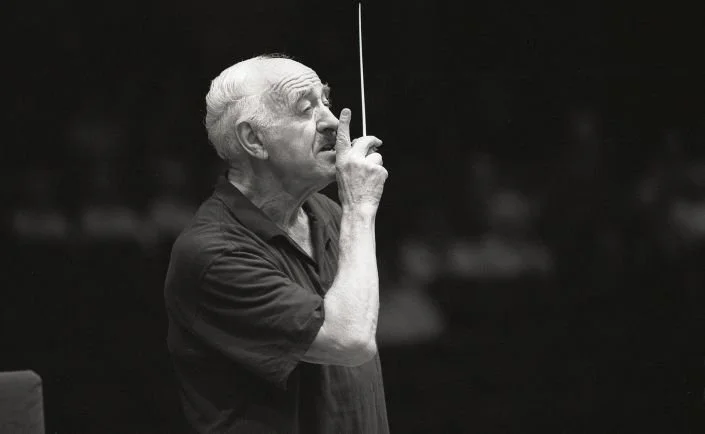
While on my second reading of the book, I took notice of a detail that escaped my previous reading of Tommy Persson’s essay, “Meeting and Promoting Weinberg”. Namely, that in 1990 he petitioned Rudolf Barshai to conduct some of Weinberg’s music in future Gothenburg Symphony concerts. The conductor never replied.
Considering that Barshai and Weinberg had been friends back in the Soviet Union, the conductor’s slight seems especially hurtful. Or had he forgotten his old friend after all?
A few weeks ago, I mentioned how Barshai in 1984 had declared his intention to introduce Canadian audiences to Weinberg’s music. (Which he was not able to do for reasons explained in that post.)
A month after that interview with the Canadian Press, an article by Ilya Gerol, a Russian émigré turned Canadian Kremlinologist, appeared in The Province that contained Barshai’s extensive reminiscences of Soviet life. According to the byline, the article was an excerpt from a forthcoming book. If it was ever published, I’ve not been able to find it. The most extensive recollection is devoted to a composer only referred to as “N”. Although it differs in a number of details, it’s unlikely that Barshai was referring to anyone else but Weinberg. (Perhaps he obscured certain things so as to stymie potential overseas informants.) The opera at the end of Barshai’s anecdote likely corresponds to Weinberg’s Pozdravlyayem!, which had been completed in 1975, two years before Barshai emigrated to Israel.
Below is the full text of this passage:
This story’s about a Soviet composer whose talent is second only to Shostakovich. We'll call him “N”, for reasons that will be clear as the story unfolds. He's still living in Moscow.
In 1952, Stalin had started a crackdown on the Jews in the Soviet Union.
Jewish doctors were accused of trying to poison the Soviet leadership. Jewish writers, musicians, and actors were said to be the agents of the CIA and world Zionism. Jews in general were said to be responsible for food shortages and everything else that was bad.
“N” was too occupied with his music to notice this. He had just completed his symphony and Shostakovich had told him that its first performance would be the musical event of the century.
Late one night in 1953, “N” was arrested by the KGB and locked up in the Lubyanka prison. All the interrogators wanted him to do was sign a confession that he was a liaison officer between the CIA, MOSSAD, and Zionists in Moscow. He did not sign, because he thought it was all a misunderstanding. He explained to his interrogators that he didn't know what the word Zionist meant. And the names CIA and MOSSAD he learned first from his interrogators.
After two weeks of sleepless nights and endless interrogation, he was put naked in a cell full of hungry rats. He was put in the cell at midnight. At six o'clock in the morning he signed the confession. For the next two months he signed confession after confession describing his participation in a plot to overthrow the Soviet government and to make the USSR a colony of the United States and Israel.
Then, suddenly, everything stopped. No more interrogations. No more visits to the prosecutor's office in the middle of the night. No more learning by heart the role he had to play at the show trial coming up soon.
When a new interrogator one day offered “N” a comfortable seat in his office, “N’s” terror was greater than ever. What else were they going to do with him? But the interrogator told “N” that all the charges against him were to be dropped and that he had to sign a document stating that all his confessions were null and void. Then he would be free to go, with the apologies of the KGB.
But “N” remembered the rats too well. “I was a liaison officer between the CIA, MOSSAD, and the Zionists”, he insisted. “I plotted to overthrow the government”.
This went on for days, until the interrogator asked “N’s” wife to help. She sent her husband a note with only two words on it: “Stalin died”.
Then he signed the paper repudiating his confessions, was freed and received the official apologies. His rights and privileges were restored. He was free to compose and his compositions could be performed in public.
But he was never the same man. He was too frightened to talk to even close friends, rarely allowed his work to be performed and categorically forbade performances outside the USSR.
“Don't tell me about audiences and fame”, he once told Barshai, “You say fame and I see rats. That’s the difference between you and me”.
Just before he left the USSR, Barshai went to see “N”, who showed him a new folk opera he had composed, based on Jewish themes. “It's a work of genius”, Barshai told “N”. “Give it to me and I will see that it is performed in the West and it will be your masterpiece. I will say that you didn't give it to me and that I smuggled it out”.
“I would rather burn it”, replied “N”. “Better that it dies with me”.
He went to the window and saw the militiamen guarding the area reserved for composers, actors, and writers. He was looking at the militiamen, but he saw rats.