Eric Salzman, in his otherwise excellent Twentieth Century Music: An Introduction, devoted barely two pages to Latin American composers. What little space he afforded them seemed mostly begrudging. When the author was not criticizing them for being inadequate or fully realized, he subtly chided them for being derivative. Although over half a century has passed since Salzman’s book, Latin American classical music still suffers from an image problem north of the Rio Grande and across the Atlantic. The achievements of its composers—and they are considerable in both quantity and quality—are usually sneered at or, at best, doted upon patronizingly for a brief, fashionable moment. That is if they are ever played at all.
Luis Humberto Salgado (1903 – 1977) was the dean of composers in Ecuador during the mid-20th century. Across his 75 years, Salgado composed a large body of work in diverse genres: chamber music, operas, ballets, concerti, piano works, vocal works, and the nine symphonies presented here for the first time on records on this 3-CD Brilliant Classics set. Despite never having personally traveled beyond the borders of his homeland, Salgado was a composer whose work was global in scope. As the Orquesta Sinfónica de Cuenca under Michael Meissner make emphatically clear on this release, Salgado’s work is a vital contribution to 20th century art.
Like Brahms and Vaughan Williams, Salgado was a late-bloomer as a symphonist. His First Symphony was not completed until his 46th year. He initially was an adherent of the "Streamline Moderne" style of post-neoclassical musical nationalism which was popularized in the New World by Copland during the 1930s – 1940s. His early symphonies are packed with native rhythmic motifs and recollections of folk music which are not only very attractive, but are also fused together into compelling musical statements. By the time of his middle symphonies, Salgado wanders off into more interesting, gnarlier paths. In these works he reminds me a little of Vagn Holmboe, Irving Fine, or Roger Sessions, but make no mistake—Salgado is very much his own man.
Part of what has inhibited the composer’s international recognition, Meissner writes in his excellent liner notes, is that none of Salgado’s sizable compositional output totaling over 200 works have ever been commercially recorded until now. Aggravating this dilemma is the apparent inattentiveness with which the composer’s manuscripts have been preserved. Sometimes a movement is missing, other times a particular work or movement exists only in a sketch score. Occasionally there are scores which are lost altogether.
Salgado’s Symphony No. 1, nicknamed the “Andean,” is one such example: Its finale is extant only in a revised and simplified version which was recycled for a much later unnumbered Symphony of Vernacular Rhythms (not included in this set). For all that, it is a stirring and colorful work. As the nickname suggests, motifs and dances from regional indigenous folk music are threaded with their urban counterparts, along with snatches of twelve-tone rows which forecast similar methods Shostakovich employed in his late works. The result is earthy and sophisticated; colorful, vibrant, but never stooping to picture postcard musical nationalism. As Salgado himself remarked: “Obviously, it would be foolish to assume that simply orchestrating elements of folk music in the order expressed would be sufficient to obtain a symphony. The result of such would not even be a suite, but just a mere collection of vernacular airs.”
The Symphony No. 2 represents a considerable leap in Salgado’s prowess with symphonic form. Dubbed the “Sintética” for its synthesizing of the traditional four-part symphonic form into a single, concise, and unbroken movement, it is a tighter and somewhat more austere work than its predecessor. Its chiseled Beethovenian cast is punctuated by a pair of solo cadenzas, first for solo violin, then later for celesta, before concluding with a stylized alza, Ecuador’s national folk dance.
Somewhat of a curveball is his Symphony No. 3, which he dubbed “A-D-H-G-E: sobre una tema pentafónica en estilo Rococó” (A-D-B-G-E: On a Pentatonic Theme in Rococo Style). The four-movement work is Salgado’s whimsical spoof on the Classical style, although its good-natured cheer is closer to Prokofiev’s “Classical Symphony” by way of Raymond Scott’s “In an Eighteenth Century Drawing Room” than the acidulous irony of Stravinskian neoclassicism. Salgado uses the colors of his orchestra with child-like glee, tossing in harpsichord and harp against each other for good measure. Remarkably, this charming and original work was not premiered until 2017, over 60 years after it was composed.
Nationalism returns to the forefront in his aptly nicknamed “Ecuadorian” Symphony No. 4. Initially it seems as if the relative terseness of the “Sintética” has given way to a generosity of instrumental color and texture which are closer to his “Andean.” These quickly subside, however. There are throughout telling moments of relatively spare orchestration in two voices. Rumblings of cellos and basses set starkly against plaintive woodwind lines; later violins twitching haunting ostinati, which draws the response of bare flute and celesta chords, before suddenly returning to the earthiness of the movement’s opening. There is nothing here like the tub-thumping confidence which one typically associates with “nationalist” music.
No less paradoxical is the Symphony No. 5, starting with its nickname. In its ambiguity of mood, sparseness of texture, and its mobile tonal gravity, it is hardly the reactionary score that the name “Neoromantic” would betoken. “[The symphony is a] cold shower for those who expected a Romantic gesture in the old sentimentalist style,” Meissner astutely observes. If not “sentimentalist,” the symphony is certainly highly expressive, although Salgado here rigorously fuses feeling into architectural logic. Its Sibelian economy of gesture represents another significant development, although how it was originally intended to sound like will probably never be known: The orchestral score has since been lost. Meissner has instead orchestrated the composer’s reduction of the symphony for piano two-hands. Very skillfully, it needs to be added, as one would be hard pressed to guess that the instrumental colors had been devised by anybody else but the composer himself, so idiomatic do they sound.
Austere unto bleak is the Symphony No. 6 scored for strings and timpani. It opens with a foreboding hymn-like theme, which is followed by a dry, neatly-cut theme; part Classical, part folkloric which is soon lost in a thicket of string polyphony before being reprised. One senses that the play here is darkened by the composer’s own sense of mortality. Or perhaps not. There is something ultimately tight-lipped, outwardly impassive about Salgado’s music which defies the easy stereotype of Latin Americans as an emotionally exuberant and ostentatious people.
Salgado’s Symphony No. 7 from 1970 (dedicated to the bicentennial of Beethoven’s birth) takes the atmosphere of its predecessor and pushes it to nearly saturnine extremes which would not be out of place in Pettersson. The residue of Ecuadorian folklore remains, but these elements are seamlessly blended into the musical material, never calling attention to themselves for their own sake. Salgado abstracts them, employing them as simply another sound element which has no especial value in and of itself.
One wonders what Salgado’s peers and listeners must have thought when they first heard his Symphony No. 8. Composed to mark the sesquicentennial of the Battle of Pichincha, the event which secured Ecuador’s independence from Spain, there is little in the symphony which is immediately “celebratory.” Instead there is throughout a sense of anxiety and restlessness, further underlined by Salgado’s free use of dissonance which verges on atonality. Only in the march-like finale does he allow the music to brighten up, but even then there is an inescapable sense of irony which darkens the proceedings; its closing stretto recalling Hanns Eisler at his most caustic.
Salgado’s compact, single-movement Symphony No. 9 “Sintética 2” is his last. A masterly work wherein the composer permits himself a slight grimace, it synthesizes much of the elements of his late style into a statement of compelling power. Like many of Salgado’s works, it was not premiered until well after his death.
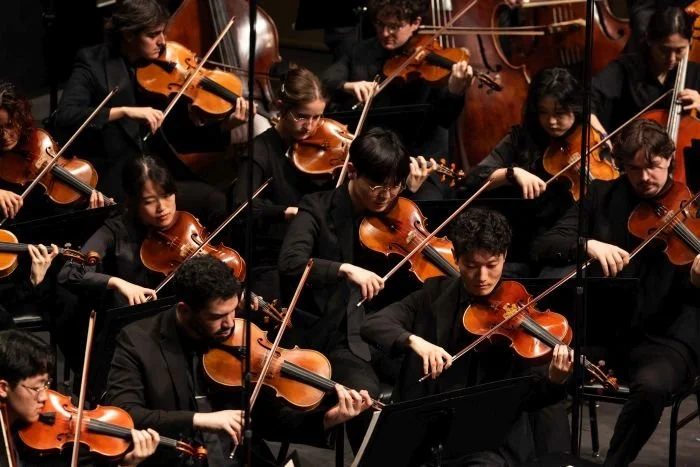
The playing by the Orquesta Sinfónica de Cuenca is alight with passion and profound commitment to the cause of evangelizing this inexcusably neglected composer, but one must admit their limitations. There are moments of wayward intonation and less than perfect ensemble which may unsettle listeners accustomed to the illusion of perfection which recordings so often conjure. Brilliant’s close-up miking and resultant powder dry acoustics only further magnifies these flaws. There are also Meissner’s occasional “retouchen” of Salgado’s scores to grapple with. In his notes for the Symphony No. 3, for example, the conductor states that certain string passages had to be rescored as the composer’s demands “exceed what is technically possible or reasonable [emphasis mine].” Whether this is true or not is impossible to say as there are no published scores of Salgado’s symphonies (at least to my knowledge) readily available to consult. But it is hard to believe that the skillful orchestrator heard in these works could have been so clumsy as to make unrealistic demands of his performers. All these notwithstanding, the enthusiasm of the Cuenca players is so great, the repertoire so rare as to make these drawbacks insignificant.
There is no good reason that these works should not be part of the international orchestral repertoire. That they are presently excluded is no fault of the music; only the lack of curiosity of performers is to blame, not to mention a classical industry bent on milking the hits. Salgado’s symphonies arrive at a timely moment too. Classical music bashing has become all too trendy the past year. (Cynically, it needs to be said. I doubt that very many of these academics, musicians, and other talking heads would ever be committed to doing anything meaningful to change a genre which also happens to provide them a healthy source of income and prestige.) The problem—at least one of them—is the fact that white and non-white "folx" alike think classical music is all "dead white males" because that is all they ever bother to know. In fact, especially from the 20th century on, classical music is far more ethnically and racially diverse than its detractors are willing to give it credit for. Salgado for his part needed no infantilizing. He unapologetically idolized Beethoven, modeled his music upon his example, and sought to continue his ideals in a language for his own time. Can we expect any of the big American or European orchestras to take up Salgado’s symphonies for the sake of inclusion and shattering "white supremacy" in classical music? I wish they would, but I am not holding my breath. That is not where the money is, after all.
In the meantime, we have this treasurable release. The Orquesta Sinfónica de Cuenca, Micheal Meissner, and Brilliant Classics have here delivered what is one of the most memorable and important classical releases of 2021. Let us hope that more Salgado is coming our way, sooner rather than later.



![Cedric Berry performing George N. Gianopoulos’ “Polarity.” [Santa Barbara Symphony]](https://images.squarespace-cdn.com/content/v1/5c51fcd9ee17597b31cebc1f/1618880367223-RI7FMYRTSBRBB2WIUPAJ/berry_gianopoulos.jpg)