
Thirty years ago there was a lot of optimism about Silvestre Revueltas, who had only recently come to wider attention thanks to a BMG/Catalyst compilation covered in the sort of visual markers of exotic otherness that the composer himself commented upon ironically and criticized. In 1999, while still in high school, I took the day-long Greyhound trip up to Santa Barbara, where Gisèle Ben-Dor, another musical figure seemingly on the verge of a breakthrough, conducted a festival of the composer’s music. But, to borrow Mahler’s famous phrase, Revueltas’ time never came: his music was too weird, too dissonant, too disruptive, and — let’s be honest — too Mexican, especially for a reactionary musical establishment.
Classical music reception in the neoliberal age has become like Food Network’s Chopped, I thought to myself while on a trip a couple of years ago. In case you’re unfamiliar with the program (you’re not missing anything), it’s a game show, wherein chefs compete through three rounds to win a cash prize. You’d think that the eventual victory would go to the best chef, except that there’s a catch: each contestant must also briefly expiate to the judges their origin story, which is invariably tragic and checks off tropes that intersect tear-inducingly with contemporary concerns (e.g. broken family, drug use, homelessness, etc.), the sorrier, the better. So it’s ultimately the biggest loser, not necessarily the best cook, who is deemed the eventual “winner”.
If Revueltas had to sing for his supper to a jury headed by Amanda Freitag, he wouldn’t even make it past the first round. Yes, the composer died young; sure, he was also an alcoholic; definitely he wasted his time pursuing fatuous political causes. Yet none of these misfortunes catch fire with modern-day conceits. Revueltas was just a composer of some of the most distinctive music of the 20th century — and that doesn’t get you an oversize check from Ted Allen.
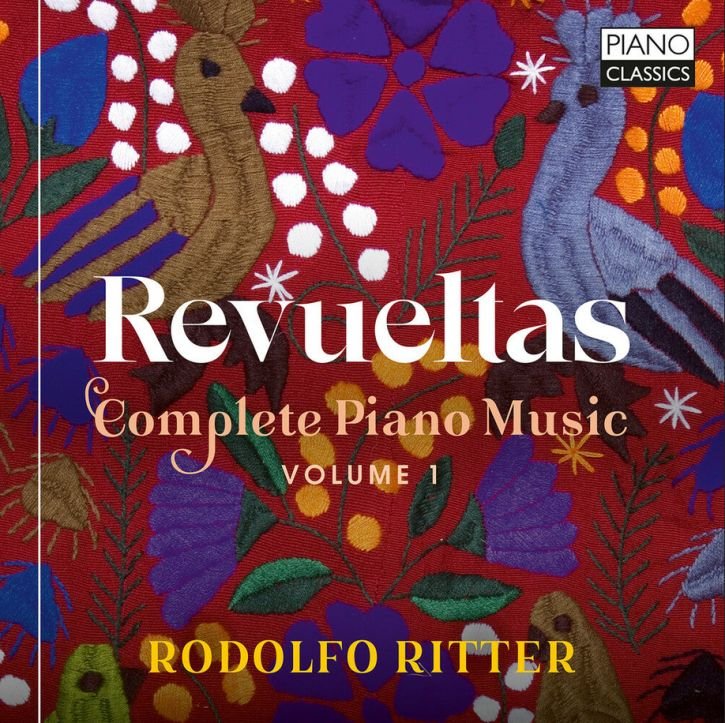
After some international attention at the turn of the century, advocacy of Revueltas has reverted to Latin American musicians. Recordings of his music continue, but these can sometimes be difficult to acquire north of the border. Which brings me to this present release, played by Rodolfo Ritter. This recital of the piano music, the first volume in an integral series, appears to be different from another similar, slightly earlier set in which Ritter is one of at least three participants. Like that shadowy release, this one is also produced under the auspices of Mexico’s Secretariat of Culture and INBAL.
Until relatively recently, as the fine liner notes by Luis Jaime Cortez explain, scholars had believed that Revueltas’ career as a composer had begun as a spontaneous reaction to meeting Carlos Chávez. These works, instead, evince that Revueltas had already been hammering away at his art for more than a decade prior to that encounter.
The Capricho húngaro, a daffy send-up of gypsy music jabbed by discordant non-sequiters, and the two-movement Sonatine, a harmonically fidgety thing perhaps influenced by Satie’s Sonatine bureaucratique, are early essays in the musical humor that Revueltas would later become a master equal to Mozart and Shostakovich. More surprising and uncharacteristic are little chips like the Invernal, Mattinata, Danza de salón, and Valsette, all of them heavy with the languorous atmosphere of Mexican high society of the late Porfiriato. (Not inappropriately, Valsette riffs on harmonic modulations from Ponce’s 1912 hit, “Estrellita”.)
Ritter would’ve done enough by simply recording these pieces, but he does his listeners — and Revueltas — one better. He plays these jottings by a young artist, who was still trying to know himself, with affection and understanding. A potentially dry recital of purely documentary value is transformed by his fingers into an enjoyable, if not necessarily transformative listen.
Most of these piano works originate from Revueltas’ adolescence; all of them date from before his maturity. Debussy once said of Stravinsky’s The Firebird, “One has to start somewhere”. None of the works on this disc are masterpieces, but this is where Revueltas started.