
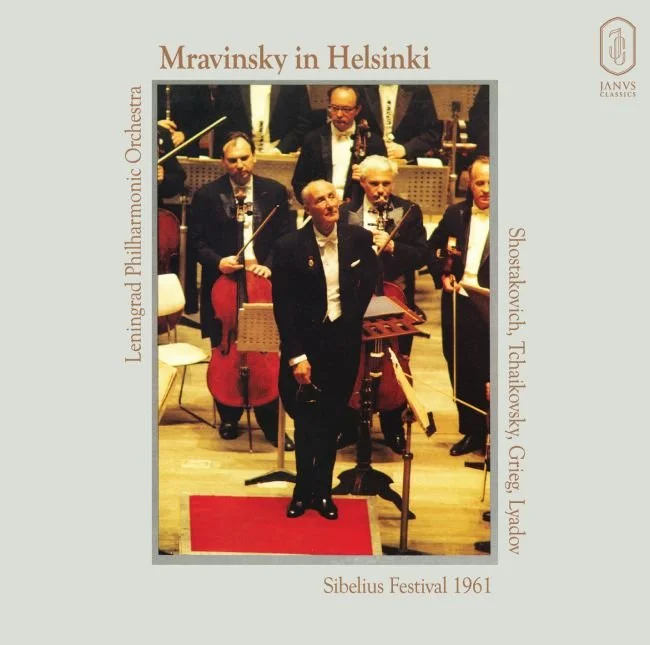
Among the unintended beneficiaries of the end of the First Cold War was the Russian conductor Yevgeny Mravinsky, who had been dead for a few years by the time the Soviet Union collapsed in 1991. His recordings enjoyed a surge of interest from collectors outside the former Eastern Bloc who were eager to explore what had been hidden behind the Iron Curtain. A slew of Mravinsky recordings, some previously unknown in the West, poured forth over the next decade, which culminated in BMG/Melodiya’s two big Mravinsky Edition boxes. After the turn of the century, though, Western interest in Mravinsky rapidly cooled.
It is a different story in East Asia, where Mravinsky’s reputation continues to run high. Japan continues to produce a steady stream of reissues of the conductor’s various recordings, most recently a series of fresh SACD transfers of some material previously reissued by Victor Japan over thirty years ago. Now there is this release from a little further east across the Tsushima Strait.
I had never heard of Janus Classics, a label based in China, until a few months ago when their discography came up during my daily browse through the Tower Records Japan website. Their discography is still small, but if this Mravinsky in Helsinki set is any indication, the Janus team has high ambitions.
Their choice of label name is likely not unintentional — it stirs up associations with Janus Films and its Criterion Collection, renowned by cinéastes for the care devoted to each home video release. Similarly, this Mravinsky in Helsinki release comes with a booklet that contains four informative essays by Nan Li, Qiao Huang, Brian Wang, and Jiewei Xiong, each covering various aspects of the concert and repertoire preserved on these two discs. The paper these essays are printed on, the elegant cover design, trimmed along the spine with the opening bars of the “Largo” from Shostakovich’s Fifth Symphony, even the quality of the jewel case this set is housed in all bespeaks of an attentiveness to detail that is now exceptionally rare in classical CD releases, even of specialist material. A loveless content dump this set is not. Just holding this release in one’s hands is a pleasure.
All this would be insignificant if the performances themselves were not worth hearing. As noted in Li’s essay, this live recording from June 12, 1961, made at that year’s Sibelius Festival in Helsinki, was only recently discovered; it is the most important addition to Mravinsky’s discography in many years. That on its own would be sufficient reason to purchase this set. More than being a notable exhumation from the archives, Mravinsky’s performances of Shostakovich and Tchaikovsky on these discs are among his finest.
First the bad news: These recordings, originally made by Yle, Finland’s national broadcasting company, have survived only piecemeal. A few measures from the opening of Tchaikovsky’s Fifth Symphony are missing, but have been spliced with another Mravinsky performance from 1955. Regrettable, but it could have been worse. The 1961 performance of Shostakovich’s Fifth Symphony, sadly, was not so lucky — the entire first movement no longer exists. These major caveats notwithstanding, these performances demand one’s attention.
The remaining torso of this Shostakovich Fifth is superb. Had it survived whole it would likely rank as one of the best in the symphony’s discography.
Mravinsky collectors know well that the conductor’s performances of a work tend to share recognizable features, despite their disparate recording dates. Their superficial similarities obscure various internal details that were constantly in flux. Mravinsky, one feels, was eternally striving to physically realize an elusive perfect realization of a given work that remained locked within the notes. As his widow related to the DSCH Journal in 2002, “each time Mravinsky returned to the Fifth he introduced something new that he had been able to draw from the depths of the piece: a nuance or an idea”.
Soviet orchestral playing has accrued an unfair reputation among some collectors as being sloppy and overbearing. Mravinsky’s Leningraders are nothing of the sort. Their playing, while forceful, displays a wide range of color and nuance here.
Cellos and basses move along smartly in the opening bars of the Fifth’s scherzo, followed by the crisp tootling of winds that lead to their off-kilter waltz, supported by the strings. Brass interject firmly, but not overpoweringly. They give way to a rendition of the trio that sounds refreshingly forthright here; solo violin and flute are refined without lapsing into sounding twee.
Admittedly, Mravinsky’s performances of the “Largo” have often sounded dry to me. Not this Helsinki performance. An impressive array of dynamic shadings between p and ppp are conveyed in the movement’s opening by the Leningraders, setting the ground for the first climax, which the first violins’ lean into with a well-timed portamento, giving the moment a unique poignancy. When Mravinsky leads the orchestra into the movement’s central climax, he achieves here the dignified sorrow, the sense of tearless grief that evaded him in other performances.
The finale starts off a true “Allegro non troppo”: moderately fast, but unhurried, thereby permitting Mravinksky’s Leningraders to articulate each note cleanly. The conductor tightens the tempo almost imperceptibly, building great tension into the development section without losing control of the music, eventually cresting into a broadly played coda that effectively resolves the anxieties that had preceded it.
Modern-day conductors fond of interpretive contrivances in Shostakovich ought to take note of this performance. Mravinsky is unconcerned with exploiting the music to make extramusical points. Instead, he places his entire trust in the score’s ability to get its message across, not to mention the listener’s intelligence to arrive at their own conclusions about the music’s significance.
On a similar level of excellence is the performance of Tchaikovsky’s Fifth Symphony on this set’s second disc. There is a touch more momentum here than in Mravinsky’s studio recordings; the second movement flows compellingly to an impassioned climax, while the finale’s coda resounds with implacable power, crowned by marvellous brass playing.
Of especial interest is one of the encores, “Solveig’s Song” from Grieg’s Peer Gynt — a first in the Mravinsky discography. It is lovingly realized here, with surprisingly affectionate phrasing from the strings. Impeccably played is the second encore, Lyadov’s Baba Yaga, one of Mravinsky’s “lollipops”.
Yle’s original mono tapes have little of the grit listeners often contend with in archival recordings. Space across the orchestra and between instruments is realistic, deep. Janus’ transfers sound gratefully hands-off. If they used any de-noising, it must have been applied very discreetly.
For admirers of Shostakovich, Tchaikovsky, and Mravinsky, this recording is essential. Archival recordings, like anything else, can be variable. What Janus unearthed here is a treasure, made all the more precious by their exemplary presentation. Get this set.