• Featured Articles
  • Blog
  • Essays/Reviews
  • Interviews
  • Reseñas y artículos selectos en castellano
  • Other Things
  • Contact
Menu

echorrhea

Street Address
los angeles
Phone Number

Your Custom Text Here

echorrhea

  • Featured Articles
  • Blog
  • Essays/Reviews
  • Interviews
  • Reseñas y artículos selectos en castellano
  • Other Things
  • Contact

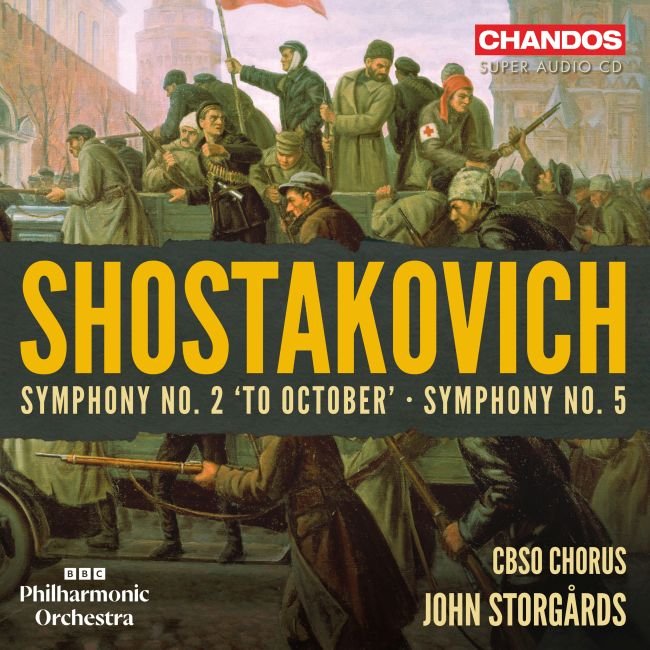
CD Review: Storgårds, BBC in Shostakovich 2 and 5

January 31, 2026 Néstor Castiglione

Modern-day performers of Shostakovich’s music often seem to believe that the composer’s restrained score markings were a hedge against snooping authorities. Now that the composer and the Soviet Union are safely dead, these musical sleuths think, his instructions can be exaggerated in order to contrive an approximation of the bathetic figure in Volkov’s Testimony.

John Storgårds, in his ongoing Shostakovich cycle for Chandos, has gratefully taken the opposite approach: just play the notes and let the listener make up their own mind. This most recent volume includes a recording of the Fifth Symphony, perhaps the most mythologized symphony of the 20th century.

Its introduction is starkly played, with especially detached staccato for the opening motif’s ascending figure. Storgårds prevails upon the BBC Philharmonic to make spare use of vibrato in the second subject, thereby clarifying the inner voices and lending a not unwelcome Hindemithian quality.

Where Storgårds stumbles is in his realization of the movement’s development. Things begin promisingly with beautifully delineated piano and pizzicato basses, sounding here like distinct components within a single musical unit, instead of a soggy mess. As more and more instruments pile on, however, Storgårds fails to heed the score and take the initiative. Instead, he maintains a sluggish tempo, then pulls back further when the march bursts through, frustrating the music’s momentum. The central climax, splendidly played though it is by the BBC Philharmonic, sounds almost inconsequential as a result.

Not everything is bad, though: the coda is gorgeously balanced, with haunting violin portamenti.

Fortunately, the rest of Storgårds’ performance is an improvement. His interpretation of the scherzo is spiky, almost Stravinskyan; an approach well suited to this music’s irony. The “Largo” eschews Mahlerian anguish in favor of controlled string vibrato, carefully terraced dynamics, and clean textures.

Timpani and crisp brass erupt impactfully at the start of the moderately paced finale. Storgårds cranks up the speed only very slightly in the rush towards the movement’s development. That interpretive level-headedness has benefits and drawbacks. When the solo trumpet’s faux premature entrance arrives, it conveys little surprise or urgency. On the other hand, the famous coda proceeds at a natural pace that sounds grand, relentless, and altogether inscrutable.

Shostakovich’s Second Symphony, often a neglected step-child, resounds decisively in this BBC Philharmonic recording. The ascending canonic lines that twist and converge into each other in the instruction sound uncommonly transparent. Very fine, too, is the solo trumpet, soaring above with soundly judged vibrato. The BBC’s crisp phrasing and biting attacks enliven the scherzo-like section that ensues. Linear clarity is maintained even through the ensuing wild contrapuntal episode that this Chandos series’ annotator, David Fanning, rightly describes as an “anti-fugue”. Arguably the finest part of this recording is the choral coda — an utterly convincing musical statement here, in no small part thanks to the excellent City of Birmingham Symphony Chorus.

Sonics on this disc, as ever from Chandos, are astonishing in their breadth of color and space. Solo and ensemble playing are both rendered true and bigger than life. Fanning’s accompanying liner notes are informative for both novice and seasoned Shostakovichian, but his essay on the Fifth Symphony traipses closer to Testimony and The New Shostakovich than one would expect in 2026.

Tags dmitri shostakovich, john storgårds, bbc philharmonic, cbso chorus, chandos records, david fanning
Comment

CD Review: Mravinsky in Helsinki

January 31, 2026 Néstor Castiglione

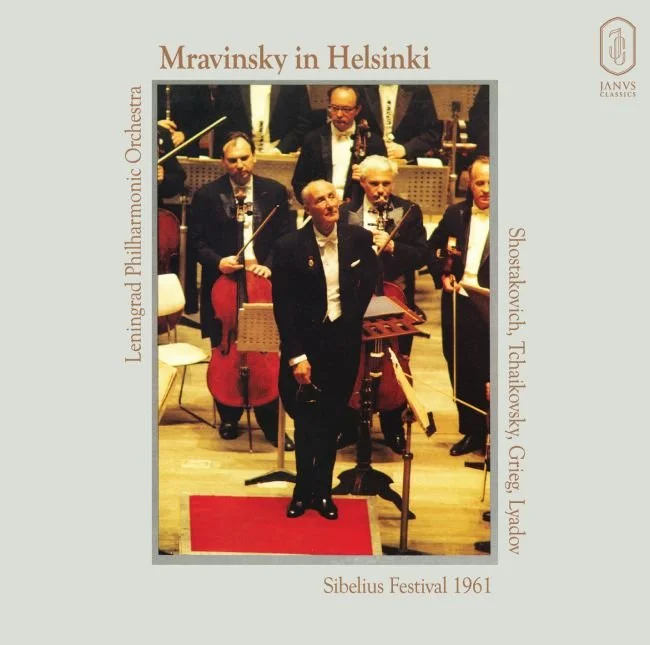
Among the unintended beneficiaries of the end of the First Cold War was the Russian conductor Yevgeny Mravinsky, who had been dead for a few years by the time the Soviet Union collapsed in 1991. His recordings enjoyed a surge of interest from collectors outside the former Eastern Bloc who were eager to explore what had been hidden behind the Iron Curtain. A slew of Mravinsky recordings, some previously unknown in the West, poured forth over the next decade, which culminated in BMG/Melodiya’s two big Mravinsky Edition boxes. After the turn of the century, though, Western interest in Mravinsky rapidly cooled.

It is a different story in East Asia, where Mravinsky’s reputation continues to run high. Japan continues to produce a steady stream of reissues of the conductor’s various recordings, most recently a series of fresh SACD transfers of some material previously reissued by Victor Japan over thirty years ago. Now there is this release from a little further east across the Tsushima Strait.

I had never heard of Janus Classics, a label based in China, until a few months ago when their discography came up during my daily browse through the Tower Records Japan website. Their discography is still small, but if this Mravinsky in Helsinki set is any indication, the Janus team has high ambitions.

Their choice of label name is likely not unintentional — it stirs up associations with Janus Films and its Criterion Collection, renowned by cinéastes for the care devoted to each home video release. Similarly, this Mravinsky in Helsinki release comes with a booklet that contains four informative essays by Nan Li, Qiao Huang, Brian Wang, and Jiewei Xiong, each covering various aspects of the concert and repertoire preserved on these two discs. The paper these essays are printed on, the elegant cover design, trimmed along the spine with the opening bars of the “Largo” from Shostakovich’s Fifth Symphony, even the quality of the jewel case this set is housed in all bespeaks of an attentiveness to detail that is now exceptionally rare in classical CD releases, even of specialist material. A loveless content dump this set is not. Just holding this release in one’s hands is a pleasure.

All this would be insignificant if the performances themselves were not worth hearing. As noted in Li’s essay, this live recording from June 12, 1961, made at that year’s Sibelius Festival in Helsinki, was only recently discovered; it is the most important addition to Mravinsky’s discography in many years. That on its own would be sufficient reason to purchase this set. More than being a notable exhumation from the archives, Mravinsky’s performances of Shostakovich and Tchaikovsky on these discs are among his finest.

First the bad news: These recordings, originally made by Yle, Finland’s national broadcasting company, have survived only piecemeal. A few measures from the opening of Tchaikovsky’s Fifth Symphony are missing, but have been spliced with another Mravinsky performance from 1955. Regrettable, but it could have been worse. The 1961 performance of Shostakovich’s Fifth Symphony, sadly, was not so lucky — the entire first movement no longer exists. These major caveats notwithstanding, these performances demand one’s attention.

The remaining torso of this Shostakovich Fifth is superb. Had it survived whole it would likely rank as one of the best in the symphony’s discography.

Mravinsky collectors know well that the conductor’s performances of a work tend to share recognizable features, despite their disparate recording dates. Their superficial similarities obscure various internal details that were constantly in flux. Mravinsky, one feels, was eternally striving to physically realize an elusive perfect realization of a given work that remained locked within the notes. As his widow related to the DSCH Journal in 2002, “each time Mravinsky returned to the Fifth he introduced something new that he had been able to draw from the depths of the  piece: a nuance or an idea”.

Soviet orchestral playing has accrued an unfair reputation among some collectors as being sloppy and overbearing. Mravinsky’s Leningraders are nothing of the sort. Their playing, while forceful, displays a wide range of color and nuance here.

Cellos and basses move along smartly in the opening bars of the Fifth’s scherzo, followed by the crisp tootling of winds that lead to their off-kilter waltz, supported by the strings. Brass interject firmly, but not overpoweringly. They give way to a rendition of the trio that sounds refreshingly forthright here; solo violin and flute are refined without lapsing into sounding twee. 

Admittedly, Mravinsky’s performances of the “Largo” have often sounded dry to me. Not this Helsinki performance. An impressive array of dynamic shadings between p and ppp are conveyed in the movement’s opening by the Leningraders, setting the ground for the first climax, which the first violins’ lean into with a well-timed portamento, giving the moment a unique poignancy. When Mravinsky leads the orchestra into the movement’s central climax, he achieves here the dignified sorrow, the sense of tearless grief that evaded him in other performances.

The finale starts off a true “Allegro non troppo”: moderately fast, but unhurried, thereby permitting Mravinksky’s Leningraders to articulate each note cleanly. The conductor tightens the tempo almost imperceptibly, building great tension into the development section without losing control of the music, eventually cresting into a broadly played coda that effectively resolves the anxieties that had preceded it.

Modern-day conductors fond of interpretive contrivances in Shostakovich ought to take note of this performance. Mravinsky is unconcerned with exploiting the music to make extramusical points. Instead, he places his entire trust in the score’s ability to get its message across, not to mention the listener’s intelligence to arrive at their own conclusions about the music’s significance.

On a similar level of excellence is the performance of Tchaikovsky’s Fifth Symphony on this set’s second disc. There is a touch more momentum here than in Mravinsky’s studio recordings; the second movement flows compellingly to an impassioned climax, while the finale’s coda resounds with implacable power, crowned by marvellous brass playing.

Of especial interest is one of the encores, “Solveig’s Song” from Grieg’s Peer Gynt — a first in the Mravinsky discography. It is lovingly realized here, with surprisingly affectionate phrasing from the strings. Impeccably played is the second encore, Lyadov’s Baba Yaga, one of Mravinsky’s “lollipops”.

Yle’s original mono tapes have little of the grit listeners often contend with in archival recordings. Space across the orchestra and between instruments is realistic, deep. Janus’ transfers sound gratefully hands-off. If they used any de-noising, it must have been applied very discreetly.

For admirers of Shostakovich, Tchaikovsky, and Mravinsky, this recording is essential. Archival recordings, like anything else, can be variable. What Janus unearthed here is a treasure, made all the more precious by their exemplary presentation. Get this set.

Tags yevgeny mravinsky, leningrad philharmonic, dmitri shostakovich, pyotr ilyich tchaikovsky, edvard grieg, anatol lyadov, helsinki, finland, janus classics, china, sibelius festival, yle
Comment

Shostakovich—Coming to a Theatre Near You!

February 20, 2024 Néstor Castiglione

Me and the boys showing up to local screenings of DD/Shostakovich

Speaking of music biopics, shooting for the forthcoming Russian film DD/Shostakovich was postponed until late March or early April. According to the director, Alexei Uchitel:

The challenge is the fact that the actor has to play Dmitri Shostakovich at 25, 35, and 65. I want him to be played by a single actor. We have tried prosthetic makeup and other things, but then other problems come up: yes, we have a face, but we still need a body. Thus, my partners in this movie and I are in a bit of a turmoil as to who to cast.[1]

Any fellow #GentleShostys ready to show up at the screenings in cowlicks and bubble glasses with me?[2]

Notes

[1]: Makarov, Andrei (February 17, 2024). “Алексей Учитель рассказал о сложностях подготовки к съёмкам «Шостаковича»” [Alexei Uchitel talks about the problems of preparations for the filming of “Shostakovich”] (in Russian). Известия.78 [News.78]. Национальная Медиа Группа [National Media Group]. URL: https://78.ru/news/2024-02-17/aleksei-uchitel-rasskazal-o-slozhnostyah-podgotovki-k-semkam-shostakovicha. Retrieved February 20, 2024.

[2]: Fahy, Claire; Oxenden, McKenna (July 8, 2022). “‘Why Is Everyone Wearing Suits?’: #GentleMinions Has Moviegoers Dressing Up”. New York Times. URL: https://www.nytimes.com/2022/07/08/style/minions-gentleminions-tik-tok-trend.html. Retrieved February 20, 2024.

Tags dmitri shostakovich, film, alexei uchitel
Comment

Bang! Zip! Pow!: Shostakovich in comic book land

January 26, 2024 Néstor Castiglione

Shostakovich submitting a secret ballot during a voting session in 1974 for the RSFSR Union of Composers [Wikimedia Commons/Yuri Shcherbinin]

Solomon Volkov’s Testimony may have faded from immediate relevance in the present state of Shostakovich reception, but the legacy of its one-dimensional portrayal of the composer whose “memoirs” it purports to be lives on. I was reminded of this earlier this month when I received my copy of the new monograph on Shostakovich’s Fifth Symphony by Marina Frolova-Walker and Jonathan Walker. Its cover is illustrated with one of the “Shostakovich Kills Stalin” images created by Andrew Crust; part of a series which first came to my attention a couple of years ago in an issue of the DSCH Journal. Fittingly, for a time and place where cultural discourse and reception has become largely infantilized, Crust reimagines Shostakovich and Stalin as comic book antipodes, superhero and supervillain; with the former on the verge of vanquishing the latter in feats of elaborately maleficent and vindictive violence worthy of Wile E. Coyote.

The belief that Shostakovich and Stalin were embraced in uneasy tidal lock as yurodivy and tsar—the composer playing the part of holy fool occasionally permitted to speak dangerously unflattering truths to the tsar, whose very omnipotence inexplicably leaves him in the thrall of his nominal inferior—has become so deeply ingrained as to be widely accepted as fact. Andris Nelsons’ remarks to the Boston Herald, in an interview about the final volume in his disappointingly limp Shostakovich symphony cycle, is a typical example of this paradigm:

“I remember reading Russian books that said, ‘Fifth Symphony of Shostakovich is a milestone, a wonderful work where the confused artist has lost his orientation and then he finds through the suffering and darkness the light of communistic ideas,” Nelsons told the Herald. Only that’s not what Shostakovich was writing about. Later Nelsons came to understand that this titan of Soviet art did his best to undermine the glory of the regime in his symphonies. “Thanks to the genius of Shostakovich, he managed to fool the authorities,” Nelsons said. “From the Fourth Symphony on, there are these qualities, the grotesque, sarcasm, irony, black humor… He understood that there was only one way, he had to keep writing and fool them.”[1]

A state which possessed the most sophisticated mass surveillance apparatus of its time, and whose bureaucracy contained not a few highly refined and musically perceptive individuals, somehow not only got “fooled” again and again, but also elevated a manifestly ideologically unreliable composer to a status that no other composer in his—or possibly any—country ever before or again experienced. It seems implausible, not to mention narrow. What if both composer and dictator were playing each other? Whatever potential benefits the latter reaped from this relationship have long been discussed, but that gained by the former tends to provoke either awkward justifications or silence. Not unexpectedly, Shostakovich was one of the first composers to issue a public statement in response to Stalin’s death. Although replete with stock phrases of contemporary officialese, the musicologist Alexander Belonnenko discerned one passage which stood apart from the prefabricated jargon that surrounded it:

A severe and onerous grief has befallen us. Joseph Vissarionovich Stalin, our best and very closest friend, has departed from our ranks. The dear teacher, whose inspirational teachings have driven and will continue to drive our art onward, has died. Never before has art been delegated such exalted tasks, never before has its importance been so great as in the era of Stalin. [Emphasis Belonnenko’s.][2]

What Shostakovich lamented, according to Belonnenko, was the passing of an era in which music—and, therefore, the concomitant industry of composers, musicians, and musicologists—was accorded respect and importance unmatched anywhere else before or since, however perversely the Soviet government may have demonstrated this. Consider that at even the height of intense official scrutiny and harassment, Shostakovich enjoyed extraordinary privilege, to say nothing of power and influence in Soviet music. Often he used these for the benefit of friends and even strangers whom he felt were mistreated. He also was, however, not above using it as a cudgel against rivals.[3] It was natural, then, that a cult of personality—unintendedly, perhaps, and comparatively modest—formed around such a singularly pivotal figure. As Georgy Sviridov, an erstwhile pupil and friend turned sometime unwilling-adversary, bluntly stated:

No composer had been more propagandized than Shostakovich during his lifetime. The full power of state propaganda was focused on declaring him the greatest musician of all times and peoples. It must be admitted that the [Soviet] musical scene willingly abetted this myth. In every sense of the term, he was a state composer…[4]

Sometimes important truths emerge from outwardly trivial details. A few months ago, while re-reading Sofia Khentova’s Shostakovich: Zhizn i tvorchestvo (Shostakovich: Life and Works), I came across a detail about Shostakovich’s personal habits:

When he got tired, he would smoke his favorite brand of cigarettes, Kazbek. Before his [final] illness he smoked two packs a day; when he went on trips abroad, he stuffed his suitcase with these cigarettes.[5]

Kazbeks were a brand of papirosy—pre-rolled cigarettes which came attached with cardboard tubes that were popular in Russia and surrounding nations until the mid-20th century. Their packaging, which depicted a man on horseback riding against the Caucasus Mountains as backdrop, was based on a painting by Gazi-Magomed Daurbekov, a pioneering Ingush artist, and personally approved by Stalin.[6] They were considered among the highest quality cigarettes in the Soviet Union and for a long time beyond the reach of ordinary citizens. In addition to being only sold at stores accessible to CPSU elites, Kazbeks were priced approximately eight times higher than cigarettes available to the average Soviet worker.[7] (To help put it into perspective, the median price of a pack of Marlboros in California is presently about $12.) That Shostakovich could smoke Kazbeks at all, much less go through at least two packs of them a day, says a lot.

Which is not to say that Shostakovich had an easy life. Following the professional and personal vicissitudes he endured during the Stalin era, he began to manifest symptoms in the late 1950s of an undetermined physio-neurological impairment that progressively worsened over the final eighteen years of his life. Variously conjectured to be polio, MND, and Parkinson’s, one wonders whether or not he may have instead been afflicted by a severe auto-immune disorder such as MS. Recent studies have demonstrated that there may be a link between their diagnoses and traumatic stress.[8] Whatever their mutual misgivings may have been, there is no denying that the state demonstrated to Shostakovich a degree of concern and favor that was unique even among his fellow composers.[9] He received the finest medical care available in the Soviet Union and eventually, in desperation for a more hopeful prognosis, the United States. It was, perhaps, a posthumous and final tribute from the leader who had been a source of both torment and sought-after patronage.

“Although [Shostakovich] inwardly despised [Stalin] and could not forgive him for [...] the humiliating insults that [he] had to endure from the tyrant himself and his cronies, Dmitri Dmitriyevich also understood perfectly that he owed to him his high standing,” observed Belonnenko. “Neither Glinka nor Tchaikovsky could have dreamed of such an exalted position as that which Shostakovich had under Stalin.”[10]

Notes

[1]: Gottlieb, Jeb (October 13, 2023). “BSO spotlights Shostakovich’s rebel journey” Boston Herald. URL: https://www.bostonherald.com/2023/10/13/bso-spotlights-shostakovichs-rebel-journey/

[2]: Belonnenko, Alexander (June 2016). “Шостакович и Свиридов: К истории взаимоотношений” [“Shostakovich and Sviridov: The Story of their Relationship”] (in Russian). Наш современник [Our Contemporary]. Volume 6., p. 209.

[3]: Frolova-Walker, Marina (2016). Stalin’s Music Prize: Soviet Culture and Politics. New Haven, Connecticut. Yale University Press. ISBN 9780300208849. Pages 132–134. (Frolova-Walker’s concluding statement on Shostakovich’s apparent hounding of the composer of Iron Foundry, Alexander Mosolov (1900–1973), merits being quoted in full: “[Shostakovich’s official mistreatment of Mosolov] prompts us to wonder if there was once some friction between the two composers, great enough to leave Shostakovich with a merciless grudge a quarter of a century later, a grudge which could not be set aside even for such an obvious underdog. There is no evidence to say so, and Mosolov was never in any position of official power over Shostakovich. We may never know, but for all his good deeds, Shostakovich had his darker moments.”

[4]: Sviridov, Georgy (2002). Belonnenko, Alexander (ed.). Музыка как судьба [Music as Destiny] (in Russian). Moscow. Молодая гвардия [Young Guard]. ISBN 5-235-024440-0. Page 397.

[5]: Khentova, Sofia (1985). Шостакович. Жизнь и творчество [Shostakovich: Life and Works] (in Russian). Vol. 2. Moscow: Советский композитор [Soviet Composer]. Page 281.

[6]: Dzarakhova, Zeinep (March 24, 2021). “К 117-летию со дня рождения: Многогранное творчество Гази-Магомеда Даурбекова” [“For the 117th Anniversary of his Birth: The Multifaceted Works of Gazi-Magomed Daurbekov”] (in Russian). Ингушетия [Ingushetiya]. URL: https://gazetaingush.ru/obshchestvo/mnogogrannoe-tvorchestvo-gazi-magomeda-daurbekova.

[7]: Pirogov, Peter (1950). Why I Escaped: The Story of Peter Pirogov. New York City: Duell, Sloan, and Pearce. Page 11.

[8]: Song, Huang; Fang, Fang; Tomasson, Gunnar; et al (June 19, 2018). “Association of Stress-Related Disorders With Subsequent Autoimmune Disease”. Journal of the American Medical Association. 319 (23). URL: https://jamanetwork.com/journals/jama/fullarticle/2685155.

[9]: Morrison, Simon (2009). The People's Artist: Prokofiev's Soviet Years. Oxford University Press. ISBN 978-0-19-518167-8. Page 357. (The medical attention Shostakovich received is in sharp contrast to the initially lackadaisical official response to Sergei Prokofiev’s terminal decline after his stroke on July 7, 1949. In the event, Shostakovich successfully interceded on his behalf to Vyacheslav Molotov for improved treatment.)

[10]: Belonnenko, p. 208

Tags dmitri shostakovich, georgy sviridov, stalin, ussr, marina frolova-walker, andrew crust, comic book
Comment

Review-in-Brief: "Playing with Fire: The Story of Maria Yudina, Pianist in Stalin's Russia" by Elizabeth Wilson

April 26, 2022 Néstor Castiglione

A flawed, but vital biography on one of the most unique 20th century performing artists.

An invaluable overview of the life and art of Mariya Yudina, one of the 20th century's most original performers, better known by reputation than by actual acquaintance with her work. For many, Yudina might be best remembered for her appearance in Solomon Volkov’s Shostakovichian ventriloquist act Testimony, where she is reduced to a caricature. Wilson restores the dignity that was Yudina's personal credo, rendering her into a three-dimensional figure hitherto unknown in the English language. The author’s profound sympathy for her subject is charismatic enough to suspend the reader’s impatience with her earthbound prose and dispel the whiff of pedanticism that occasionally creeps in. (Does the target audience for this biography of a relatively obscure Russian pianist really need an explanation of who “The Mighty Handful” were?) Shortcomings notwithstanding, this book is an essential read for anybody interested in Russian music, as well as the cultural life and history of the Soviet Union.

Tags mariya yudina, piano, elizabeth wilson, book review, ussr, solomon volkov, dmitri shostakovich, biography
1 Comment