
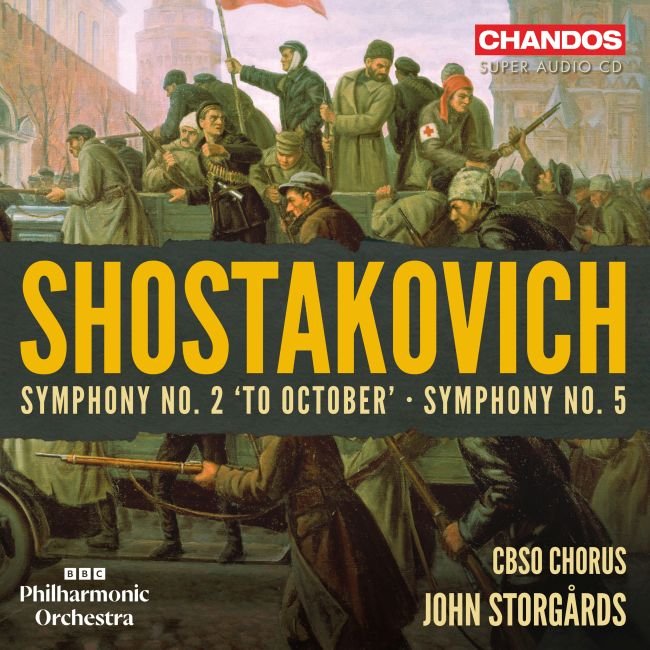
Modern-day performers of Shostakovich’s music often seem to believe that the composer’s restrained score markings were a hedge against snooping authorities. Now that the composer and the Soviet Union are safely dead, these musical sleuths think, his instructions can be exaggerated in order to contrive an approximation of the bathetic figure in Volkov’s Testimony.
John Storgårds, in his ongoing Shostakovich cycle for Chandos, has gratefully taken the opposite approach: just play the notes and let the listener make up their own mind. This most recent volume includes a recording of the Fifth Symphony, perhaps the most mythologized symphony of the 20th century.
Its introduction is starkly played, with especially detached staccato for the opening motif’s ascending figure. Storgårds prevails upon the BBC Philharmonic to make spare use of vibrato in the second subject, thereby clarifying the inner voices and lending a not unwelcome Hindemithian quality.
Where Storgårds stumbles is in his realization of the movement’s development. Things begin promisingly with beautifully delineated piano and pizzicato basses, sounding here like distinct components within a single musical unit, instead of a soggy mess. As more and more instruments pile on, however, Storgårds fails to heed the score and take the initiative. Instead, he maintains a sluggish tempo, then pulls back further when the march bursts through, frustrating the music’s momentum. The central climax, splendidly played though it is by the BBC Philharmonic, sounds almost inconsequential as a result.
Not everything is bad, though: the coda is gorgeously balanced, with haunting violin portamenti.
Fortunately, the rest of Storgårds’ performance is an improvement. His interpretation of the scherzo is spiky, almost Stravinskyan; an approach well suited to this music’s irony. The “Largo” eschews Mahlerian anguish in favor of controlled string vibrato, carefully terraced dynamics, and clean textures.
Timpani and crisp brass erupt impactfully at the start of the moderately paced finale. Storgårds cranks up the speed only very slightly in the rush towards the movement’s development. That interpretive level-headedness has benefits and drawbacks. When the solo trumpet’s faux premature entrance arrives, it conveys little surprise or urgency. On the other hand, the famous coda proceeds at a natural pace that sounds grand, relentless, and altogether inscrutable.
Shostakovich’s Second Symphony, often a neglected step-child, resounds decisively in this BBC Philharmonic recording. The ascending canonic lines that twist and converge into each other in the instruction sound uncommonly transparent. Very fine, too, is the solo trumpet, soaring above with soundly judged vibrato. The BBC’s crisp phrasing and biting attacks enliven the scherzo-like section that ensues. Linear clarity is maintained even through the ensuing wild contrapuntal episode that this Chandos series’ annotator, David Fanning, rightly describes as an “anti-fugue”. Arguably the finest part of this recording is the choral coda — an utterly convincing musical statement here, in no small part thanks to the excellent City of Birmingham Symphony Chorus.
Sonics on this disc, as ever from Chandos, are astonishing in their breadth of color and space. Solo and ensemble playing are both rendered true and bigger than life. Fanning’s accompanying liner notes are informative for both novice and seasoned Shostakovichian, but his essay on the Fifth Symphony traipses closer to Testimony and The New Shostakovich than one would expect in 2026.