• Featured Articles
  • Blog
  • Essays/Reviews
  • Interviews
  • Reseñas y artículos selectos en castellano
  • Other Things
  • Contact
Menu

echorrhea

Street Address
los angeles
Phone Number

Your Custom Text Here

echorrhea

  • Featured Articles
  • Blog
  • Essays/Reviews
  • Interviews
  • Reseñas y artículos selectos en castellano
  • Other Things
  • Contact

Stubborn Earworm

February 18, 2026 Néstor Castiglione

Small thing. Earlier this morning, I found myself unable to yank a persistent earworm from my mind. The track was by Vince Guaraldi, but its opening riff referred to a classical work. A minuet, the sort of thing a beginning pianist would learn. Who composed it and which work was it?

The whole day it played in my head. Still no answer. I suppose I could’ve looked it up online, but I refused to do so. Partly out of pride; partly out of conviction that dependence on machines isn’t healthy.

Finally, before the day ended it suddenly hit me: Beethoven. It was his Minuet in G major, WoO 10, no. 2. No wonder Guaraldi’s wistful piece was the theme for Schroeder in the Peanuts television specials. Now it all made sense. Finally.

Tags vince guaraldi, ludwig van beethoven, schroeder, peanuts, charles m schultz
Comment

Heavy Light Listening

February 4, 2026 Néstor Castiglione

Between my return from Phoenix last night and my departure for San Luis Obispo this afternoon, I managed to squeeze in just enough time to listen to music.

Somehow I’d never heard András Schiff’s ECM cycle of the Beethoven piano sonatas. When it was commercially available, I wasn’t interested. Then I was — but by then it was out-of-print. Took me a while to track down a physical copy, which arrived this morning.

I first listened to Op. 31, no. 1, one of my favorite works by Beethoven. While the recording played, I looked through the box set and came across the last CD in the set, entitled Encores after Beethoven, which suggests a collection of “lollipops”. The program is anything but. Which was no surprise. (My eyebrows would have raised right off my forehead had the disc included Schiff recordings of things like Étincelles and Polka de W. R.)

Schubert’s late Allegretto in C minor, D. 915 is the second track. Compact, moody, and emotionally potent, it arguably overshadows the one Beethoven work on the program (the “Andante favori”). Truly remarkable and original music, composed in the valley of death: Beethoven’s and, imminently, Schubert’s.

Heavy music for a little encore.

Tags andrás schiff, ludwig van beethoven, franz schubert, ecm records
Comment

Second-Hand Abbado

January 16, 2026 Néstor Castiglione

The desktop computer I’ve used for the last six years finally went kaput yesterday. It had been running on hopes and prayers the last few months, but 2026 was the year the thing finally said no more. QEPD.

I started to use a new computer earlier today, but 21st-century technology is a struggle for my stubbornly analog mind to grasp at times. After a while, I needed to get some air, so I went thrifting with my wife.

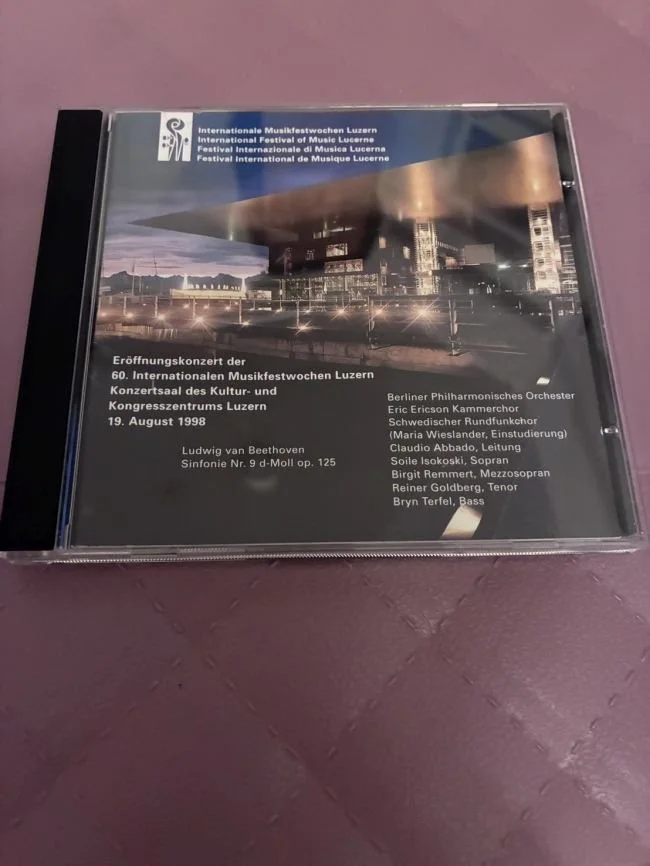
We still have a few record stores in Los Angeles (the “vinyl renaissance” shops don’t count in my mind) where classical CDs can be found, but some of the best finds I’ve had in the wild in the past decade have been at thrift stores. This disc is one of them: a private press CD of Abbado conducting Beethoven 9 in Lucerne back in 1998. (A good year, by the way. I had more hair, Pasadena’s short-lived meikyoku kissa was still around, and my wardrobe was filled with stylish duds from Aaardvark’s Odd Ark.) This performance doesn’t appear to have been reissued. Haven’t listened to it yet, but it scratches a two itches: my ongoing reevaluation of Abbado’s discography and my longstanding interest in niche private-press CDs. How did this end up at a random thrift store deep in the suburbs?

Tags ludwig van beethoven, claudio abbado, lucerne festival, berlin philharmonic orchestra, thrift stores
Comment

Karajan Between East and West

January 4, 2026 Néstor Castiglione

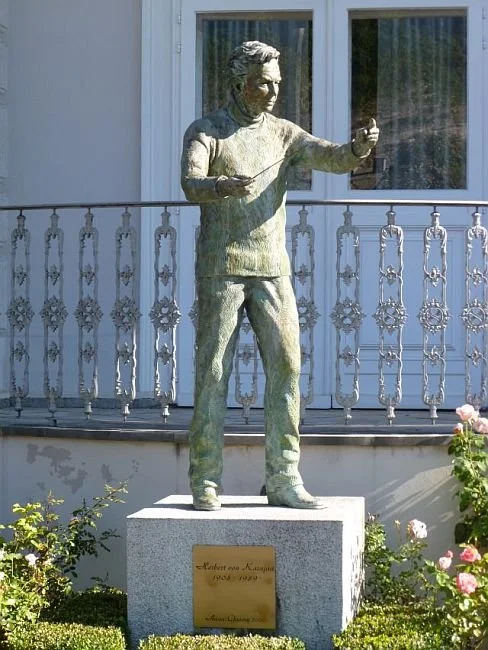
Karajan statue in Salzburg [Image:Wikimedia Commons/User:Luckyprof]

One of the CDs that arrived for me last week from Japan was a live Karajan concert from 1961. On this occasion he was helming the Berlin Philharmonic on tour in Paris; their program was Beethoven 8 and 9.

Disdain for Karajan was downright trendy around the turn of the century. The Maestro Myth signaled the upbeat on this ritualistic grave dancing, fomented by shifts in tastes, as well as outrage over Karajan’s proximity to the NSDAP. The latter became so infamous, that at times it almost overwhelmed purely musicological discourse about Karajan. There was still a lot of that in the 1990s, though, while the conductor’s corpse was still warm. Karajan became obsessed with schönklang for its own sake, people would say; that he cowered under the shadow of Furtwängler, whose explosive posthumous reevaluation coincided with Karajan’s dwindling years; his hearing declined and his final digital mixes were terrible as a result; Karajan was a creation of the record studio, a muzak bandleader of a plastic listening experience. I heard these and other criticisms during my first record store stint between 1998 and 2003. Arguably, Karajan’s legacy in North America and Europe never recovered the primacy it once had; his recordings no longer are the default recommendation of critics and listeners.

In East Asia, on the other hand, Karajan’s studio recordings continue to be highly prized and regularly reissued, often in premium SACD editions. These are supplemented with a steady stream of live recordings, most of which come with excellent annotations and other paraphernalia that testify to Karajan’s enduring appeal in the region. The aforementioned set of the conductor’s 1960 French concert is a case in point: it was packaged with a nifty poster of the the man at work, evidently immersed in the moment, lost to the world. For a moment, as I folded it back up, I thought maybe it was time to take down the Farah Fawcett poster in my room and make way for Herbie.

Few conductors matched Karajan in his effortless and, for his time, visionary use of the studio as instrument. Other conductors had anticipated him. Stokowski and, to a degree, Mengelberg, who had not an insignificant influence on the young Karajan. But it was the Berlin Philharmonic’s longtime GMD that arguably perfected the role of conductor as co-producer, even if he did go too far at times (e.g. his recording of Schoenberg’s Variations for Orchestra).

His virtuosic use of the studio control deck was no crutch, to be sure, as is amply testified by this Paris Beethoven concert, issued on Spectrum Sound’s Belle Âme sub-label, and released in cooperation with the INA. What is remarkable is not only the apparent consistency in energy between his studio and live recordings — which, as the flawed discographies of Barbirolli and Tennstedt demonstrate, is easier said than done — but also the moments of risk-taking and experimentation that dispel the rather staid image Karajan evokes in Western listeners. Another fascinating detail is the transitional sound of the Berlin Philharmonic in 1960. Six years after Furtwängler’s death, they still sounded much like his orchestra, albeit brightened with emergent qualities that would blossom into full flower by the mid-1960s. Still, the mid-range winds and basses especially recall the Berlin Philharmonic of the immediate postwar.

It would be interesting at a later date to explore why appraisals of Karajan’s legacy in East Asia have diverged from the more critical consensus in North America and Europe. (Although, if the recent Berlin Philharmonic box sets are any evidence, he still has his die-hards on this side of the world.) Where the world is headed to in this century seems more uncertain than ever, but global pluralism, at least in the realm of culture, seems here to stay. That is something to encourage and be thankful for.

Tags herbert von karajan, ludwig van beethoven, wilhelm furtwängler, spectrum sound, belle âme, ina, paris, japan, south korea, china
Comment

"The Cigarette Symphonies"

January 2, 2026 Néstor Castiglione

“And now a word from our sponsor…”

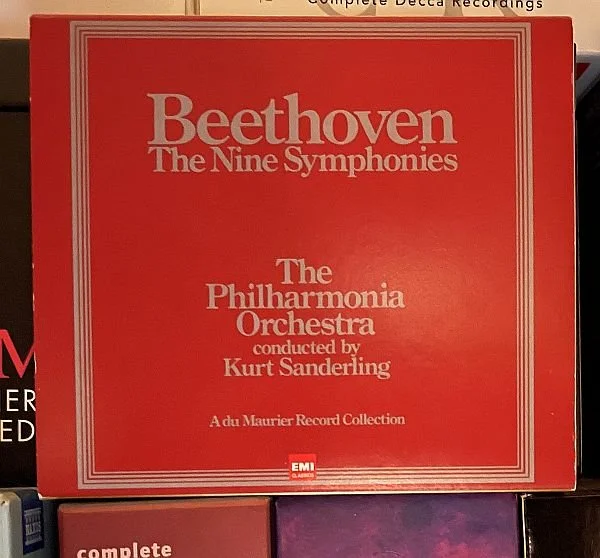
I’d been looking for it for years: the Japanese CD reissue of Kurt Sanderling’s EMI cycle of the Beethoven symphonies. One of my pet passions are Beethoven cycles led by conductors of the “old school”. With over 80 such sets in my collection, you’d think it’d be time to give this proclivity a rest. But, no — I needed to listen to this one too.  Over the past several years, I’d bid on a number of listings for this set on Yahoo Auctions Japan. Each time it slipped my grasp, either because the auction ended higher than expected or because there was something else that I chose to bid all-out on. Last November I threaded the needle and won the thing for a very reasonable $22. Fast-forward: it was delivered to me on December 31 and I finally got around to listening to it today.

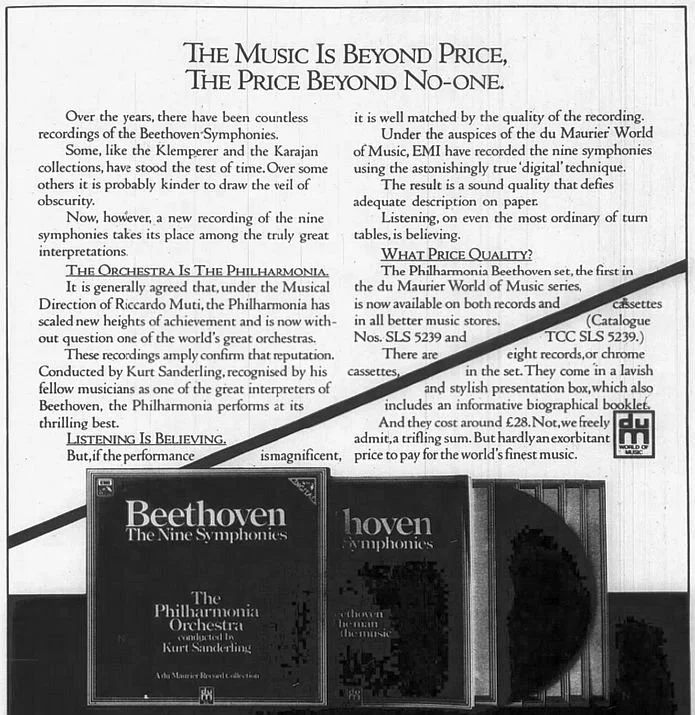
Sanderling’s was the first digital Beethoven symphony cycle, beating out the likes of Karajan, Muti, Abbado, and other more glamorous maestros. Asari Kōzō’s liner notes for the CD reissue touched upon that, but didn’t mention a more interesting detail: that the recording was sponsored by the British-Canadian tobacco company, Du Maurier. Which is why Sanderling’s Beethoven cycle was nicknamed by some contemporary reviewers as “the cigarette symphonies”.

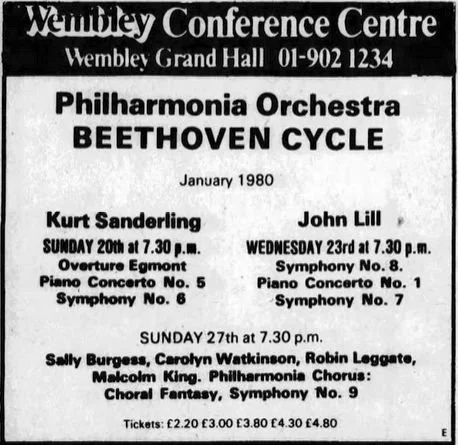
Online tabloidists have ascribed darker motives for Du Maurier’s sponsorship and insinuated that Sanderling was shanghaied into this recording project. In fact, by the time Sanderling’s Beethoven was released in late 1981, Du Maurier had been the Philharmonia’s main sponsor for several years. Hardly chagrined at being “outshouted” by a cigarette brand, the orchestra prominently featured their sponsor’s logo in their advertisements, underlined by the legend, “A Du Maurier Concert Series”. They recorded the Beethoven symphonies with Sanderling at Abbey Road and Kingsway Hall in early 1981, a year after they performed the cycle live at Wembley Conference Center. Recordings were packed into a crowded schedule of two three-hour sessions per day, which permitted the musicians to maintain the flow of their performances. However, this came at the cost of retaining some technical imperfections.

Du Maurier was one of many British corporations of the time who viewed classical music as a potential avenue for brand outreach, a tactic that journalists likened to the sponsorships typical of American television programs. One of the beneficiaries of corporate interest in classical music was the unfinished period instrument Haydn cycle conducted by Derek Solomons. As a 1982 New York Times article explained:

The financial aid from Martini & Rossi included complete payment for the musicians and 50 percent of the cost of advertisements in which the Martini & Rossi logo appears.

Marcel Rodd, chairman of Saga Records, which had recorded the Solomons cycle, had no misgivings about this arrangement: “We could never balance our budgets if it were not for our vices”. Neither did the author of the article, who seemed more concerned that future listeners would forget about the musicians involved in recordings and, instead, talk “about the ‘Amoco Tristan’ and the ‘Du Maurier Beethoven’”.

After having listened to the cycle, I have to admit to being puzzled at its existence. Reviews of the live performances at Wembley were tepid. A critic for The Guardian wrote:

But for all the warmth and sturdiness […], Sanderling’s sometimes serious lack of fire and energy too often proved as perplexing as it was disconcerting.

Not exactly the thing that calls out for digital immortalization.

CD reissue of Sanderling’s Beethoven on my shelf [Image:Me]

Critics were not much more enthused by the recorded cycle. Alan Blyth in The Daily Telegraph was polite enough. He began by likening Sanderling to Weingartner, then expressed cautious approval of the former’s “sturdy and honest” cycle, before he admitted that Sanderling was “less convincing in the abrupt, blazing side of [Beethoven]”, and that he preferred a Beethoven cycle conducted by James Loughran over Sanderling’s. Theodore W. Libbey, Jr. of the New York Times was perhaps the most equanimous reviewer of Sanderling’s cycle:

There is much to be said for Mr. Sanderling’s approach. It is learned, though not archaeologically inclined. It takes into account the rhetorical foundations and performance practices of the 18th-century style — on which [Beethoven’s] symphonies were built — purging the orchestra’s playing of the attacks, accents, and wayward gestures that have come as later accretions to the interpretation of music of that period. This is done without giving up the sonic color or weight of the modern instruments or the methods of modern players. One suspects that in Beethoven’s ears, the Sanderling/Philharmonia performances would come closer to the measure of the music, if not the spirit, than almost any other “modern”, as opposed to “scholarly”, account.

In spite of this, Libbey also noted the set’s lapses in ensembles, awkward coordination, and generally variable quality. He reserved his most unreluctant approval for Sanderling’s recordings of the “Eroica” and “Pastoral”, as well as the Ninth, although the latter drew a caveat. “[It] is simply wonderful”, Libbey said, “until the singing starts, when it becomes simply awful”.

All these years chasing after this set, only to find that it’s a dud. But that’s OK! Sanderling left great recordings of Haydn, Brahms, Tchaikovsky, Mahler, and Shostakovich. So he’s allowed an off day or two. Disappointments are also rewarding because they help to cultivate one’s tastes. So as I slip the obi strip back on this set and slip it away into my shelves, I’m glad that I finally got to hear it.

Now onto the next Beethoven symphony cycle.

Tags ludwig van beethoven, kurt sanderling, cigarettes, du maurier, derek solomons, franz joseph haydn, emi, saga records
Comment