• Featured Articles
  • Blog
  • Essays/Reviews
  • Interviews
  • Reseñas y artículos selectos en castellano
  • Other Things
  • Contact
Menu

echorrhea

Street Address
los angeles
Phone Number

Your Custom Text Here

echorrhea

  • Featured Articles
  • Blog
  • Essays/Reviews
  • Interviews
  • Reseñas y artículos selectos en castellano
  • Other Things
  • Contact

The Good Ol' Days?

February 19, 2026 Néstor Castiglione

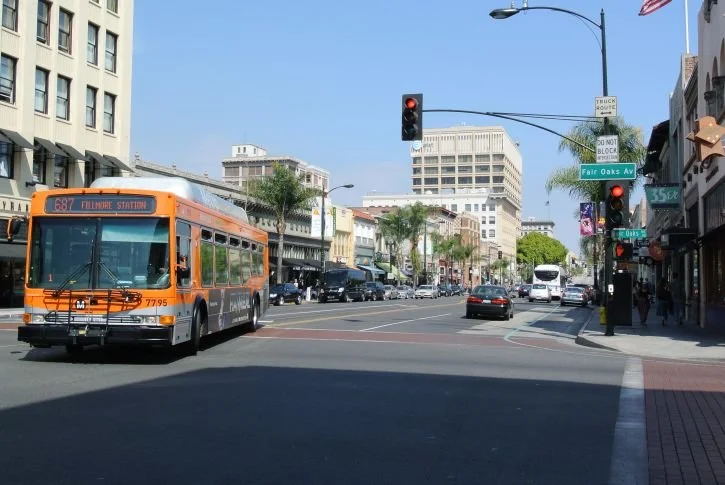
Corner of Fair Oaks and Colorado in Old Town Pasadena. In 1996, Opus, Moby Disc, Pennylane, and The Wherehouse were all within a few hundred feet from here. [Image:Wikimedia Commons/User:Adbar]

Within a few hundred feet from each other here in the heart of Old Town Pasadena, there were no less than four record stores at one point. I used to browse through all of them several times a week. They didn’t stock everything. For specialty items and imports, I’d have to take long bus rides to stores in West Hollywood, Brentwood, and the San Fernando Valley. When the premiere recording of Shostakovich’s Fifteenth Symphony in the Derevianko arrangement was issued in 1997, the only store that stocked a copy was the Tower Classical Annex on Sunset Blvd. Before the advent of the Gold and Red Lines, it took 3 or 4 buses to get there from Highland Park. Without a car and being largely unfamiliar with places outside northeastern Los Angeles and the western San Gabriel Valley, it almost felt to me like I was wandering off into some exotic, far-away locale.

Nowadays that recording and several others of that arrangement are virtually on-tap whenever I want them.

Had I been told back in the 1990s that the vast majority of human musical achievement could be immediately accessible at one’s fingertips, anytime, anywhere, it would’ve seemed the stuff of delirious sci-fi fantasizing. There’s a price for these comforts, not least in that undefinable quality sometimes referred to as “romance”. Online listening can often feel like one is merely accumulating data. (Or “content”, hideous word, but perhaps appropriate in this context.)

One has to accept that things change — for better and worse.

I was reminded of the “better” last weekend. An auction came up for a bootleg CD-R that purported to contain a live recording from 2006 of Bruckner’s Ninth Symphony with the Chicago Symphony conducted by Claudio Abbado. My eyes widened — I had to have it. Evidently I didn’t want it enough, though. My bid lost; some other lucky collector won. Fortunately, a fellow member on a forum I frequent was quick to inform me that the credit on that CD-R was false. Abbado never conducted the Chicago Symphony again after 1991.

I was saved from a potentially expensive lesson. Not that it would’ve been my first one.

At the Pasadena City College Flea Market some time around 2000, I bought a clutch of what purported to be audience recordings of Los Angeles Philharmonic concerts conducted by Carlos Maria Giulini. Only many years later did I learn that these CD-Rs actually contained broadcasts of British orchestras conducted by Kurt Sanderling and a handful of others. Altogether, I had spent around $75 on those discs. (If you trust the CPI index — and I’ve been skeptical since at least 2020 — that comes out to about twice the amount in today’s money.)

YouTube and numerous other sites now have all kinds of bootleg recordings for streaming available. Whether or not the performers listed are indeed the ones playing is no more certain today than it was in the past, but at least now you don’t lose anything by clicking anything to listen.

“Romance” may be a thing of the past, but at least taking your ears off-roading has gotten a little cheaper.
Tags tower records, bootlegs, pasadena city college flea market, claudio abbado, carlo maria giulini, kurt sanderling
Comment

"The Cigarette Symphonies"

January 2, 2026 Néstor Castiglione

“And now a word from our sponsor…”

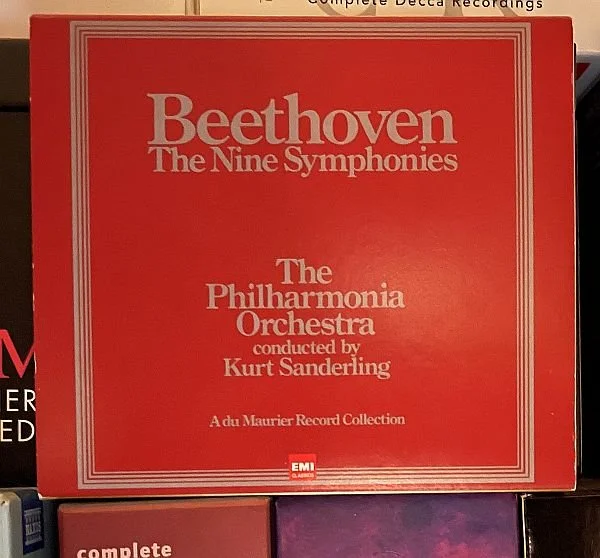
I’d been looking for it for years: the Japanese CD reissue of Kurt Sanderling’s EMI cycle of the Beethoven symphonies. One of my pet passions are Beethoven cycles led by conductors of the “old school”. With over 80 such sets in my collection, you’d think it’d be time to give this proclivity a rest. But, no — I needed to listen to this one too.  Over the past several years, I’d bid on a number of listings for this set on Yahoo Auctions Japan. Each time it slipped my grasp, either because the auction ended higher than expected or because there was something else that I chose to bid all-out on. Last November I threaded the needle and won the thing for a very reasonable $22. Fast-forward: it was delivered to me on December 31 and I finally got around to listening to it today.

Sanderling’s was the first digital Beethoven symphony cycle, beating out the likes of Karajan, Muti, Abbado, and other more glamorous maestros. Asari Kōzō’s liner notes for the CD reissue touched upon that, but didn’t mention a more interesting detail: that the recording was sponsored by the British-Canadian tobacco company, Du Maurier. Which is why Sanderling’s Beethoven cycle was nicknamed by some contemporary reviewers as “the cigarette symphonies”.

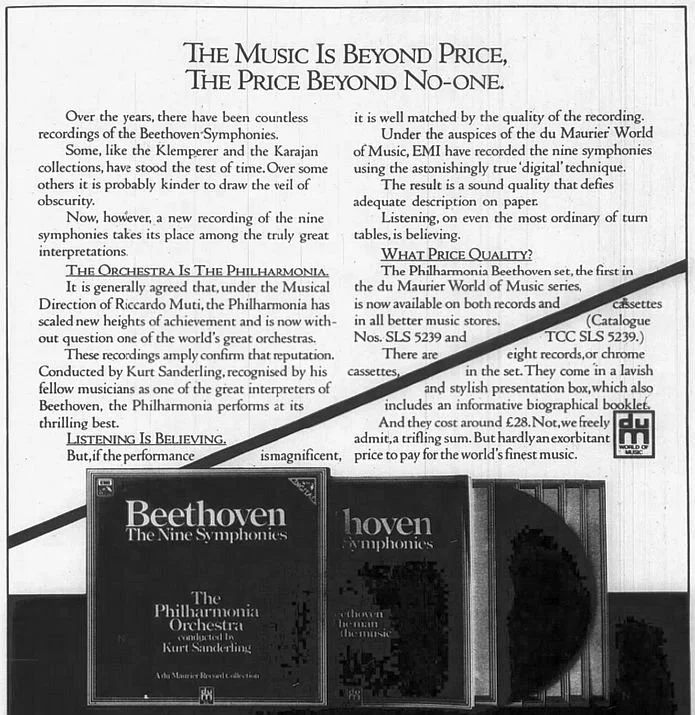
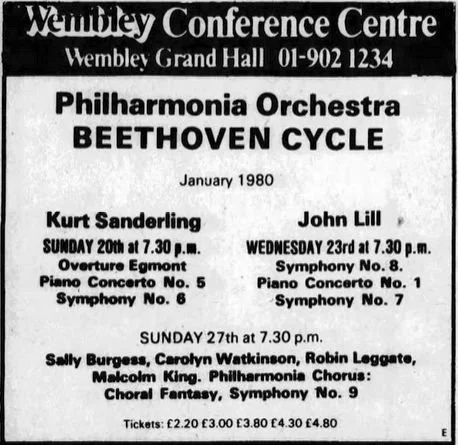
Online tabloidists have ascribed darker motives for Du Maurier’s sponsorship and insinuated that Sanderling was shanghaied into this recording project. In fact, by the time Sanderling’s Beethoven was released in late 1981, Du Maurier had been the Philharmonia’s main sponsor for several years. Hardly chagrined at being “outshouted” by a cigarette brand, the orchestra prominently featured their sponsor’s logo in their advertisements, underlined by the legend, “A Du Maurier Concert Series”. They recorded the Beethoven symphonies with Sanderling at Abbey Road and Kingsway Hall in early 1981, a year after they performed the cycle live at Wembley Conference Center. Recordings were packed into a crowded schedule of two three-hour sessions per day, which permitted the musicians to maintain the flow of their performances. However, this came at the cost of retaining some technical imperfections.

Du Maurier was one of many British corporations of the time who viewed classical music as a potential avenue for brand outreach, a tactic that journalists likened to the sponsorships typical of American television programs. One of the beneficiaries of corporate interest in classical music was the unfinished period instrument Haydn cycle conducted by Derek Solomons. As a 1982 New York Times article explained:

The financial aid from Martini & Rossi included complete payment for the musicians and 50 percent of the cost of advertisements in which the Martini & Rossi logo appears.

Marcel Rodd, chairman of Saga Records, which had recorded the Solomons cycle, had no misgivings about this arrangement: “We could never balance our budgets if it were not for our vices”. Neither did the author of the article, who seemed more concerned that future listeners would forget about the musicians involved in recordings and, instead, talk “about the ‘Amoco Tristan’ and the ‘Du Maurier Beethoven’”.

After having listened to the cycle, I have to admit to being puzzled at its existence. Reviews of the live performances at Wembley were tepid. A critic for The Guardian wrote:

But for all the warmth and sturdiness […], Sanderling’s sometimes serious lack of fire and energy too often proved as perplexing as it was disconcerting.

Not exactly the thing that calls out for digital immortalization.

CD reissue of Sanderling’s Beethoven on my shelf [Image:Me]

Critics were not much more enthused by the recorded cycle. Alan Blyth in The Daily Telegraph was polite enough. He began by likening Sanderling to Weingartner, then expressed cautious approval of the former’s “sturdy and honest” cycle, before he admitted that Sanderling was “less convincing in the abrupt, blazing side of [Beethoven]”, and that he preferred a Beethoven cycle conducted by James Loughran over Sanderling’s. Theodore W. Libbey, Jr. of the New York Times was perhaps the most equanimous reviewer of Sanderling’s cycle:

There is much to be said for Mr. Sanderling’s approach. It is learned, though not archaeologically inclined. It takes into account the rhetorical foundations and performance practices of the 18th-century style — on which [Beethoven’s] symphonies were built — purging the orchestra’s playing of the attacks, accents, and wayward gestures that have come as later accretions to the interpretation of music of that period. This is done without giving up the sonic color or weight of the modern instruments or the methods of modern players. One suspects that in Beethoven’s ears, the Sanderling/Philharmonia performances would come closer to the measure of the music, if not the spirit, than almost any other “modern”, as opposed to “scholarly”, account.

In spite of this, Libbey also noted the set’s lapses in ensembles, awkward coordination, and generally variable quality. He reserved his most unreluctant approval for Sanderling’s recordings of the “Eroica” and “Pastoral”, as well as the Ninth, although the latter drew a caveat. “[It] is simply wonderful”, Libbey said, “until the singing starts, when it becomes simply awful”.

All these years chasing after this set, only to find that it’s a dud. But that’s OK! Sanderling left great recordings of Haydn, Brahms, Tchaikovsky, Mahler, and Shostakovich. So he’s allowed an off day or two. Disappointments are also rewarding because they help to cultivate one’s tastes. So as I slip the obi strip back on this set and slip it away into my shelves, I’m glad that I finally got to hear it.

Now onto the next Beethoven symphony cycle.

Tags ludwig van beethoven, kurt sanderling, cigarettes, du maurier, derek solomons, franz joseph haydn, emi, saga records
Comment