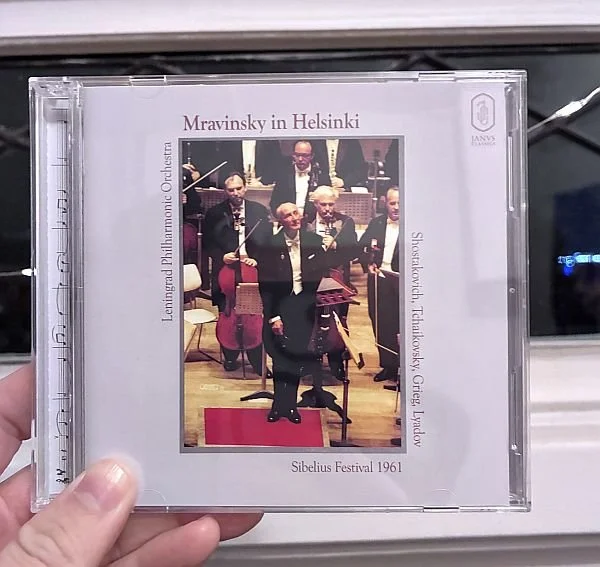
One of the CDs that arrived for me last week from Japan was a live Karajan concert from 1961. On this occasion he was helming the Berlin Philharmonic on tour in Paris; their program was Beethoven 8 and 9.
Disdain for Karajan was downright trendy around the turn of the century. The Maestro Myth signaled the upbeat on this ritualistic grave dancing, fomented by shifts in tastes, as well as outrage over Karajan’s proximity to the NSDAP. The latter became so infamous, that at times it almost overwhelmed purely musicological discourse about Karajan. There was still a lot of that in the 1990s, though, while the conductor’s corpse was still warm. Karajan became obsessed with schönklang for its own sake, people would say; that he cowered under the shadow of Furtwängler, whose explosive posthumous reevaluation coincided with Karajan’s dwindling years; his hearing declined and his final digital mixes were terrible as a result; Karajan was a creation of the record studio, a muzak bandleader of a plastic listening experience. I heard these and other criticisms during my first record store stint between 1998 and 2003. Arguably, Karajan’s legacy in North America and Europe never recovered the primacy it once had; his recordings no longer are the default recommendation of critics and listeners.
In East Asia, on the other hand, Karajan’s studio recordings continue to be highly prized and regularly reissued, often in premium SACD editions. These are supplemented with a steady stream of live recordings, most of which come with excellent annotations and other paraphernalia that testify to Karajan’s enduring appeal in the region. The aforementioned set of the conductor’s 1960 French concert is a case in point: it was packaged with a nifty poster of the the man at work, evidently immersed in the moment, lost to the world. For a moment, as I folded it back up, I thought maybe it was time to take down the Farah Fawcett poster in my room and make way for Herbie.
Few conductors matched Karajan in his effortless and, for his time, visionary use of the studio as instrument. Other conductors had anticipated him. Stokowski and, to a degree, Mengelberg, who had not an insignificant influence on the young Karajan. But it was the Berlin Philharmonic’s longtime GMD that arguably perfected the role of conductor as co-producer, even if he did go too far at times (e.g. his recording of Schoenberg’s Variations for Orchestra).
His virtuosic use of the studio control deck was no crutch, to be sure, as is amply testified by this Paris Beethoven concert, issued on Spectrum Sound’s Belle Âme sub-label, and released in cooperation with the INA. What is remarkable is not only the apparent consistency in energy between his studio and live recordings — which, as the flawed discographies of Barbirolli and Tennstedt demonstrate, is easier said than done — but also the moments of risk-taking and experimentation that dispel the rather staid image Karajan evokes in Western listeners. Another fascinating detail is the transitional sound of the Berlin Philharmonic in 1960. Six years after Furtwängler’s death, they still sounded much like his orchestra, albeit brightened with emergent qualities that would blossom into full flower by the mid-1960s. Still, the mid-range winds and basses especially recall the Berlin Philharmonic of the immediate postwar.
It would be interesting at a later date to explore why appraisals of Karajan’s legacy in East Asia have diverged from the more critical consensus in North America and Europe. (Although, if the recent Berlin Philharmonic box sets are any evidence, he still has his die-hards on this side of the world.) Where the world is headed to in this century seems more uncertain than ever, but global pluralism, at least in the realm of culture, seems here to stay. That is something to encourage and be thankful for.