
• Featured Articles
  • Blog
  • Essays/Reviews
  • Interviews
  • Reseñas y artículos selectos en castellano
  • Other Things
  • Contact
Menu

echorrhea

Street Address
los angeles
Phone Number

Your Custom Text Here

echorrhea

  • Featured Articles
  • Blog
  • Essays/Reviews
  • Interviews
  • Reseñas y artículos selectos en castellano
  • Other Things
  • Contact

Footfalls of Giants in Beethoven and Alexander Tchaikovsky

February 24, 2026 Néstor Castiglione

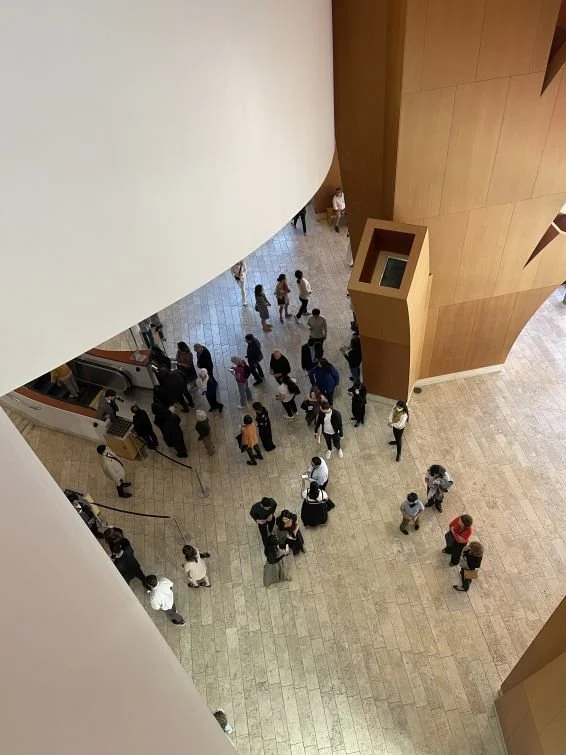
Looking down from Disney Hall’s third floor [Image:Me]

Since the 19th century, classical music, perhaps uniquely among Western musical genres, has been defined as much by progress into the future, as well as intense preoccupation with the past. Schoenberg and Stravinsky, each in their characteristic ways, attempted to subvert and render homage to their forebears. A half-century before them there was Brahms and his anxiety about a certain giant tramping behind him. Would it have surprised him to learn that the giant himself felt daunted by the footfalls of his predecessors?

Last weekend, Dudamel conducted Beethoven’s Missa solemnis for the first time. It was a first for me too: I’d never heard the work performed in concert before. Music heard in person, it is sometimes easy to forget, can be an experience quite distinct from hearing it on records. So it was for me hearing the Missa solemnis, a work that I’m well familiar with, yet felt at times unexpectedly new in that Disney Hall performance.

Beethoven’s music isn’t typically thought of as being burdened by history in the way later composers were. After all, he was busy forging the very musical language to which musical developments for over a century afterward would respond to and recoil against. What did he have to worry about?

Brought to life by the combined power of the Los Angeles Philharmonic, Orfeó Català, and the Cor de Cambra del Palau de la Música Catalana, Beethoven’s struggle to honor and surpass his past suddenly came to my notice.

The Missa solemnis speaks of its composer’s struggle to reconcile himself with Catholicism or at least God, the notion of the Divine; somehow I had entirely missed this until last Friday. (An appropriate enough epiphany at the start of this Lenten season. Incidentally, I haven’t read Nicholas Chong’s The Catholic Beethoven, but it is on my “to-read” list.)

On another level, the work is almost as if Beethoven were trying to measure himself up against the past, to prove — to himself and to those who came before him — that he is a worthy inheritor of its legacy. The work’s dramatic if peculiar use of fugue, its Handelian bravado took on a new dimension for me. Whenever I thought about how Beethoven explicitly referenced the past, as in the Eighth Symphony or the strange minuet that draws the curtain on the Diabelli Variations, it seemed to me that he sort of laughed or shrugged it off. In the Missa solemnis, however, joy and a rare sense of unease pervades much of its music. At least in this work, the past was no joke.

Nor is it a trifling matter in Alexander Tchaikovsky’s The Tale of Boris and Gleb, a work I heard a few days before. (The video I had posted of its performance is now, unfortunately, no longer available.) The composer’s concern there was not so much musical history, as it was time and history itself. “Past”, “present”, and “future” coexist, clash, and oppress one another; neither one existing separately, but all of them threaded into a single, living whole.

Like Beethoven’s Missa solemnis, Tchaikovsky’s The Tale of Boris and Gleb also grapples with the nature of faith, but the latter work contains a number of additional implications only imaginable in our postmodern and, possibly, incipiently post-human age, where all of us may soon need to take cover from the footfalls of giants still unknown.
Tags ludwig van beethoven, missa solemnis, disney hall, los angeles philharmonic, gustavo dudamel, orfeó català, cor de cambra del palau de la música catalana, xavier puig, alexander tchaikovsky, the tale of boris and gleb, freddy cadena, yuri bashmet
Comment

Will The Dude Abide?

January 3, 2026 Néstor Castiglione

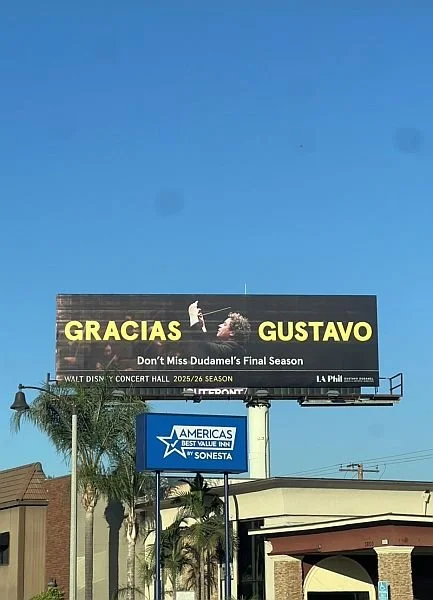
Billboard in Pasadena [Image:My brother]

Reading the morning headlines in the 21st century can be a white-knuckle thrill ride; today was no different.

As much as Venezuela and related issues have figured in national news during the 2020s, these have never significantly affected the US. It’s a different story in Latin America, however, where more than two decades of Chavismo and American opposition against it have had significant consequences for local politics and quotidian life. One of the most dramatic recent manifestations of this phenomenon was the triumph of José Antonio Kast in the second round of the 2025 presidential election in my parents’ home country of Chile, a result powered in great part by widespread frustration over unprecedented levels of Venezuelan immigration.

In my childhood, Venezuela seemed like a glamorous country; a place that telenovelas, vaudevillian comedy programs, and other shows produced by Venevisión enticed me into believing was populated entirely by elegant gentlemen of leisure and beautiful women. The latter was a recurring cultural idée fixe growing up, perhaps because one of my mother’s friends, a Venezuelan lady, ostentatiously prided herself on that popular notion.

There are achievements in high culture, too, foremost among them those by Andrés Bello, an eminent polymath whose impact in Latin American history and the Spanish language are comparable to that of Goethe’s in Germany.

Dudamel, the single most recognizable Venezuelan fine artist in the entire world, maybe of all time, came much later, of course. His face and name are ubiquitous here in Los Angeles. You don’t have to go very far to see “The Dude” plastered on a billboard, hanging from a street lamp banner, or decorating the side of an MTA bus.

Whatever one’s opinion of Dudamel as a conductor, he undoubtedly possesses an instant brand recognition that is exceptionally rare in recent classical music history. It has been a blessing for a career unblemished by scandal, but this is increasingly being tried by his longstanding association with Chavismo. Gone are the days when sympathy for Hugo Chávez and his jumbled ideology was fashionable among the discontents of the Bush II era. As mainstream American and European media narratives on Chavismo have soured, scrutiny into Dudamel’s personal political beliefs has increased.

The first warning shots were fired at Dudamel before his international career had really begun, in 2007, goaded by media outrage over Chávez’s unsuccessful constitutional referendum that year. However, it was an op-ed published five years later in Commentary that broadened public attention into Dudamel’s connections to the Venezuelan government. Not satisfied with earlier critics’ implication of Dudamel as an unwitting accomplice, the essay’s author took a step further and accused the conductor of being a willing co-conspirator or at least enabler of Venezuela’s anti-democratic turn:

Instead of using his international prestige to stand up against Chávez’s efforts to subvert democracy, Dudamel may have become one more artistic façade for a government hell-bent on destroying human rights in Venezuela. In doing so, he has become part of a long tradition of morally obtuse musicians who played for dictators. [...] So while the likeable Dudamel has become a classical star here in the United States, he has also become a symbol of the way every aspect of Venezuelan culture has been taken over by the Chávez regime to the detriment of his country’s freedom and the security of the region.

Others expanded this line of attack, most notably the pianist Gabriela Montero, a fellow Venezuelan and former friend. Just last year, while urging on a boycott of the Simón Bolívar Symphony Orchestra, she called for regime change in her home country.

Circumspect annoyance with the “over-politicized” state of the world notwithstanding, Dudamel has maintained his composure. For neoconservatives and the present day equivalent of those people that Mencken long ago referred to as “world savers”, Dudamel’s neutralism has been insufficient. A few hours ago, one tabloidist vaguely said that the conductor had to make some kind of correct public statement on the ongoing situation in Venezuela, lest he “be held to account” for his relationship to its government. What that actually involved and whether anything illicit resulted from it, as this tabloidist intimated without evidence, is unclear.

Shortly after the end of World War II, Richard Strauss grumbled that Americans were too obsessed with politics. He had a point, but there is more to it than that. (And it is not just Americans anymore.) Most people are either unable or unwilling to parse information given to them, exacerbating political partisanship that in the last two decades has become akin to the rivalry of the demes in Constantinople. In such an environment, where puerile “good guy/bad guy” dynamics define mainstream political discourse, and such perceptions can fluctuate on a whim, holding Dudamel to task for his mostly undefined ideological affiliations is a waste of time — his as much as ours.

Tags gustavo dudamel, nicolás maduro, hugo chávez, el sistema, gabriela montero, neoconservatism, regime change, venezuela, los angeles philharmonic, new york philharmonic
Comment