
Since the 19th century, classical music, perhaps uniquely among Western musical genres, has been defined as much by progress into the future, as well as intense preoccupation with the past. Schoenberg and Stravinsky, each in their characteristic ways, attempted to subvert and render homage to their forebears. A half-century before them there was Brahms and his anxiety about a certain giant tramping behind him. Would it have surprised him to learn that the giant himself felt daunted by the footfalls of his predecessors?
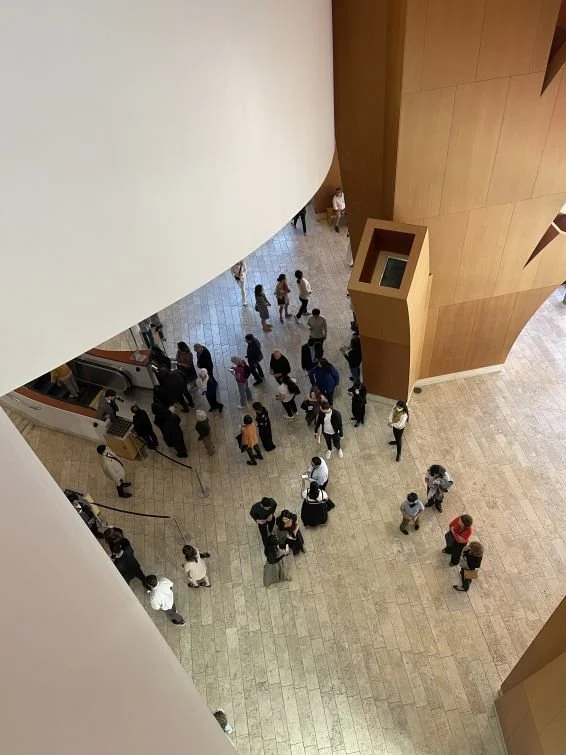
Last weekend, Dudamel conducted Beethoven’s Missa solemnis for the first time. It was a first for me too: I’d never heard the work performed in concert before. Music heard in person, it is sometimes easy to forget, can be an experience quite distinct from hearing it on records. So it was for me hearing the Missa solemnis, a work that I’m well familiar with, yet felt at times unexpectedly new in that Disney Hall performance.
Beethoven’s music isn’t typically thought of as being burdened by history in the way later composers were. After all, he was busy forging the very musical language to which musical developments for over a century afterward would respond to and recoil against. What did he have to worry about?
Brought to life by the combined power of the Los Angeles Philharmonic, Orfeó Català, and the Cor de Cambra del Palau de la Música Catalana, Beethoven’s struggle to honor and surpass his past suddenly came to my notice.
The Missa solemnis speaks of its composer’s struggle to reconcile himself with Catholicism or at least God, the notion of the Divine; somehow I had entirely missed this until last Friday. (An appropriate enough epiphany at the start of this Lenten season. Incidentally, I haven’t read Nicholas Chong’s The Catholic Beethoven, but it is on my “to-read” list.)
On another level, the work is almost as if Beethoven were trying to measure himself up against the past, to prove — to himself and to those who came before him — that he is a worthy inheritor of its legacy. The work’s dramatic if peculiar use of fugue, its Handelian bravado took on a new dimension for me. Whenever I thought about how Beethoven explicitly referenced the past, as in the Eighth Symphony or the strange minuet that draws the curtain on the Diabelli Variations, it seemed to me that he sort of laughed or shrugged it off. In the Missa solemnis, however, joy and a rare sense of unease pervades much of its music. At least in this work, the past was no joke.
Nor is it a trifling matter in Alexander Tchaikovsky’s The Tale of Boris and Gleb, a work I heard a few days before. (The video I had posted of its performance is now, unfortunately, no longer available.) The composer’s concern there was not so much musical history, as it was time and history itself. “Past”, “present”, and “future” coexist, clash, and oppress one another; neither one existing separately, but all of them threaded into a single, living whole.
Like Beethoven’s Missa solemnis, Tchaikovsky’s The Tale of Boris and Gleb also grapples with the nature of faith, but the latter work contains a number of additional implications only imaginable in our postmodern and, possibly, incipiently post-human age, where all of us may soon need to take cover from the footfalls of giants still unknown.