
• Featured Articles
  • Blog
  • Essays/Reviews
  • Interviews
  • Reseñas y artículos selectos en castellano
  • Other Things
  • Contact
Menu

echorrhea

Street Address
los angeles
Phone Number

Your Custom Text Here

echorrhea

  • Featured Articles
  • Blog
  • Essays/Reviews
  • Interviews
  • Reseñas y artículos selectos en castellano
  • Other Things
  • Contact

An Infamous Anniversary

January 28, 2026 Néstor Castiglione

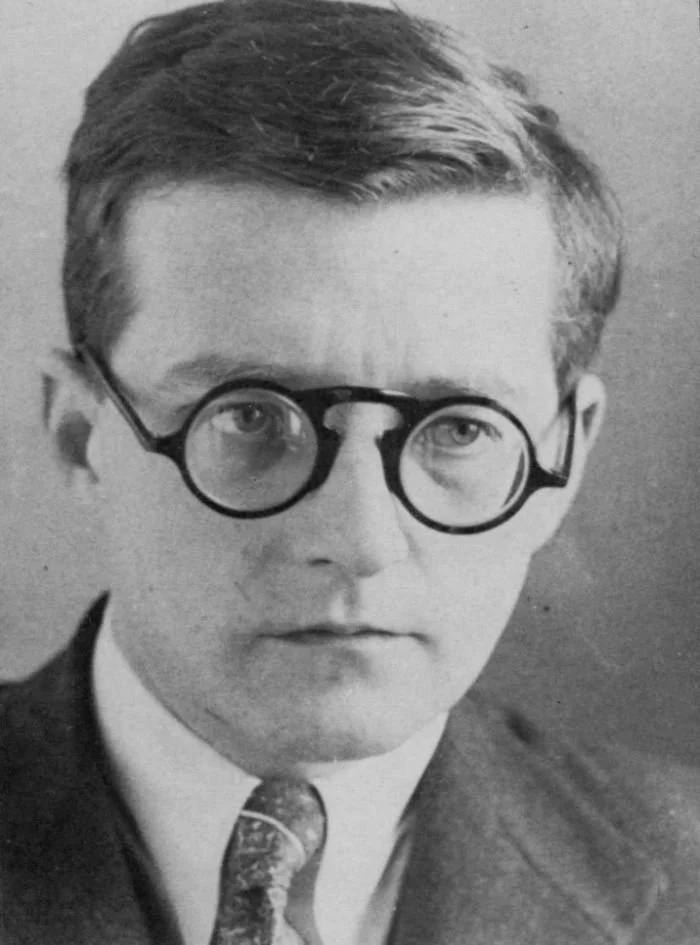
Shostakovich, circa late 1930s [Image:Wikimedia Commons/User:PlanespotterA320/Priuralsky Pravda]

My recent dive into Roy Harris almost led me to overlook that today is the 90th anniversary of the “Muddle Instead of Music” article that effectively ended the first stage of Shostakovich’s career. As with everything else relating to the composer, the notorious op-ed has acquired a certain mythos, including that it forced Shostakovich to turn away from modernism (he had already moderated his style significantly since the Second Symphony) and that the essay was penned by Stalin himself (not true; in fact, Marina Frolova-Walker has shown that, compared to his deadlier interest in film and literature, he kept comparatively aloof from musical affairs).

I thought it’d be interesting to share some excerpts of contemporary coverage of the event. Some things never change: political biases warped Western Shostakovich scholarship and reportage in the 1930s just as much as they often do now.

One of the earliest reports was a brief from the Associated Press published on February 16, wherein it stated that the attack on his music had been extended against other composers, including Gavriil Popov and Alexander Mosolov.

A fuller report followed on April 6 from Sergei Radamsky in the New York Times, which provided an outline of the now familiar saga.

A week later in the same paper, Olin Downes, who had been one of the fiercest critics of Lady Macbeth of Mtsensk District, began his analysis with cautious approval:

Now we learn that Stalin, a man of some musical experience, and, one would say, common sense, saw Lady Macbeth and instigated, in a direct or indirect manner, newspaper disparagement of it.

Downes’ mood turned to outright glee as the article continued, taking swipes at “our brethren on the left” and at Shostakovich himself, who, the critic said, now had shun the modernists and, instead, reconcile himself to the classics. Perversely, Downes viewed the persecution of Shostakovich as being indicative of diminished official interference in Soviet cultural life.

The columnist Bruce Catton echoed those sentiments in an op-ed that barely concealed its glee over the humiliation visited against a presumed ideological adversary:

Until a few days ago, Shostakovich was the darling of the radicals. His music embodied the purest spirit of Communism, and when capitalist outfits like the Philadelphia Orchestra played some of it, the world revolution drew perceptibly nearer.

But Shostakovich has gone off the front page and is back among the want ads, and no good Communist will listen to him.

A few months over we swing from one deep end over to another.

On November 8, the Daily Worker printed an essay by the artist Jacob Burck of his recent visit to the Soviet Union. He began by relating the festive atmosphere, the material plenty, and beautiful women he encountered in Moscow, which he said was “quite a change from the depression atmosphere” in the United States. A few paragraphs later, he touched upon the “Shostakovich case”:

[It] was merely an incident in a campaign by the Soviet press to jolt the Russian art world into an appreciation of sensible art values. Shostakovich was evidently a good example to begin with. This campaign didn’t stop with Shostakovich. Famous writers, artists, and architects who were going arty à la Paris and other centers also got it in the neck. Contrary to predictions in the capitalist press none of these are living in garrets and Shostakovich is at the present time busy on a new opera.

Pauline Fairclough, in her recent monograph on Lady Macbeth of Mtsensk District, noted that the commotion over the opera quickly dissipated. The campaign against the work served as a useful template for Soviet officialdom, which then repeated and modified it against figures in other sectors of the fine arts. Unlike Burck’s cheerful report, however, Fairclough sketches the real-life consequences this had for Shostakovich and those in his immediate circle. “He was permanently scarred by the trauma of what happened to him”, she said, “and his youthful confidence would never fully return”.

Tags dmitri shostakovich, lady macbeth of mtsensk district, sergei radamsky, olin downes, bruce catton, jacob burck, new york times, daily worker, pauline fairclough, socialist realism, muddle instead of music, pravda
Comment

Linking a pair of recent personal passions

January 26, 2026 Néstor Castiglione

A happy place [Image:Me]

Two concerts last weekend, both superb. My head is still swimming over my first time hearing Harris’ Third Symphony live. That was at Friday night’s all-American concert, conducted by John Adams at Disney Hall. A review should be online soon. (I sent it out to my Bachtrack editors over the weekend, but sometimes there can be a delay pending concert photography.)

In the morning, I spoke to two persons who played crucial roles in Harris’ life and posthumous legacy: the conductor Murry Sidlin, and the community activist and arts advocate John Malveaux, who befriended Harris in his later years. The former was drafted last minute into conducting the premiere of the composer’s last symphony, the “Bicentennial”. Quite a bit of drama behind that event. Over thirty years later, Malveaux organized the second-ever performance of the “Bicentennial”. (Joseph Taylor, a fascinating musician in his own right, conducted.)

An essay will be forthcoming on the “Bicentennial” next month, in time for the 50th anniversary of its premiere. Stay tuned.

In the meantime, I caught the Harris bug bad; my mind has been mostly preoccupied with his music the last few days. Although very different stylistically, it occurred to me that he shared some important commonalities with another composer I’ve recently become an admirer of: Robert Simpson.

Both were composers with similar political orientations. Both had strong convictions about the artist’s civic duty. Both constantly tinkered with their music. (Lionel Pike said that “Simpson confessed to using the eraser very widely”. Similarly, Dan Stehman noted that Harris had a “proclivity toward constant revising and rewriting”.) Both turned to explorations of overtones in their later music. Above all, as symphonists both based themselves on principles of autogenesis.

Simpson listed in his two-volume overview, The Symphony, what he considered were the establishing factors of symphonic form:

  1. The fusion of diverse elements into an organic whole.

  2. The continuous control of pace.

  3. The reserves of strength necessary to achieve [the first two factors] are such as to express size.

  4. In the first place, it was the dynamic treatment of tonality that made all this possible: it was a reaction against the passivity of earlier music.

  5. Perhaps the basic observation one can make about a true symphony is that it is active in all possible ways.

Harris’ symphonies — particularly the purely instrumental ones — embody these ideas. Of course, Simpson’s symphonies also fulfill the above criteria. Just as obvious, too, are the divergent ways in which each composer ultimately explored the implications of these principles. The Englishman, ultimately, was a more consistent composer; the American wider ranging and, in some aspects, more experimental.

Earlier today, I listened to a broadcast of a rehearsal by the Boston Symphony conducted by Serge Koussevitzky of Harris’ Third. In the middle of the broadcast, the host, Olin Downes, recalled the first time he encountered Harris and his music back in 1925. At the time, Marian MacDowell was considering granting Harris a scholarship to study at the MacDowell Colony; she asked Downes for his opinion on the young composer’s music. “All I could tell her”, he recounted, “was that it had a certain spaciousness and ideality of character by a composer who had yet evidently learned little of the actual technique of composition”. As Downes admitted, he could not foresee the mastery that Harris would later develop, much less that his music would compare favorably with the best the old continent had to offer:

[I]n the year 1942, the Boston [Symphony] played on the same program the Third Symphony of Roy Harris [...] and the Sixth Symphony of [...] Shostakovich. And I was not alone among my colleagues in writing that the Third Symphony by Roy Harris [...] was a score more strongly and compactly written than the Sixth Symphony by Shostakovich.

Downes’ insights into Harris’ Third are worth quoting more fully, as they also encapsulate well aspects of his other symphonies:

And [the Third Symphony] has, in fact, some very special attributes [...] [I]t’s quite austere in its style and there are quite learned devices of composition employed in it. [...] That thing — Harris’ ideality — his lack of the merely topical, or jazzical, or realistic in American music, the distance he looks into the future, or — let us say — life itself is the thing which puts him in a special place of his own among American composers.

Again, I’m reminded of Simpson. As Calum MacDonald observed of the “aggressively anti-pessimistic” English composer’s music, it expressed “human character that is sane, honest, downright, tender, humorous, immovable on things that matter, dealing seriously and responsibly with profound issues, embodying the best of which human beings are capable”.

Much the same could be said of Harris. Though it’s unlikely that either composer knew the other’s work well, if at all, their shared commitment to the noblest qualities of the human spirit is uncanny. Not to mention prescient. Because with the world being what it is these days, we could all benefit from being edified by the aggressive anti-pessimism of Harris and Simpson.

Tags roy harris, robert simpson, dan stehman, calum macdonald, olin downes, murry sidlin, john malveaux, symphony
Comment