
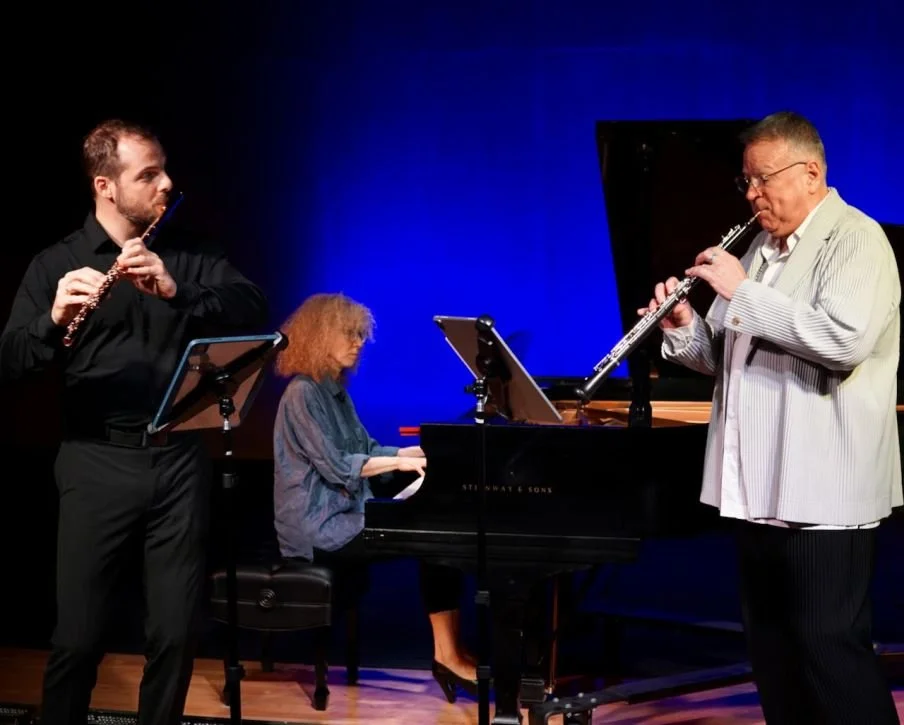
Nadia Boulanger heard Stravinsky’s subversion of powdered wig conventions, then misinterpreted it as nostalgia for order: and so France’s peculiar strain of neoclassicism was born. Mistake or not, it was popular enough to be the presiding transatlantic style during the mid-20th century. Dapper and beguiling, it also sometimes sounds like organized fun, which is probably why its melos, by way of Alexandre Desplat, so impeccably provides the aural background for Wes Anderson’s aseptic dollhouses.
Taken in doses, however, such as was offered by Camerata Pacifica last Tuesday, French neoclassicism can be refreshing, even salutary.
Madeleine Dring, whose Trio for Flute, Oboe, and Piano opened the program at the Huntington Library, wasn’t actually French (she was from the other side of the English Channel). She also wasn’t a member of Les Six, even though her Trio would've qualified her as an honorary member. Composed late in Dring’s life — she died unexpectedly less than a decade after its completion — it’s full of the harmonic side-slips, off-kilter rhythms, and in the central movement gentle mélancolie that would’ve drawn an approving smile from Poulenc.
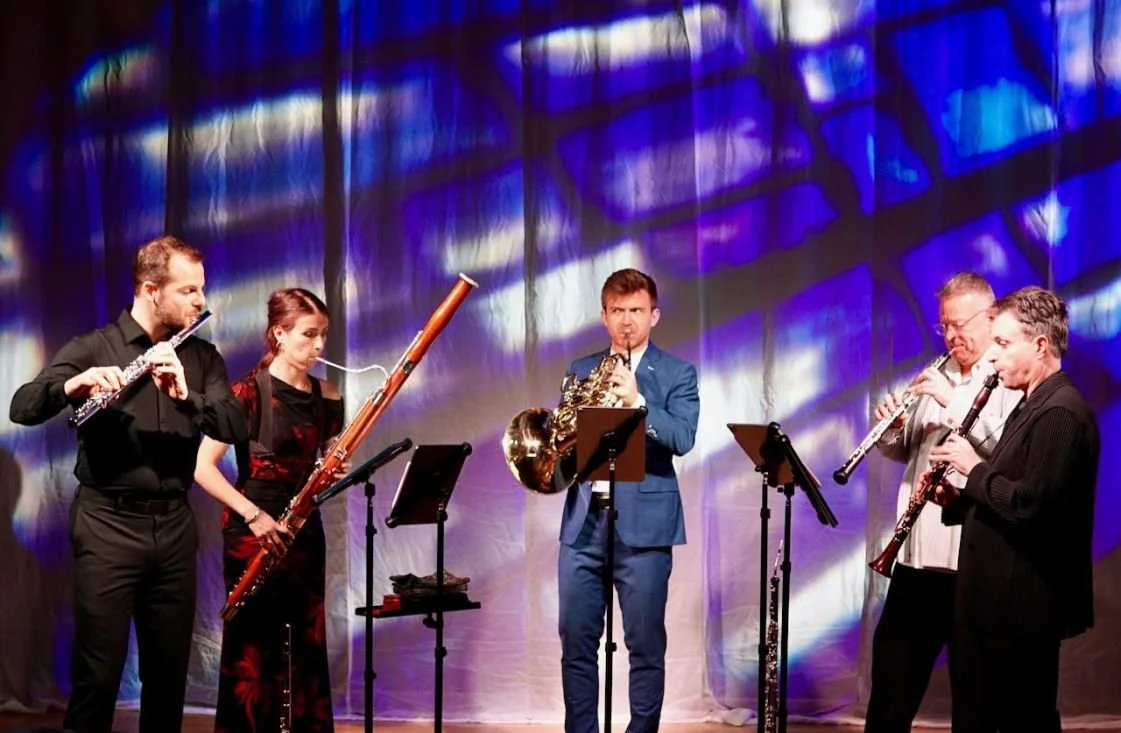
From left to right: Sébastian Jacot, Eleni Katz, Ben Goldscheider, Nicholas Daniel, and José Franch-Ballester play David Bruce’s Natural Light. [Image: Camerata Pacifica]
David Bruce was barely an adolescent when Boulanger was breathing her last, but his Natural Light for wind quintet bears traces of the grand dowager of French music’s legacy, most of all in its transparency and easy-going mood.
Cast in five movements, the work was, according to the prefatory remarks by Camerata Pacifica artistic director Adrian Spence, inspired by the stained glass windows in Barcelona’s Sagrada Familia, abstracted versions of which were projected onto a screen behind the musicians during the performance.
For the musical material itself, Bruce delved into the interior of Gaudí’s basilica for more direct influence on his Natural Light, namely Gregorian chant, heard in the monodic outer movements. There were also what sounded like stylized Catalan folk dances and tunes in the inner movements, escorted along by rowdy foot stomps in the second movement. A softly tolling tam-tam was an evocative framing device.
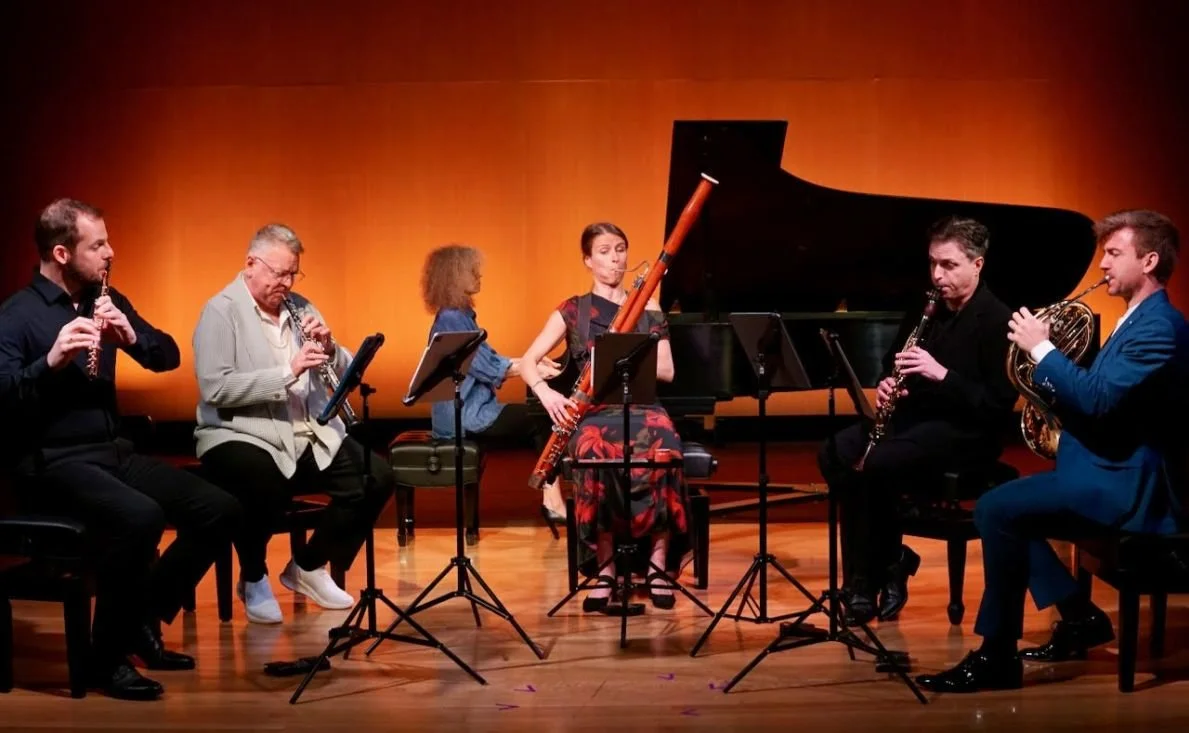
Members of Camerata Pacifica playing David Jolley’s arrangement of Dvořák’s Piano Quintet No. 2 [Image:Camarata Pacifica]
If not “rowdy”, then David Jolley’s reimagining of Dvořák’s Piano Quintet No. 2 as a Sextet for winds and piano struck a surprisingly giddy note. Dvořák isn’t exactly known for gravitas, but a wind sextet imparts an altogether different atmosphere to his music than a string quartet. Actually, it sounded like Janáček; as if it were a test run for his Mládi. Even the famous “Dumka” sounded sunny rather than soulful. Jolley’s arrangement of Dvořák wouldn’t be something I’d seek out again — at least I don’t prefer it over the original — but it was skillfully done, even more skillfully executed by the winds of Camerata Pacifica.
Their partner and foil was the pianist Irina Zahharenkova, who had a brief moment to herself playing Cécile Chaminade’s Thème varié, a lovely Mozartian-Chopinesque pastische. Zahharenkova’s fingers caressed and cajoled this music, unspooling its genuine nostalgia for a style that betokens an unspoilt past of Meissen porcelain and Jasperware, probing beneath Chaminade’s salonnière surface.
“Strange”, May Sarton once said, “how much can be summed up in a little tale”.