• Featured Articles
  • Blog
  • Essays/Reviews
  • Interviews
  • Reseñas y artículos selectos en castellano
  • Other Things
  • Contact
Menu

echorrhea

Street Address
los angeles
Phone Number

Your Custom Text Here

echorrhea

  • Featured Articles
  • Blog
  • Essays/Reviews
  • Interviews
  • Reseñas y artículos selectos en castellano
  • Other Things
  • Contact

Concert Review: Colburn, Salonen's "good vibes" Bruckner and more at Royce Hall

January 27, 2026 Néstor Castiglione

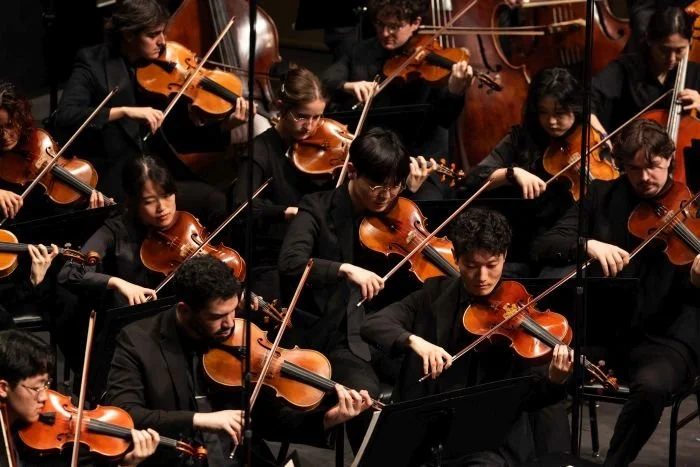
Members of the Colburn Orchestra last Saturday at Royce Hall [Image:Brian Feinzimer]

Esa-Pekka Salonen, who was wrapping up his latest visit to Los Angeles, and the Colburn Orchestra drew the crowds to Royce Hall last Saturday. Standing at the head of the program were two emerging young musicians, both of them Salonen Conducting Fellows. Comparatively unknown for now, their talents have them poised to achieve wider recognition of their own.
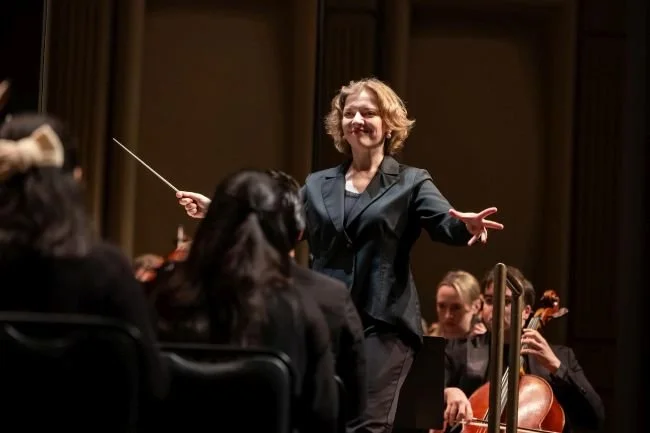
Melaniuk conducting the Colburn Orchestra [Image:Brian Feinzimer]

The Polish-born Aleksandra Melaniuk took the stage first in a sweeping performance of Liszt’s Les Préludes, a former repertoire warhorse whose reek of mothballs most modern-day performances have difficulty in dispelling. Not here.

Melaniuk dug into the introduction, drawing rich tone from the Colburn cellos and basses. Against this background emerged the famous fanfare, cresting above the orchestra incisively played. Throughout the performance Melaniuk displayed an impressive sense of blend, as well as a knack for convincingly supple phrasing. She steered the orchestra through carefully gauged rubati in transitions, not to mention stunningly dispatched hairpin dynamics. Altogether a bold, knockabout performance — major orchestras take note.
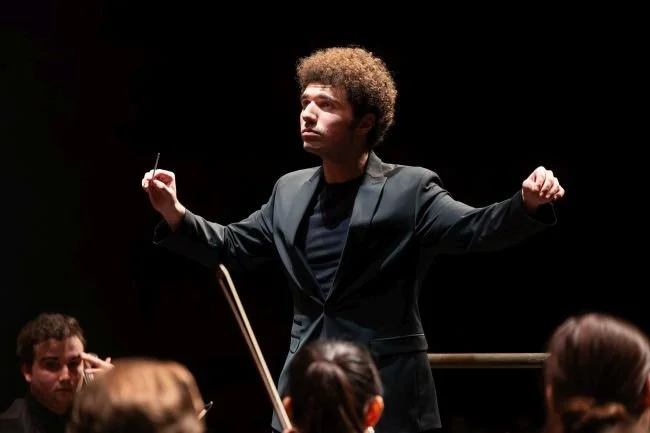
Yalniz conducting the Colburn Orchestra [Image:Brian Feinzimer]

Her German-Turkish colleague, Mert Yalniz, displayed his own multifaceted abilities with his impressive conducting of his own Limit: A rollicking piece that thrives on swift changes of moods and textures, riding climax after climax, all of it sumptuously scored. Yalniz certainly knows how to push his orchestra to the limits.

It’s also a fascinating example of Gen-Z new music. Yalniz’s predecessors don’t seem to be Schoenberg or Stravinsky, but various composers of music for films, trailers, and video games. Even the later RCA discography of Esquivel seemed to hover over the clashing ethnic colors in Limit.

More familiar territory, in the guise of Bruckner’s Fourth Symphony, awaited the audience after the interval, but Salonen kept the music fresh. Attacks were crisp, textures lucid; tempi, never pressed unduly, nonetheless moved along.

The Colburn Orchestra responded readily to Salonen’s treatment, piling onto climaxes with enthusiasm. They also knew when to turn up the finesse, especially in those broad passages wherein Bruckner transports his listeners into his enigmatic personal meditations. His famous luftpausen, too, were taken in unified breaths by orchestra and conductor, conveying the music latent within those silences.

Long an idiosyncratic interpreter of Romantic-era music, Salonen’s performance was more Laurel Canyon good vibes than Sunday service introspection. Adroitly realized by the Colburn Orchestra, Royce Hall resounded with a Bruckner Fourth for our time.
Tags esa-pekka salonen, aleksandra melaniuk, mert yelniz, salonen fellows, colburn orchestra, franz liszt, anton bruckner, royce hall
Comment

Concert Review: Levit plays Busoni's Piano Concerto at Disney Hall

January 19, 2026 Néstor Castiglione

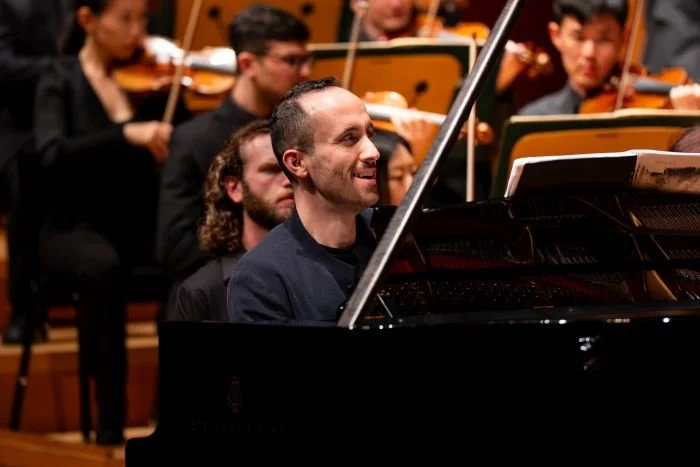
Igor Levit playing Busoni’s Piano Concerto at Disney Hall [Image:Elizabeth Asher/Los Angeles Philharmonic]

Spanning five movements that last over an hour, Busoni’s Piano Concerto is the apotheosis of the genre; a Sebaldian commentary on the piano, its mythos, as well as personal reflection on its composer’s sense of self. For once the informal adjective is apt — this music is epic. How else to describe a piano concerto that concludes with a chorus?

Just as epic was Los Angeles’ wait to finally hear the thing. More than a century passed until Grand Avenue resounded with Busoni’s monument to the piano, unleashed by guest super-virtuoso Igor Levit at last weekend’s Los Angeles Philharmonic concerts.

Preternaturally endowed to play Busoni’s Piano Concerto, Levit displayed his three-dimensional mastery in full. After the concerto’s Brahmsian opening, with songful solo horn soaring over the strings, Busoni hardly gives his soloist a moment’s rest. Colossal chords, massive tapestries of arpeggios and scalar runs, long passages of Chopinesque cantilena all were the vehicles which testified to its composer’s protean creativity, not to mention served as displays for the soloist’s Horowitzian wizardry. In some ways he goes beyond that. Levit’s pianism is brainy as well as dazzling — a uniquely 21-century kind of virtuosity.

In the ruminative third movement, he brought to the fore his opulent tone, convincing shading, and telling coloring of interior voices. Even in fearsome passages of rapid fingerwork, the pianist’s observance of each note’s full value ensured their individual sparkle and overall clarity. But there is also something more, an appealingly argumentative quality about Levit’s playing that surpasses mere interpretation. He is that rare pianist whose playing not only conveys the music, but also a running commentary on it.

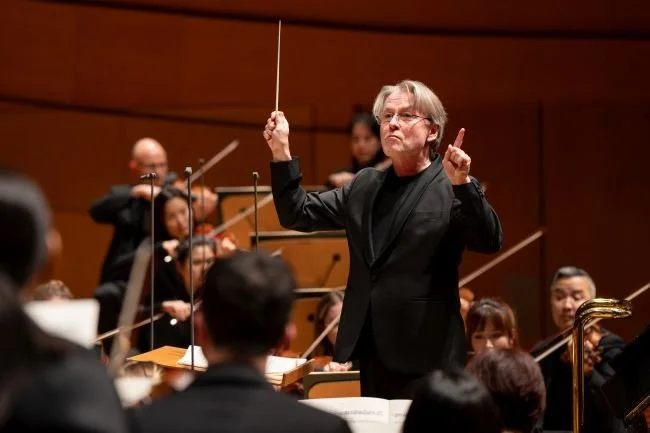
Esa-Pekka Salonen [Image:Elizabeth Asher/Los Angeles Philharmonic]

Busoni and Levit found a matching virtuoso unit in the Los Angeles Philharmonic. Conducted by Esa-Pekka Salonen, the orchestra played with the exactitude and chrome-plated polish that is his trademark. Their individual components were no less breath-taking, such as the concerto’s hectic bassoon passages that, led by principal Donald Crockett, were executed with the sureness of an Olympic athletic team.

Salonen has evolved since the days of his youthful idiosyncratic interpretations of Romantic music. Sleekness and precision remain the foundations of his style, yet as long passages of the opening movement and finale proved, he has developed a willingness to yield, to mold phrases for rhetorical emphasis. He also proved an ideal partner to Levit: pianist, orchestra, and conductor worked as if they were all parts of a single body.

This was especially striking in the penultimate “All’Italia” movement, a bracing, motoric tarantella that in this performance was as much showpiece as it was a statement on Busoni’s pride in his mixed parentage — a foreshadowing of the world yet to come.

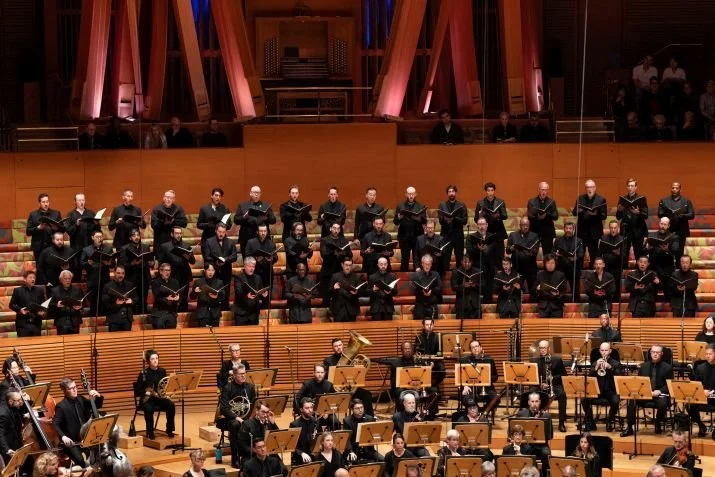
The Los Angeles Master Chorale during their performance of the “Cantico” [Image:Elizabeth Asher/Los Angeles Philharmonic]

Remarkably, the “Cantico” finale largely sees the soloist step aside from its own starring role. The men of the Los Angeles Master Chorale took the lead in Busoni’s Goethian invocation of eternity, which surely must have been ringing in Mahler’s ears as he penned his Eighth Symphony. Busoni here recounts the piano’s role as accompanist and here Levit, together with the Philharmonic, carried the voices aloft, soaring together until the concerto’s ecstatic final bars engulfed Disney Hall.

Tags ferruccio busoni, igor levit, esa-pekka salonen, los angeles philharmonic, piano
Comment