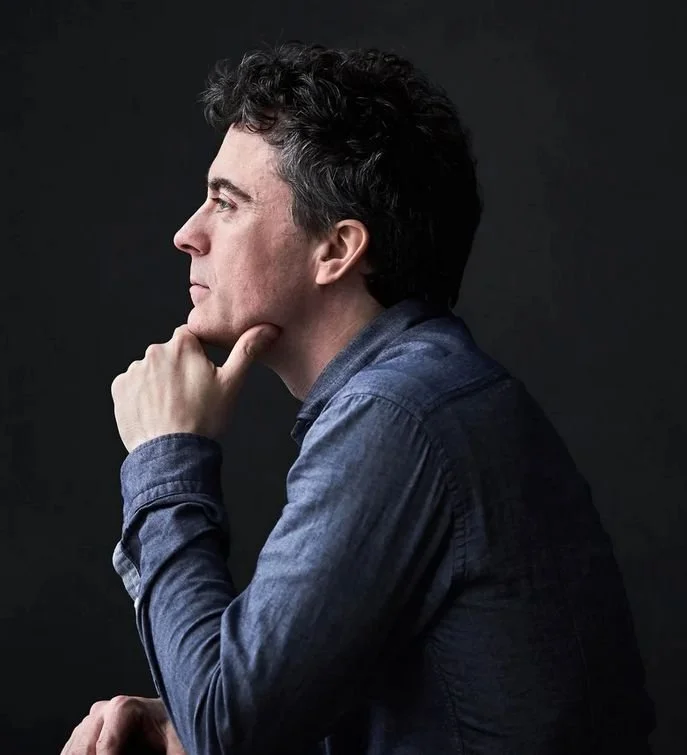
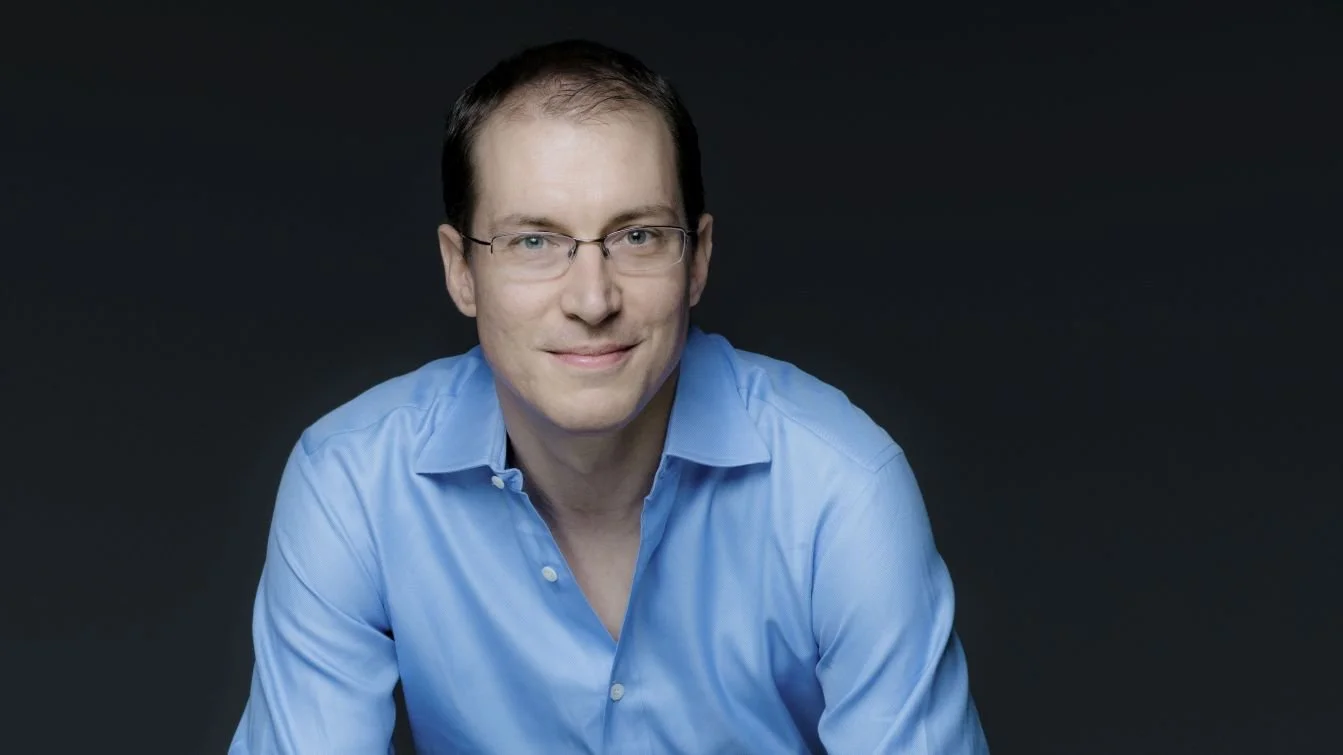
Last January, as I sat listening to a performance of some Beethoven sonatas at the Huntington Library’s Rothenburg Hall, something Georgy Sviridov once said bubbled up in my mind:
I couldn’t imagine anyone [else] playing with such taste, power, simplicity, and grandeur — just the way Beethoven ought to be played… So it’s true: music can be a loftier thing than all that stuff cranked out … by vapid carnival barkers.
Sviridov, of course, has been dead for nearly 30 years and, in any case, had someone else in mind. But I suspect that had the Russian composer still been among us, he would’ve thought much the same about Gilles Vonsattel’s playing on that chilly night in San Marino.
A laureate of the Naumburg Prize, Vonsattel has spent his life in the company of Beethoven’s music, something that is immediately evident in his balance between architectural control and expressive strength. The pianist’s playing of Beethoven is free of overwrought contrivances. One hears not an “interpretation” but something like the expression of nature itself; resounding untrammeled, raw, and breathtakingly beautiful from Vonsattel’s fingers. Art enfolds art here, for that illusion of spontaneity depends on the exceptional intellectual and technical resources of a sensitive musician. No mean feat this. As the Swiss-born pianist told another journalist back in 2014, “The rhythm of what I’m doing is very intense.”
Artur Schnabel remarked that Beethoven’s sonatas were better than they could ever be performed, so when during the course of the interview I brought up a flippant quote that Vonsattel’s younger self had casually made to the press, he laughed it off. Yet something of the directness implied in that comment, as if he and Beethoven were on a first-name basis, endures in the Vonsattel’s mature artistry.
Last week, the pianist spoke with me over the phone, between practice sessions, including for his forthcoming Beethoven recitals for Camerata Pacifica. The performances on Friday and Sunday, are the next in the pianist’s continuing cycle of the composer’s piano sonatas.
***
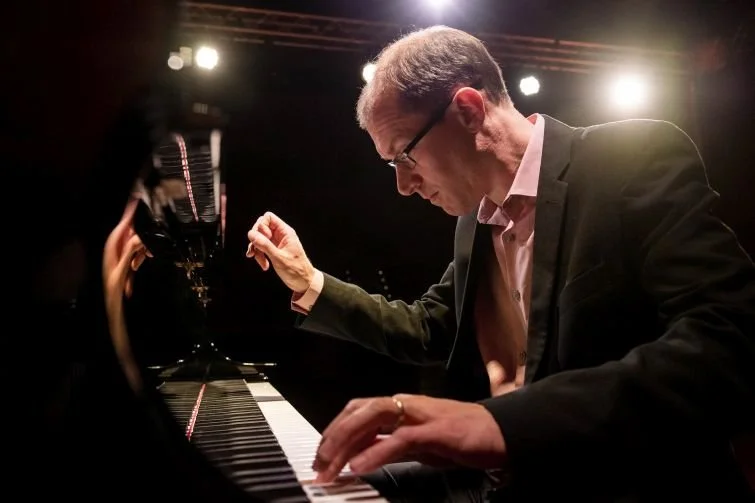
Gilles Vonsattel [Image: Camerata Pacifica]
Néstor Castiglione: Southern California is very lucky to have you play all the Beethoven sonatas over the next few years. It’s been a while since we’ve heard them as a cycle. I was reminded of something you told the Salt Lake Tribune in 2002: “With Beethoven, I can sit back and enjoy it while I’m playing.” Do you still feel that way about his music?
Gilles Vonsattel: No! I no longer feel that way! Absolutely not. There’s an element of structural control in even Beethoven’s small-scale efforts that I’m much more aware now in my 40s than in my 20s. There is this need to hold the music together. Nothing in Beethoven's music is taken for granted. His music follows this principle where development springs from the smallest ideas, either composing something immense or compact. Which means a pianist really has to sit there and imagine being in the composer’s shoes. For the audience, too, it’s really important for them to get a sense that the piece is being composed right before them in real time.
N. C.: You talk about that sense of control even in small works. How do you convey to a listener that they should listen deeper to a piece that may sound simple on the surface?
G. V.: There are different layers of engagement that happen for me: the initial layer of simply playing it. Then you have to start considering a lot of questions. A movement like the [first movement of the Piano Sonata No. 19 in G minor, Op. 49, no. 1], an “Andante” — that’s an ambiguous tempo. Is it going to be moderately flowing? Can it be quicker? What can be exploited by choosing a slower tempo? What mood are we creating? What sonorities are going to be highlighted? Beethoven also moves so easily between homophonic and polyphonic textures. How should those be conveyed? If one tries playing everything at a uniform tempo, it sounds too simplistic. His music also requires a lot of tempo control. How does one deal with that? These questions multiply the deeper you get as an interpreter. For me, I’m much more aware now of how hard it is to convey musical character and nuance to an audience. It’s one thing to believe you’ve accomplished that, another for the audience to actually feel that message. In the “Waldstein,” it should be clear to a listener what an exciting ride that music is; its dimensions are epic. But in a smaller and more ambiguous work like [Op. 49, no. 1], it can be very tricky.
N. C.: Hearing you play it in January, I can tell you that the quiet intensity of that deceptively simple sonata reached the very back of the hall. Playing Beethoven’s sonatas in a cycle has its own challenges apart from playing them as individual works. How familiar are you with each one?
G. V.: Every pianist in the tradition of [Beethoven cycles] encounters these works early on, when they’re still students. They open up your vocabulary of playing and introduce you to classical forms. A lot of young pianists, for example, are introduced to the “Pathétique” sonata, which I’ll be playing at my next recital, because it establishes the Beethoven “C minor mood”, that atmosphere you hear in the Fifth Symphony and so on. There’s a lot of early sonatas that pianists play. And maybe if one’s talent develops enough, you’re given the “Appassionata” to learn. I learned it at 15; it was so thrilling and so much fun to play. At the time, I just loved playing for people, and that thrill, more than anything structural, was so appealing. I was very lucky to have had a great teacher to guide me through it. Because of its drama, its contrasts. And that’s why Beethoven’s middle period is so well known, so popular. You can play this music to anybody without giving them any background and its power comes through. It has universal themes and ideas we can all connect with. So over the years, I’d add a sonata or two to my repertoire. But I certainly didn’t know all of them when [Camerata Pacifica] asked me to play them in a cycle. When we talk about all 32 of Beethoven’s sonatas, they are absolutely not created equal. It’s like scaling a mountain range — and sometimes you can fall off the cliff and die!
N. C.: And even within a particular period there can be enormous differences.
G. V.: Absolutely. Beethoven also by that point took much longer to compose sonatas and he wrote them less frequently. His rhythm of writing them at the piano was changing. The music was, perhaps, more costly for him somehow to create. A lot of my work has been a triage situation. I had played Opp. 110 and 111, but I hadn’t played Op. 109. I had played Op. 101, a very challenging sonata, only a few times. There is another thing that one has to address — that the perception of difficulty isn’t necessarily the truth. For example, somebody might hear the “Waldstein” and come away thinking it must be one of the most difficult things to play. And while I don’t think anyone would call it “easy,” Opp. 101 and 106 are orders of magnitude more difficult. But not in a way that the audience might be able to tell.
N. C.: That anticipation of Schumann in Op. 101, whose individual movements sound like precursors to his charakterstücke, must be a challenge to make into a unified statement.
G. V.: Yes. You have this dream-like opening that makes you question what exactly is happening. Then there’s a canon in the trio. What does this succession of moments mean?
N. C.: Then there’s the challenge of playing music which is so beloved, like two of the works being played in your next recital. Back in 2014, you told the Springfield Republican that, “There is so much expected of us in the age of recorded music.” That’s especially true when you play something like the “Pathétique” or the “Appassionata,” isn’t it?
G. V.: I think it’s helpful to play works like that in the context of the cycle. Because when heard and played that way, it really helps you to understand what is going on there. The creation of the Beethoven “C minor mood” [in the “Pathétique”], the jarring contrasts between the “Grave” introduction and the propulsive “Allegro di molto e con brio.” Then there’s the slow movement. A few months ago, I heard Beethoven’s Ninth Symphony and could hear in the slow movement the bass line from this sonata’s slow movement. There’s the odd, ghostly finale. There are a lot of things that are still surprising, even now, in the context of his creative career. It’s really important above all that performing this cycle helps to ward me off clichés. If you ask me whether I’d program the “Pathétique” outside this cycle, I likely wouldn’t have. Just because, unfortunately, it’s a piece often assigned to gifted students, which has condemned it as being kind of overrated in the repertoire, something the sonata doesn’t deserve. When I was examining all the sonatas, I can’t say I was thrilled to look at it, but now I’m really getting a lot out of it. It’s an amazing work. It’s so balanced, the way its movements refer to one another. I have a newfound appreciation for it. The “Appassionata”, because it’s unabashedly in Beethoven’s “heroic style” — I don’t think I’ll ever get over the fact that I get to play that. It’s just so wild, so thrilling.
N. C.: It’s interesting that you chose to perform these sonatas with another that is a relative obscurity to most listeners. Playing the Piano Sonata No. 13 “Quasi una fantasia,” Op. 27, no. 1, must require a rather different approach.
G. V.: On this program, the “Pathétique” in a way is the only true exemplar of Beethoven’s early period. There is this transformation in Beethoven that occurs. After he finished Op. 22, a work that marks the conclusion of his post-Haydenesque music, he wrote, “I must seek new paths.” You also have his impending personal crisis, his deafness is worsening, there’s a lot happening in this period. And that’s when he begins composing these extraordinarily experimental sonatas, of which we’ll be hearing two [next recital], Opp. 26 and 27, no. 1. This is really a key moment of him trying things out. The latter is a piece that is through-composed in its totality; each movement flows into one another. You also hear something of the fragmentation that is more prominent in the late music, these mercurial shifts in mood and textures that jump from one to the next, then concludes with a tiny coda. This sonata’s structure is very special. If one were to drop the needle on any one of these moments in the work, a listener won’t hear anything so shocking as can be heard in some of Beethoven’s other music, but his choices in how he maps everything out is really revolutionary. This sonata forecasts Op. 101; a lot of things that happen in the later work could be traced to this sonata composed in 1801. Playing and listening to it can be a little like sitting in somebody’s workshop. Really the process of how the piece was composed is part of the performance.
N. C.: You sound like a man in the fresh throes of love for this music.
G. V.: I really have not been fatigued by this music. Its inspiration is inexhaustible. And if I could meet my 21-year-old self who said the quote you cited at the beginning of this interview, well, I’d take him aside and talk to him patiently.
***
Gilles Vonsattel’s next installment in his Beethoven cycle for Camerata Pacifica will take place Friday, March 20, at the Music Academy of the West’s Hahn Hall in Santa Barbara, then Sunday, March 22, at the Colburn School’s Zipper Hall in Los Angeles. For tickets and more information, please click this link or call Camerata Pacifica at (805) 884-8410.