
One of the most memorable experiences in my musical life occurred in spring 2012, at a chamber music concert at the Huntington Library. The concert was an eclectic one: a program of music by Claude Debussy, Takemitsu Tōru, Richard Rodney Bennett, and Iannis Xenakis, concluding with the mighty Piano Quintet by Dmitri Shostakovich. All of the works were known to me, save for one: Dmaathen for oboe and percussion by Xenakis. “Difficult” music is where I started as a listener, so it was (and still is) very dear to me, but the work of the Greek composer had never interested me. Too obtuse, too concerned with complex compositional processes for their own sake. That night, however, oboist Nicholas Daniel playing for Camerata Pacifica that night did something that one longs for so often in concerts: He gave a performance of such technical and emotional potency that it became a transformative experience. That’s why today I’m a passionate admirer of Xenakis.
Those kinds of experiences are rare, but Camerata Pacifica seems to have discovered the alchemy to realize these as if on demand. This is no fluke. Camerata Pacific has gathered some of the most preeminent musicians in the country. Each concert is characterized by the sort of superlative level of musicianship that stands at the very best one can hear anywhere in the world.
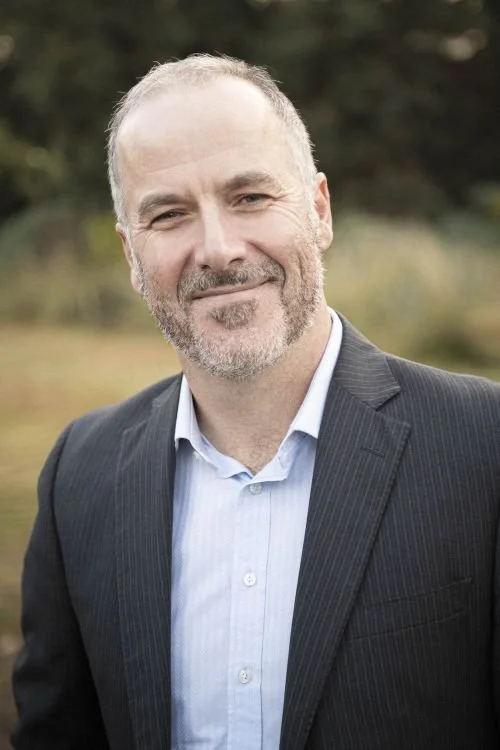
But what takes these musical experiences into another plane is the vision of Adrian Spence, Camerata Pacifica’s founder and artistic director. There is a three-dimensional quality to his programming, a sense of music transcending the boundaries of art and lunging into the living world of our everyday.
Beginning tonight at Zipper Hall and ending next Tuesday in San Marino, Camerata Pacifica will be performing its final concert of this season, comprising of music by Beethoven, Thierry de Mey, Kenji Bunch, and the final symphony of Shostakovich, the latter presented in a chamber arrangement which will be heard in California for the first time in these concerts.
Last week I had a wide-ranging interview with Spence, a conversationalist whose breadth of thinking and sheer energy is betokened by the programs he assembles for music lovers in Southern California.
***
Néstor Castiglione: If there is a single quality that characterizes what Camerata Pacifica is about, I’d say it’s “expect the unexpected.” Or the kind of experience that Artur Schnabel described as “safety last.”
Adrian Spence: Those are the things I aim for as artistic director because I believe that the canon has to be put into context. Especially in something like this Beethoven sonata cycle [performed by Gilles Vonsattel]. At first I thought to myself, “Well, I don’t want to be one of these people that puts on another Beethoven cycle.” The reception history around him has made him so iconic, so people don’t hear how radical his music was. Doing this cycle of his piano sonatas the way we’re doing it — using a hybrid model that mixes some of the sonatas with other works, as well as all-Beethoven recitals — and when you get to hear these sonatas, especially the ones people don’t know, the lesser known ones — they’re still genius! When you hear them next to other Beethoven sonatas, when you hear them in context with chamber music by other composers, you’re reminded that Beethoven was single-handedly changing the direction of music of that time.
N. C.: Speaking of “changing the direction in music,” you chose the right work to initiate that sonata cycle.
A. S.: We opened the whole project with the “Hammerklavier.” Gilles just came out and started playing that. And then at the next installment, where the big pieces on that program were works by Schubert and Schumann, and Beethoven’s music in that program had a supporting role, that to my ears was revelatory to hear Beethoven like that.
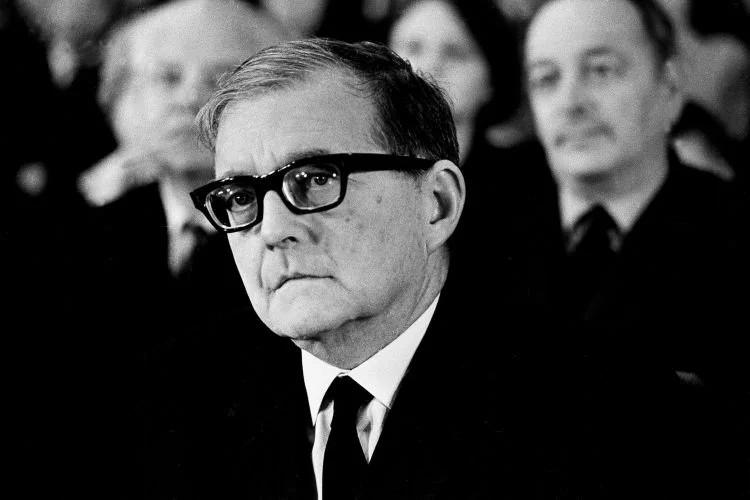
Dmitri Shostakovich, circa 1970s [Image:Wikimedia Commons/User:Roman Kubanskiy]
N. C.: Here in this forthcoming concert you pair him with Shostakovich, whose music continued that line of musical thinking.
A. S.: Yes. Beethoven and Shostakovich go together so well, in terms of their approach to form, their intensity of expression. People often link Beethoven and Brahms similarly. I have to be careful with this criticism, but to me Brahms only looks back to Beethoven. Brahms is often seen as the logical evolution in this history, but to be quite honest I’d be happy to skip that part of the evolution! What Schubert and Mahler did, for example — that was so much more interesting. Shostakovich, on the other hand, acknowledges Beethoven, but his music had a forward-looking, reactive, acerbic quality that doesn’t exist in Brahms.
N. C.: It’s interesting that you begin this program with a work by the young Beethoven and conclude with a Shostakovich symphonic valedictory that was completed only four years before his death.
A. S.: Think about Beethoven, who lived in a constant state of war. It was raging around him all the time. Vienna was twice occupied when he lived there. There was this remarkable instability in Europe in the late-18th century — not so different from the kind felt the world over now — and yet, from all that chaos, there emerged this beautiful music. And no matter what Shostakovich work is on the program, it’s replete with metaphor and symbolism. We all know what his life was like.
N. C.: How did you come to discover Viktor Derevyanko’s arrangement of Shostakovich’s Fifteenth Symphony?
A. S.: I was talking with the violinist Paul Huang, who also runs a music festival in Taiwan. He asked me, “Hey, do you know this arrangement of [Shostakovich’s Fifteenth Symphony]?” And I was like, “No — tell me about it, send the score!” That happened about three years ago. When I learned the music, I knew that it was a keeper.
N. C.: It was immediately apparent that it’d be a good fit for Camerata Pacifica?
A. S.: You know, there are times when I come across pieces of music and can already hear how the musicians of Camerata Pacifica will play this, I can hear their colors. They’re phenomenal artists and they get lots of rehearsal time. So we know this performance will be tight and characterful.
N. C.: The emotive scope of the music — ranging from spine-chilling gallows humor to utter disconsolate tragedy — is also not only the kind of thing that Camerata Pacifica does well, but seems to get a response from listeners.
A. S.: Imagine being a listener new to the piece and listening to the first movement, then suddenly there it is — the Lone Ranger. That’s a WTF moment! So if you’re a thinking person, you’re going to be struck by that and wonder what it’s all about. You may not get the other references, but you’ll get the Lone Ranger. So there’s a reason this symphony was programmed at the end of the season; the fact that it’s Shostakovich’s final symphony, that it speaks to listeners on so many levels. Yet it’s also a fun piece.
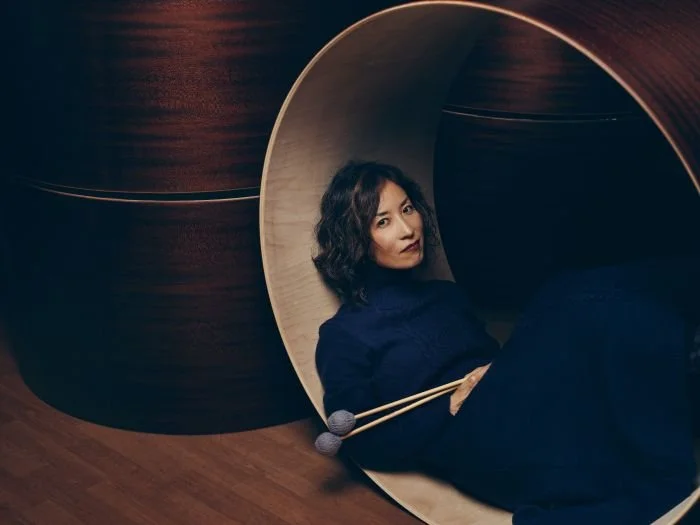
Percussionist Ayano Kataoka [Image:Ayano Kataoka]
N. C.: Your program also implies that there’s more going on there than just fun.
A. S.: So I think as a programmer at this point in time in the 21st century, I feel a responsibility for [Camerata Pacifica’s] programming to be aware of the times we’re in. I don’t necessarily want to be overt about it. Even talking about this with you gives me a bit of pause. While I’m happy to share what my thinking is, I want our audiences to draw their own connections. It is part of the job of an artist working in a serious art form, of a music director, of musicians to reflect the times in music, to contextualize it within this time. To at least acknowledge the time that we’re in. This might be too straightforward, but I think it’s also important to program music by Russian composers at this moment. Delving into it a little deeper, there is this connection to Beethoven. So we begin the program with Beethoven’s [Piano Sonata No. 2]. Early Beethoven, late Shostakovich — that pairing seemed easy. But how to get from A to B? And we have all these percussionists [for the Shostakovich]. Then Huang commissioned this piece from Kenji Bunch, Transcontinental, for violin and percussion quartet. And this is also going to be a fun piece of music. Anytime you put musicians on stage who make their living from pounding the hell out of stuff it’s going to be great fun. Percussionists always make things fun. Bunch has written this piece and its message isn’t covert: It’s about the Chinese people who constructed this nation’s railways. There is meaning in that. Today we have a richness of chamber music that represents a wide breadth of expression from all kinds of cultures, whatever their genders. It’s a richness that, now that we’re 25 years into the 21st century, seems unending. Then there is Thierry de Mey’s Musique de table, the pivot of the concert. Its placement answered a question: How to steer the ship of this program towards Shostakovich? This is really my kind of program! I mean, again, it’s a really fun program.
N. C.: Fun and thought-provoking: You wouldn’t think those go together, but reconciling those kinds of extremes seems to be one of the things that Camerata Pacifica is really good at.
A. S.: The wonderful thing about our concerts is that you can just show up without any awareness of these works, not know anything Shostakovich and his life, and just listen to some really cool music. You will not be sorry to have bought a ticket. And if you want, you could take it a little deeper, go back home, pour yourself a scotch, and talk about and debate this music with your significant other. This is the kind of program that allows a listener to take it as deep as they want to go. I have members of the Camerata Pacifica audience who have been part of our family since the beginning. And these programs provoke that kind of thinking, talking, just like you and I are doing now. I’m thrilled about that. That’s what I think a good concert ought to do. Maybe not every one. That measure of gravitas — it would wipe you out. But I think you can come to this music and choose to take it as deep as you want. That’s the difference between art and entertainment.
***
Camerata Pacifica’s final concerts of the season begin tonight at Zipper Hall in Downtown Los Angeles, followed by concerts on May 15 in Santa Barbara, May 17 in Thousand Oaks, and may 19 in San Marino. For tickets and more information, please visit Camerata Pacifica’s website or call (805) 884-8410.