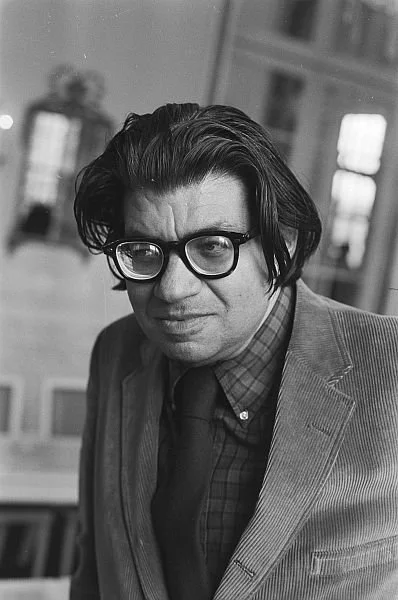
Earlier today I spent a pleasant morning reading Ryan Dohoney’s Morton Feldman: Friendship and Mourning in the New York Avant-Garde; an excellent book and quick read. It had been on my “to buy” list for some time and because of the forthcoming Piano Spheres recitals commemorating the composer’s centennial, now seemed a good time to pull the proverbial trigger.
The book is about the webs of friendships that sustained Feldman, his peers, and how these became objects of mourning in his late music. It also touches upon a number of other interesting related subjects. One of them is addressed at the very start of the first chapter, with an extensive quote by Feldman from a lecture in 1967:
When one begins to work — until that unlucky time when it is no longer involved with just a few friends, admirers, complainers — there is no separation between what you do and who you are. I don’t mean that you hope what you are doing is real or right. That is not the question. You work. The work leads to a concept of music that draws attention. You soon find yourself in the world. Maybe not for the right reason — but you find yourself in the world.
Yet there was that other “world” — of conversation — of anonymity — of seeing the paintings in the intimacy of the studio and not in a museum — of playing a new work on the piano in your home and not the concert hall — of the hours spent walking, eating, and talking with John Cage and not wondering if I should fly to Paris from London in order to spend a few hours with him in arrogant crowds of people. Nothing lasts.
“Even with his burgeoning success, Feldman longed for the past”, Doheny summarized. “Publicity yielded estrangement”.
Feldman’s quote chimed with another near the end of the book, wherein he explained to Philip Guston how he sought to create a music unburdened by the weight of music history, of centuries of reception that explicitly and implicitly indoctrinated composers and listeners alike into linking musical gestures with ready-made associations. Or what Feldman called “fifteen-hundred years of goddamned references”. The trajectory of his life and work was trained on reaching that goal, but along the way he inadvertently created new references, sometimes in unexpected contexts that have been felt beyond his life and art in general.
Could Feldman have anticipated that the corrosive properties of professional renown would have wider implications beyond what he imagined? Consider the ongoing process of gentrification and economic stratification in one of its most visible flashpoints: the Lower East Side of New York, an enclave that historically was the domain of immigrants and the working poor. It was there that Feldman and his friends lived in the facetiously dubbed “Bozza Mansion”.
Mostly viewed as a 21st-century phenomenon, gentrification began in the immediate postwar years, when low income areas in large cities began to attract young artists and intellectuals still vying to establish themselves. These early gentrifiers differed in some crucial ways from their later successors; many of these postwar bohemians were not much better off economically, if at all, to the long-term residents they joined. Feldman himself was the son of an immigrant whose clothier business was forced into bankruptcy. The composer, his Eisenhower-era social milieu, and the yuppies of today, nonetheless, share important traits. Their perception of depressed urban spaces as a source of “authenticity”, for one, and their exhibitionist delight in juxtaposing themselves and their lofty aesthetic ideals against dilapidated surroundings.
I was alerted to this by Doheny’s astute observation that the places where Feldman and his friends lived and worked ironically “were offered up for public consumption”. He noted the “prurient delectation” with which Harper’s Bazaar in 1952 presented the “Bozza Mansion” and its denizens to a mass audience; a telling reveal of how postwar artists often were agents working on behalf, not against the postwar consumerism they ostensibly challenged. Their chosen surroundings became emblematic of the New York School, Doheny said, but it could also be said that these artists encoded for mainstream society expectations of the tópos of artistic creation, which they further reinforced by their sometimes self-aware performative bohemianism that became part of the popular iconography of the arts.
But the coveted “authenticity” perceived in low income urban neighborhoods is a finite resource, depleted with each new arrival, until they are stripped bare for developers eager to render their death blow by completing the transformation of an organic entity into yet another anonymous urban landscape, indistinguishable from any other, with streets walled by endless 5-over-1 condos fated to be the tenement housing and rest homes of the future. Despite everything, the vicious cycle continues and replicates itself. As a scholar on the Lower East Side told the New York Times in 2009, “the very history being rubbed out by developers and yuppies is, paradoxically, what draws them to the area”.
Success for Feldman was double-edged: it opened potentials for creative enrichment and material gain, but also for destruction; the latter produced its own “goddamned references” that society draws on to confirm the fertility of artistic soil. The results are neighborhoods like the Lower East Side, or Little Tokyo and Highland Park in Los Angeles; places where economic improvement has come at the cost of lives displaced, meaning disfigured, and the evisceration of collective memory.
The loved ones, places, ways of life that Feldman mourned in his late music, then, become a shared experience; his music a nexus that permits us to contemplate our grief along with his, superimpose our feelings of loss upon his in a continual thanatic palimpsest. When everything that shaped us, everything that established the parameters of living, those countless experiences, places, people that helped us forge identity and meaning are gone, what else remains but to mourn?
As the man himself once said, “nothing lasts”.