
• Featured Articles
  • Blog
  • Essays/Reviews
  • Interviews
  • Reseñas y artículos selectos en castellano
  • Other Things
  • Contact
Menu

echorrhea

Street Address
los angeles
Phone Number

Your Custom Text Here

echorrhea

  • Featured Articles
  • Blog
  • Essays/Reviews
  • Interviews
  • Reseñas y artículos selectos en castellano
  • Other Things
  • Contact

Sound and Place in late Stravinsky

February 3, 2026 Néstor Castiglione

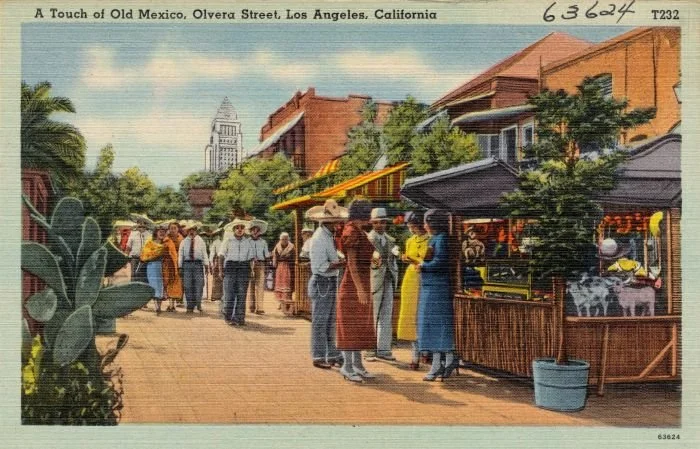
Olvera Street, circa late 1930s/early 1940s [Image:Wikimedia Commons/User:Junkyardsparkle/Tichnor Brothers]

We arrived from Phoenix late this afternoon; the flight back to Burbank lasted barely an hour. Most of our final day was spent driving around, our eyes soaking in as much of the city and its environs as possible before our departure.

For some reason, I kept thinking about the kind of music a composer could compose here. Would the heat, the ubiquitous grackle calls, the rock formations jutting amidst the cityscape, the wide boulevards somehow inform a resident composer’s music?

Donald Vroon of the American Record Guide made a snide comment in some review from over 20 years ago — I no longer recall the exact context; maybe it had something to do with Ernő von Dohnányi? He said to the effect that Florida was hardly an environment to inspire great art. That reminded me of a question once put to Stravinsky during a visit to Chile: did the country provide him with any musical inspiration? (Speaking of “snide”, Stravinsky was a prodigious master of bitchy commentary.)

While I listened to the newest Pentatone CD of Stravinsky’s late music, it occurred to me that this music might’ve sounded quite different — or would’ve never have existed — had its composer chosen to live anywhere else but in Southern California.

From Ventura to Riverside, the region today is relentlessly subjugated by human development. Hard though it may be to believe, especially to recent transplants from elsewhere, this urbanization, especially in the San Gabriel Valley and Inland Empire, is relatively recent. There were unpaved streets well into the 1990s in Highland Park, where I was born and raised. Turn back the clock a couple of more decades and the contrast with today’s Manhattanization is even more dramatic. Jack Webb shows like Adam-12 and Emergency! reveal an environment that resembled the Midwest more than the East Coast, even in neighborhoods within the radius of Downtown. In the 1950s and 1960s, parts of the Greater Los Angeles area were still untamed enough that they plausibly served as rural backdrops in Perry Mason and The Andy Griffith Show. 

So in 1940, when Stravinsky became a permanent resident in Los Angeles, he found a city that, geographically and, to an extent, culturally, was the furthest away he ever settled beyond his known world. He was far from the observation posts on the Old World in the East Coast, let alone the European capitals where the composer once strode through as a magnate.

It was Agatha Fassett, I think, who once said that among the aspects of American life that most chafed her teacher Bartók was the inescapable smell of chili con carne. Did Stravinsky have similar misgivings about the place that received him as a recent émigré? Or was he energized in some way by a place so distinct from cities like Paris and Berlin; a locale that upon his arrival must’ve looked like a cowtown overrun with tamale carts, improbably wedged between desert, mountains, and a Mediterranean coastline?

Stravinsky hung onto neoclassicism for another decade after he settled in Los Angeles, but almost immediately his American style evinced a break from the preceding French period. Further interesting transformations can be heard on this Pentatone disc, whose program spans Stravinsky’s transitional late-neoclassical and final serial periods. Is there a correlation between the composer’s ultimate development and the possibly concomitant transformation of his adopted hometown from relative backwater into a global cultural capital in its own right?

It’s something I’ll be thinking about as memories of Phoenix recede behind me during my drive up to San Luis Obispo tomorrow.
Tags igor stravinsky, pentatone, daniel reuss, requiem canticles, los angeles, phoenix, agatha fassett
Comment

Stravinsky's Late Music: Put Your Ears to Work

January 30, 2026 Néstor Castiglione

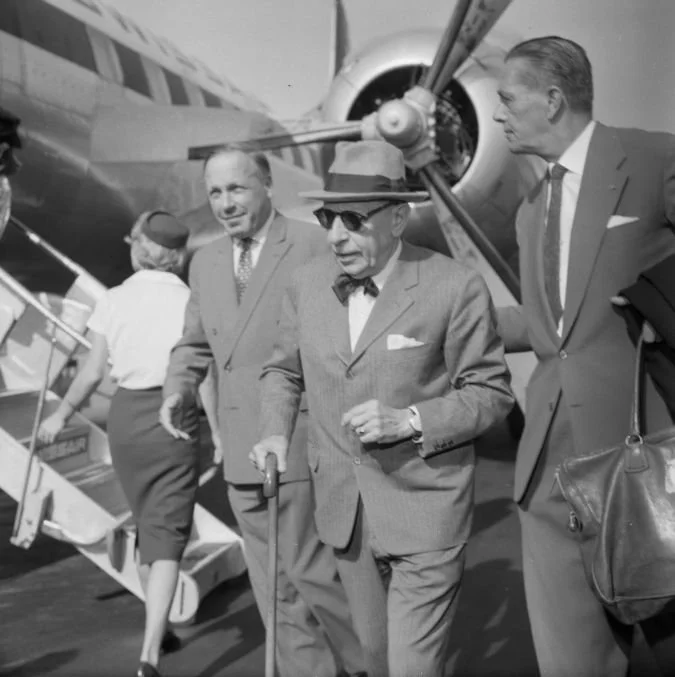
Stravinsky arriving in Zurich, 1961 [Image:Wikimedia Commons/User:Günther Frager/Cornet Photo AG]

I hardly spent a moment at home for most of the day. Went for coffee and a stroll with my mother, then accompanied my wife for errands. By the time we returned home, the sun was setting on another unseasonably warm January day in Southern California. As we approached our driveway, an Amazon driver emerged from inside, rounded the corner, and quickly vanished. And when I approached my doorstep, there it was: the new Pentatone CD conducted by Daniel Reuss.

Stravinsky’s late music is among my most cherished. Recordings of this vital, nourishing music are infrequent; live performances in my area even rarer. A few years ago, Salonen devoted a program to some of these late works in a Stravinsky series he conducted with the Los Angeles Philharmonic. Disney Hall was filled to around 80% capacity. Did these people know what they were about to listen to?, I wondered. Evidently they didn’t. No sooner did the Requiem Canticles begin than the hall started emptying out — conspicuously. Because the program was played without an intermission. An hour and twenty minutes later, only about 30% of the audience remained.

“Stravinsky, after all these years, is still is not very popular with audiences”, wrote Harold C. Schonberg in 1967. “Everybody will say he is the world's greatest composer, and almost everybody will make enormous detours to avoid his music”.

But Stravinsky is one of the greatest composers and his late music among his finest. That most people don’t think so is irrelevant. (A quick browse at the various quack theories, beliefs, “lifehacks”, sociopathic behaviors, and so on that are amplified by social media is enough to make any rational person permanently skeptical of the vox populi.) It took decades for listeners to begin to come around to late Beethoven. So when Milton Babbitt wrote that he didn’t care if people listened, he had a point. Some people will only ever like that which is instantly gratifying — or vetted by consensus. For a serious composer, why even bother trying to please listeners like that? Artistic creation isn’t a democracy, much though people seem to believe it is. That which is beautiful, great, and enduring simply is. If it goes over their heads or they simply refuse to grapple with it, that’s their loss. Art lives on.

Schonberg concluded his essay by predicting that Stravinsky’s legacy would endure because of his impact on music history rather than on listeners. Even if, that achievement alone is a lot more than most composers can ever dream of. And if someone like myself, who did not come from a musical background and dropped out of high school on top of that, can enjoy works like Threni or the Requiem Canticles, then maybe there’s hope for those listeners for whom these works continue to mystify.

All it takes is the willingness to put your ears to work.

Tags igor stravinsky, harold c schonberg, esa-pekka salonen, los angeles philharmonic, daniel reuss, pentatone
Comment