CD Review: Vänskä’s Mahler 7 as Modernist Urtext

The emergence of BIS’ ongoing cycle of the Mahler symphonies under Osmo Vänskä’s direction was, at least to me, unexpected. His rhythmically punchy, excessively accented interpretations would seem to be an ill fit for Romantic music of long-breathed melodic sweep, as it indeed has been in the previous installments of his flawed survey of the Austrian composer’s symphonies. (The less said about his role in Stephen Hough’s Tchaikovsky concertos, the better.) When the symphonies of so many other worthy composers—Roger Sessions, Vagn Holmboe, Gavriil Popov, George Rochberg, et al—are practically screaming for a top American orchestra to take them on a spin to the recording studio, why yet another mediocre Mahler cycle? So the arrival of this present recording of the Mahler Seventh with the Minnesota Orchestra was not exactly an auspicious one. Nor is the work itself considered much of a treat.

The Seventh, as Jeremy Barham reminds the listener in his fine liner notes, is the ugly duckling among the composer’s symphonies, being his least discussed and performed. Though the public has remained cool to the work, cognoscenti such as Schoenberg and Webern agreed with its composer’s high estimation; while decades later, Shostakovich would copy out parts of it for study as he prepared his own Fourth Symphony.

This time around, Vänskä’s approach is an asset rather than a detriment to Mahler, and very much at home in the forward-looking qualities of this tricky score. By digging hard into the startling dissonances of this vast nightscape and letting its incongruities fall where they may, Vänskä presents the symphony as if refracted through the lens of the present; or better still as if an awestruck revelation of a long lost modernist urtext. Although the cumulative effect deliberately focuses on contrasts rather than blend, he deftly navigates the Minnesota Orchestra through the crashing rapids of its shifting moods, managing to keep the whole unwieldy thing from coming apart. 

In the inner Nachtmusiken, orchestra and conductor are carefully attuned to Mahler’s proto-Klangfarbenmelodie orchestration, imparting edgy tension to the Nachtmusik I and Scherzo which are often glossed over. The symphony’s starlit serenade in the Nachtmusik II, for once and correctly so, is kept from dissolving into the treacle ordinarily heard; its sentiment instead recalling the “masculine tenderness” that elicited Beecham’s admiration in Mozart’s music.

Equally revelatory is the symphony’s knotty finale, wherein Vänskä steps aside and lets the listener decide for themselves what all its bustling noise means. Is its merry-making sincere, or is it a spiritual progenitor of the unsettling cavalcade to come at the end of Nielsen’s much later “Sinfonia semplice?” No matter. Its festive glitter becomes a concerto for orchestra, a triumph for Mahler, as well as an occasion to celebrate a partnership between orchestra and conductor which for the past 17 years has been one of the great success stories in American classical music. 

Whether you know this symphony well, or consider yourself one of its many detractors, you owe it to yourself to hear this fresh perspective on a problematic score.

Beautiful and strange: Osmo Vänskä and the Minnosota Orchestra’s traversal of Mahler 7.

Beautiful and strange: Osmo Vänskä and the Minnosota Orchestra’s traversal of Mahler 7.

CD Review: Urbański’s Strauss for the soyboy generation

Following their excellent Lutosławski and Shostakovich discs, the NDR Elbphilharmonie and their music director Krzysztof Urbański now turn to some of Richard Strauss’ best-known music in their latest installment of their ongoing series of recordings for Alpha. To which one can only ask: Why? It is a question worth asking when the competition consists of a virtual roll-call of the greatest conductors of the last century, starting with the composer himself. 

Just to be clear, none of these are bad recordings, and one can imagine themselves emerging from a concert hall fairly pleased after hearing Urbański’s readings live. On records, however, superior alternatives are at least as plentiful as Don Juan’s lovers. 

Speaking of which, the opening riff of the eponymous tone poem which he inspired falls flat with excessively tenutoed and legatoed articulation that robs this music of the sensuality, charm, and dazzle its composer intended to convey. Till Eulenspiegel hobbles about with none of the insouciance of the best performances, resigned from the start to his unhappy destiny. And the revelations of Also sprach Zarathustra seem to go no further than the performers’ navels. 

Alpha’s sound is warm, with fine midrange presence (if a touch shallow in the bass), but is hardly enough to save these perfunctory performances. 

Pass.

If only he had spent at least half as much attention on Strauss as he did on his hair…

If only he had spent at least half as much attention on Strauss as he did on his hair…

CD Review: Stoki's expressionistic Beethoven with the NBC

The destiny and legacy of the NBC Symphony and Arturo Toscanini are so inextricably bound that it is sometimes easy to forget that each had a life of its own, occasionally even far apart. Throughout the orchestra’s existence they collaborated with a long rotating list of guest conductors. But for a brief period spanning the 1941 – 1942 season, the Maestro split altogether, fallout from a fracas with NBC’s management. Though he eventually would return, Leopold Stokowski was appointed his replacement during the interregnum, enlivening the repertoire with a number of world and local premieres of the sort of music Toscanini never touched.

Stokowski also was, as a recent compilation from Pristine Audio reminds the listener, himself a superb Beethoven interpreter, if of a totally different type from his elder colleague. Whereas Toscanini cultivated a lean and tight sound that highlighted the music’s freshness, Stokowski’s interpretations of Beethoven’s Fifth, Sixth, and Seventh are dark-hued, imposing, and Romantic; with flexible tempi, grand rhetorical gestures (listen to the opening “fate” motif of the Fifth), and a quasi-cinematic breadth of sonority. Stokowski had recorded Beethoven before and would do so again much later, but these NBC interpretations arguably capture him at his best. 

The gem of this compilation may be his Reubenesque rendering of the Seventh, which has a voluptuousness of tone rarely heard in Beethoven (or from the NBC Symphony, for that matter). It is songful, yet heaven-storming; with an “Allegretto” whose funereal cast is like something out of the expressionistic world of Murnau and Lang. Nothing drags, however, and it is followed by propulsive and vigorous readings of the final two movements that leave one clutching their seat. How the audience at Studio 8-H managed to keep themselves from screaming their heads off at the vertiginous excitement that Stoki goaded from the NBC strings at the finale’s coda is beyond me.

Of his various recordings of the Beethoven Fifth, this NBC performance may be Stoki’s finest, aided by a touch of rhythmic tightness that sharpens the contours of its drama. When the finale’s blaze of light erupts upon the scherzo, Stoki conveys a sense of implacable triumph: Nothing can (and does) stop Beethoven’s victory.

Stoki’s super sleek approach to the Beethoven Sixth, fine performance though it is, has little of the earthy bumptiousness this music demands. (It is the “Pastoral,” after all.) His is very much an urbanite’s glossy daydream of country life rather than the thing itself; the central scherzo sounding more like the frolicking of impeccably airbrushed models for The Gap, than that of peasants.

Also in this collection are some of Stoki’s Wagner performances with NBC; appropriate given the conductor’s Wagnerian approach to Beethoven, including a steamy, XXX-rated rendition of the “Prelude to Act I” and “Liebestod” from Tristan und Isolde that practically scorches one’s speakers.

While this material has been made available before, the sound restoration by Andrew Rose polishes it further to a lustrous gleam. Nowhere can this be heard better than on Stoki’s NBC Beethoven Seventh, previously heard on a deleted Cala disc which suffered from an unusually over-filtered transfer. Bad memories of that CD are immediately cast aside by this present reissue, with the strings especially taking on a vivid presence nothing like the boxiness one normally expects from this venue.

Here’s to hoping Pristine keeps the treasures from NBC’s vault coming.

Lustrous and bold: Stokowski’s Beethoven with the NBC Symphony.

Lustrous and bold: Stokowski’s Beethoven with the NBC Symphony.

CD Review: Gardner's journey through Schoenberg's waking dream

Late in his life, Otto Klemperer sniffed dismissively at it. “[It] isn’t Schoenberg’s greatest work,” he said, “not at all.” The late Alan Rich was more to the point: “If you believe, as I once did, that Ein Heldenleben is the ugliest of all major orchestral works, you don’t know Schoenberg’s Pelleas und Melisande.” 

Their derision notwithstanding, Schoenberg’s sprawling tone poem has (along with Verklärte Nacht and the Gurre-Lieder) remained one of the composer’s most enduringly popular works, even over a century after its creation. Well, perhaps not “popular,” but orchestras seem to program it fairly regularly and audiences do not seem to mind. 

In recent years Edward Gardner has become one of Chandos’ house conductors, with surveys of music by Janáček, Bartók, Britten, and Lutosławski already under his belt. Having delivered a fine Gurre-Lieder awhile back, Gardner now turns to Schoenberg’s other early exercise in post-Wagnerian hyper-romanticism.

Pelleas und Melisande is certainly a score which has led a charmed life on records, beginning with Winfried Zillig’s excellent Telefunken recording from 1949. This latest release, played by the Bergen Philharmonic, is another distinguished addition to its discography. Chandos’ spacious, larger-than-life sound befits this cryptic, dream-like, yet curiously phonogenic music; a Begleitmusik avant la lettre. 

Gardner is a precise and sensitive guide through this phantasmagorical soundscape, pellucidly articulating Schoenberg’s orchestration and counterpoint (listen to the haunting layering of instrumental color beginning at :37 on track 3, or the ebbing away of Melisande’s life depicted at the start of track 12). His Danish strings, though lacking the last bit of opulence that one hears in first-rank orchestras, play with great polish and expressive nuance. Their judicious use of portamenti are especially welcome, highlighting the proto-cinematic qualities of early Schoenberg. (Franz Waxman and Max Steiner must have studiously cribbed off of Pelleas for their later film scores.)

On a lesser plane is the performance of Erwartung that is Pelleas’ discmate. Excellently played and sung though it is, Gardner lacks the ability to fully unleash this score’s expressive vehemence; nor does his soloist, soprano Sara Jakubiak, have the vocal heft and dramatic urgency required. For that, listeners are directed to Jessye Norman with the Metropolitan Opera Orchestra under James Levine (Philips), Anja Silja and the Vienna Philharmonic under Christoph von Dohnányi (Decca); and if vintage sound is not an impediment, Dorothy Dow and the New York Philharmonic with Dimitri Mitropoulos (Sony), and the volatile rendering of Helga Pilarczyk with the NDR Philharmonic under Hermann Scherchen (Wergo).

Recommended for Gardner’s superb Pelleas.

Let Gardner be your guide through Schoenberg’s Pelleas und Melisande.

Let Gardner be your guide through Schoenberg’s Pelleas und Melisande.

CD Review: "Blue" Gene Tyranny "Detours" Into a Twilit Soundworld

For years I had seen this album staring back at me from the avant-garde section at Amoeba Hollywood, where I had worked years ago. But despite my adoring his Out of the Blue and Country Boy Country Dog (How To Discover Music in the Sounds of Your Daily Life), to say nothing of Detours’ appealingly late 1990s-esque cover, I never took a chance on the album. Having finally acquired it during Unseen Worlds’ coronavirus relief sale, all I can ask is: What took so long?

Tyranny unspools thread after lyric thread of lyricism, while gently peeling off the veneer of pretense and affectation that have encrusted themselves upon minimalism post-John Adams. It is simultaneously a distillation  and an encapsulated retrospective of Tyranny’s art. Wafting by are traces of influences, of musical doings long ago; bits of parlor song calling out across the chasm of time, the sprightly chatter of synthesizers wryly answering back. their wistfulness augmenting this music’s crepuscular feel. It is music borne of a lifetime’s strivings, hopes, heartbreaks, joys; untouched by bitterness; filled only with gratitude.

If Bartók had his “night music,” then in Detours “Blue” Gene Tyranny gives the listener “twilight music”: Rarefied musical visions which dance along the shimmering frontier straddling waking and repose. 

A quiet milestone in the work of a modern American master.

Laid back melancholia: “Blue” Gene Tyranny’s Detours.

Laid back melancholia: “Blue” Gene Tyranny’s Detours.

CD Review: Roth Versus Ravel—Whose "Authenticity?"

Not content with beating the life out of music of the 16th – 19th centuries, the period performance cult in the last two decades has turned its sights onto the music of the 20th century. Their puritanical, hairshirt conjectures have been able to stubbornly survive given that there is no contemporary recorded evidence for earlier music that disproves their negatives. With music of the 20th century, however, their inflexible dogmas are revealed as just that as such evidence of the composer’s intentions survive, often from the creators directly and sometimes abundantly so. The latest installment of Les Siècles’ ongoing Ravel project under François-Xavier Roth is a perfect case in point. 

The gushing liner notes state: “[T]he approach of François-Xavier Roth with his ensemble Les Siècles, which gives pride of place to period instruments, is the obvious way to do full justice to this masterpiece. . .” Fair enough. Only problem is that Ravel composed the work for Serge Koussevitzky, who left behind not one, but two recordings of the work. 

Comparison with his 1930 RCA Victor recording, the first ever made of Ravel’s arrangement and set down only eight years after it was premiered (while the composer was still very alive, it should be noted), reveals a performance that is the polar opposite of Roth’s bland, featureless recording. Under Pierre Monteux, Koussevitzky, and Charles Munch, the former “aristocrat of orchestras” cultivated a tangy, lithe Gallic sound that was in keeping with Ravel’s expectations. The color they were capable of defies the limitations of their era’s sound reproduction. Fruity winds beautifully complement and contrast Boston’s sleek strings; cumulatively their orchestral palette is Technicolor to Les Siècles’ monochrome. Listen, for example, to the Bostonian trumpet principal on “Samuel Goldenberg und Schmuÿle,” whose bittersweet solo verges on words, mingling sarcasm, anger, and pity. Roth’s soloist, on the other hand, merely plays a series of difficult repeated notes (albeit splendidly). “Baba Yaga” and “The Great Gate of Kiev” under Koussevitzky possess a cinematic breadth, a sense of structural cohesion and dramatic line that continues to impress nearly a century later. The blazing coda of the latter movement is the triumphant end of a long journey, its joy daubed with pathos. Roth, for all his “period” conceits, is unable or unwilling to actually conduct in the period style of podium auteurs like Koussevitzky. 

Its discmate, La valse, is no better. As so happened, Monteux conducted the first recording of the score in Paris in 1930. That performance—alive with vibrato, portamenti, and tempi fluctuations—sounds nothing like the perfunctory blandness masquerading as “authenticity” of the Les Siècles recording. Not only that, but evidence suggests that Ravel himself preferred hearing the work interpreted in a far more virtuosically dramatic manner than what Roth is capable of. 

“I have never heard [La valse] shine so bright,” the composer wrote to Willem Mengelberg, not exactly a conductor known for his interpretive reticence, following a performance in Amsterdam. “I would like to tell you once more how pleased I was at the beauty of what you performed. . . You are not only a great conductor, but a great artist.” 

Then there is the unforgettable nightmarish vision of this music from Victor de Sabata, another conductor whom Ravel praised, with the Vienna Philharmonic in 1951. 

Wherefore Roth and Les Siècles’ scrupulous adherence to period performance practices then? So much for scholarship and fidelity to the composer’s intentions!

Hard pass on Roth’s “period” conceits.

Hard pass on Roth’s “period” conceits.

CD Review: Harty beguiles in compilation of British music

Among British conductors of the 20th century, the work of Sir Hamilton Harty is sometimes lost in the shuffle, at least on this side of the Atlantic. Hereabouts listeners may be more familiar with him as a composer and arranger, but in his lifetime the Irish-born maestro was considered one of the best conductors in England. His last years, unfortunately, were clouded by professional setbacks and deteriorating health, which forced him to abstain from performing for an extended period before his death at age 61 from brain cancer. At the peak of his career and health, however, he earned critical and public acclaim as music director of Manchester’s Hallé Orchestra; not only for shoring up the ensemble’s standards, but also for his wide and sometimes daring repertoire. (Although his personal tastes could be eclectic. He admitted to disliking Franck and Scriabin, looked upon Brahms skeptically, and rated Wagner below Berlioz.) 

“[N]obody has given so many inspired performances and nobody displayed the same inherent taste for diverse works or the same remarkable versatility,” eulogized John F. Russell.

Collectors have been treated to a handful of Harty compilations in the CD era from Dutton, Symposium, and Pearl, but they have all since vanished from the catalog. So it is very welcome to find Pristine devoting a number of releases to his recorded art, including this latest program of British music.

The debut recording of Bax’s Overture to a Picaresque Comedy, which opens this program, remains unsurpassed 85 years after it was recorded. Contrasting with the Sibelian mood of his better known symphonies, this work captures Bax in a playful, rakish mood. Hardy demonstrates a superb sense of comic timing in the chattering orchestral back-and-forth, as well as great suaveness in the overture’s more lyrical moments. The London Philharmonic, at their Beecham era peak, give Harty (the score’s dedicatee) finely etched playing brimming with character, especially the winds. 

Following are three selections that show off Harty’s work as composer and arranger, as well as the playing of the Hallé Orchestra, to which he was contracted to until he was unfairly ejected shortly after these recordings were made. Their collective sound is handsome, well burnished, and balanced, with some beautifully string shaded playing.

At the end we arrive at the music of Elgar, this collection’s center of gravity. The two wistful Dream Children miniatures are tenderly caressed, but the Enigma Variations are the real stars here. Save for a hard to find commemorative disc that was briefly available from the BBC 30 years ago, this performance is otherwise new to the digital era. Listen to how Hardy overlaps the wind and string textures in “W. N.,” like a play of light and shadow that follows a breeze in the canopy of a forest. “Nimrod” is sensitively moulded, with careful use of string portamenti at expressive nodal points that balance poignancy with noble bearing; a lesson for conductors today who post-Bernstein are wont to turn the variation into a funeral dirge. There are also reminders that the music was still somewhat fresh when Hardy recorded it in 1931, as well as telltale signs that the Hallé, for all its quality, was still technically below the ensembles in London, never mind those in continental Europe or America. There are moments in the faster variations (try “W. M. B.”) where Hardy’s orchestra is being stretched to its limits, occasionally scrambling to keep up with his pace. Despite all that, the performance overall is excellent; perhaps the best of all the early ones of this piece.

Mark Obert-Thorn’s transfers of this material is, as ever, superb. His use of reverb is tastefully and discretely applied; as is his noise reduction, which never threatens to dilute the fullness of sound often lost in less skilled hands.

For collectors new to Harty’s art, this attractive collection is a great place to start.

Pristine offers an assortment of British works on their latest volume devoted to Sir Hamilton Harty.

Pristine offers an assortment of British works on their latest volume devoted to Sir Hamilton Harty.

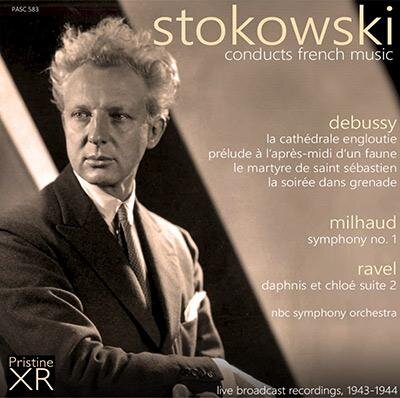
CD Review: Stokowski Basks in Gallic Sunshine at Studio 8-H

Leopold Stokowski was certainly one of the most versatile conductors of the 20th century. His affinities matched his vast repertoire, which ranged from the centuries old to the freshly inked. Though his living composer contemporaries (and critics) may have bristled at the liberties he allowed himself, there is little doubt that his discography preserves a consistently high level of engaging interpretive commitment, not to mention sonic opulence. 

A born cosmopolitan, Stokowski was home nearly everywhere in the realm of music, but there were certain corners of the orchestral literature which were especially tailor-made for his talents. This selection of his NBC performances of Debussy, Milhaud, and Ravel, for example, finds him at his opulent best; especially in the shimmering colors of the older two composers, whose post-Wagnerian sensibilities called out to Stokowski’s own. 

The NBC Symphony, for all the excellence of its individual members, was not exactly celebrated for the beauty of its corporate sonority. Most of the blame can be laid on the powder dry acoustics of Rockefeller Center’s Studio 8-H, which Stokowski helped to mitigate during his brief tenure at the orchestra’s helm 1941 – 1944. But the ensemble’s fierce loyalty to Toscanini, which made them skeptical of ideas from other conductors, also did not help. Despite those challenges, Stokowski conjured from them playing of spellbinding gorgeousness. 

Listeners here are treated to two of his sumptuous orchestrations of Debussy’s piano music—La cathédrale engloutie and La soirée dans Grenade respectively—with the former opening this compilation, followed by the Prélude à l’après-midi d’un faune. A Stokowski favorite, he recorded the score he praised as a “dream world of pagan loveliness” several times. They all follow the same basic interpretive outline, although each has telling details unique to them. This NBC performance from 1944 is no different, boasting a number of retouchings that, while not “faithful” to the score, are undeniably effective. Take a listen to the evocative 3-D effect achieved by the last of the horn calls that echo the opening flute motif, which Stokowski directs to play stopped. Or try his use of chime bars at the coda; very different from the fragile timbre of Debussy’s crotales, but lending a haunting glow to the work’s closing pages. 

The present performance of two “symphonic fragments” from Debussy’s incidental music to Le Martyre de saint Sébastien, on the other hand, are the only ones in Stokowski’s discography. They are quite fine, too, if a tad steelier than one would prefer in this ethereal score. 

Also making its only appearance on his programs is this New York City premiere performance of Milhaud’s brief Symphony No. 1. Although his catalog of works had already by then swollen into triple-digits—with a number of operas, oratorios, ballets, and string quartets already under his belt—he was a symphonic late-bloomer, not penning his first essay in that form until he was nearly fifty. (Perhaps his friend Honegger’s own Symphony No. 1 from ten years earlier had deterred him.) It is a sprightly, lively work alive with Milhaud’s typical harmonic and rhythmic playfulness, all of which Stokowski does proud in this zestful performance. 

Closing is this compilation is an impassioned rendition of the second suite from Ravel’s Daphnis et Chloé, which turns urgent unto hectic in its “Danse générale.” If its finale could have benefitted from a more measured approach, the preceding “Lever du jour” and “Pantomime” are practically erotic desire itself manifested in sound. While some may prefer Stokowski’s later, more relaxed Decca recording, this performance has its own rewards which demand to be heard. 

Abetting these performances are the superb remasterings from Pristine’s Andrew Rose, who skillfully imparted the illusion of space around the NBC Symphony. One could imagine the sonic wizardry on these restorations having elicited the approval of Stokowski, himself no stranger to the possibilities afforded by the studio mixing console. Especially benefitting from this are the Prélude à l’après-midi d’un faune and Daphnis et Chloé. Stokowski’s lushly atmospheric stereo recording of the former for Capitol has been my favorite for as long as I can remember, but the sound on this Pristine issue, which markedly improves upon the sound of the Cala transfer from two decades ago, helps carry this performance to the top. 

A welcome companion for the languid summer afternoons just around the corner. 

Stoki and the NBC get steamy in all-French program from Pristine Audio.

Stoki and the NBC get steamy in all-French program from Pristine Audio.

CD Review: Mengelberg and “His” Concertgebouw’s living “lingua franca,” courtesy of Pristine audio

It has been a bit of a sentimental journey listening to Pristine Audio’s latest release. Thanks to a $20 gift certificate to The Wherehouse a friend gave me on my 18th birthday, these recordings, albeit in a now long out-of-print compilation from the defunct Pearl label, were my gateway to Willem Mengelberg and historical recordings about 20 years ago. What dazzled me then continues to now: The crisp, tart sound of the Concertgebouw Orchestra; and the marshalling of its musicians into feats of seemingly spontaneous virtuosity by their music director with the shock of red hair that matched his temper.

Of course, these recordings hardly need another recommendation. The just over 100 sides that Mengelberg and the Concertgebouw Orchestra cut with English Columbia represent some of the finest things ever preserved on records. Their glittering reading of the once popular Anacréon overture by Cherubini is a capsule demonstration of the best qualities of this artistic partnership: Vibrant tone color that is skillfully blended and offset as needed, flexibility of phrasing held together by steely ensemble unanimity; all of it embodying a belief in musical performance not as ossified ritual, but as a living act of the moment. Then there is their flashy strut through Beethoven’s “Turkish March” from The Ruins of Athens, which with its sly charm and play of color gives Sir Thomas Beecham a run for his money. Best of all, arguably, is the June 1929 recording of Liszt’s Les préludes, a swashbuckling symphonic drama in miniature approached by very few other conductors and surpassed by none. 

Only the fallible (and cut) recordings of Mendelssohn and Berlioz stumble, but even giants must trip every now and again. 

Some of this repertoire was re-recorded for Telefunken (or captured in live broadcasts) a few years later, but by then interpretive bloat and a perceptible drop in the orchestra’s near-superhuman standards crept in. It is in these recordings made between 1926 – 1931 where Mengelberg and the Concertgebouw can be heard at their staggering prewar peak; a partnership which combined interpretive verve, orchestral color, precision, and flexibility of response that was equaled perhaps only by Leopold Stokowski and the Philadelphia Orchestra. 

The second volume of that aforementioned Pearl set had been fetching handsome sums on the second-hand market for years, which alone makes this new and inexpensive recompilation from Pristine something to celebrate. Better still, these discs now sound better than ever thanks to fresh transfers by Mark Obert-Thorn (who also transferred that earlier set, as well as selections of this material for Naxos Historical). Much has changed since the 1990s and that era’s preferences for taming as much as possible the inevitable “bacon fry” that 78 RPM records make as the needle drags through their shellac grooves. The unavoidable trade-offs, however, were often fuzzy sounding instrumental attacks, tubby bass, and a glassy treble. Some collectors continue to have their sleep disturbed by the horrific, chalky, over-CEDARed nightmares produced by the likes of Grammofono 2000 and Iron Needle (“Rusty Needle” would have been more fitting). These present transfers are discreetly noisier than their predecessors, but gain over them considerably in depth and presence. 

Compare the opening attack of Mengelberg’s dramatic recording of Beethoven’s Coriolan with previous iterations. The articulative bite of the Dutch strings finally comes through with an arresting immediacy and sharpness, underlining the surface gloss with a sense of danger. Tuttis cut through, rather than thump; textures sound taut. Or listen to their joyous romp through Weber’s Euryanthe overture, a deceptively tricky score with overlapping and contrasting layers that shift with dizzying speed. For once, listeners hear the immaculately etched lines that Mengelberg (and Weber) surely intended, rather than runny pastels. 

“I study the score daily and continue to discover new things,” Mengelberg once admonished his orchestra who was languishing under one of his infamously intensive rehearsals of a work they knew well. Garrulous though he may have been in life, these stunning series of recordings are a poignant testament to a time when the language of Bach, Beethoven, Weber, Mendelssohn, were a living lingua franca, not dusty relics codifying rituals in a dead language. 

(A previous Pristine compilation of Mengelberg’s Tchaikovsky for Columbia and Odéon can be found here.)

Latest release from Pristine Audio: The first of a two-part compilation of maestro-auteur Willem Mengelberg and “his” Concertgebouw Orchestra’s recordings for Columbia.

Latest release from Pristine Audio: The first of a two-part compilation of maestro-auteur Willem Mengelberg and “his” Concertgebouw Orchestra’s recordings for Columbia.

CD Review: Wang and Dudamel Lost Amidst Adams’ Footnotes

If modern mainstream American academic music can seem like a never ending series of footnotes on Igor Stravinsky’s neoclassical phase, then the work of John Adams are footnotes upon those footnotes; less music than it is aural commentary on the original accomplishments of more talented predecessors; descending further into the same, exhausted ready-made gestures that may have amused long ago, but now decades later seem embarrassingly twee. 

Philipp Gershkovich infamously called Dmitri Shostakovich “a hack in a trance.” Had he lived long enough to hear Adams’ blowzy Must the Devil Have All the Good Tunes?, the former pupil of Anton Webern would have found a more fitting target for his ire.

Composed for Yuja Wang, who premiered the work in Disney Hall last year (and from where this “live” recording was patched together), the work is a three-movement concerto of the usual Adams twitch-and-shout; awkwardly subsuming reminiscences of others’ music within a basic framework of kitsch nostalgia. 

Although the opening movement is marked “Gritty, Funky,” the music is—white boy appropriation of black urban slang from half a century ago notwithstanding—anything but. It ambles about smiling wanly, goaded forward by involuntary rhythmic tics, perhaps geriatric in inspiration. It is minimalism for bluehairs, Liberace for intellectual posers. Pastiches of Bartókian “night music” (shades of the Hungarian’s Piano Concerto No. 2) in the central slow movement give way to the “Obsession/Swing” finale. Those familiar with the composer’s Century Rolls, Chamber Symphony, and Naïve and Sentimental Music (or Stravinsky’s Piano Concerto and Capriccio, for that matter) will have heard it all before. 

Sound as per usual from DG’s recent live recordings tends to be diffuse, yet spotlit (take a listen to the cello riff at the opening). Long on surface, short on substance, the music is tailored well to Wang’s glitzy style, who bangs away as compellingly as the composer presumably hoped. Her performance of Adams’ early China Gates—Terry Riley for yuppies—is fine. Dudamel and the Los Angeles Philharmonic have a solid grasp of the work, but their palpable sense of eking through the score one measure at a time suggests they have yet to fully embrace this music. 

Speaking of “Mr. Showmanship,” the underrated composer Michael Daugherty accomplished a quarter century ago in his Le Tombeau de Liberace what eluded Adams here: An ironic pop-flavored tribute/eulogy to “plastic fantastic” postwar culture. Adams’ concerto hardly approaches the brittle wit and transient moments of genuine pathos (to say nothing of originality) of Daugherty’s superior score.

For those seeking a musical equivalent to the egomaniacal, navel-gazing, grand-standing bien pensant smarminess of a Shepard Fairey or Noah Baumbach look no further. Admirers of serious new music, however, would do better to seek Daugherty’s concerto instead

Why must Adams have all the good commissions?

Why must Adams have all the good commissions?

"A Religious Rite": Otto Klemperer's Final Concerts in the United States

Two of the most tempestuous decades of history, personal and global, had passed by the time Otto Klemperer returned to conduct the Philadelphia Orchestra in 1962. Militarism, World War II, and the resulting seismic political and cultural shifts had left the world vastly changed from the one that existed at the time of his previous visit in 1936, when he aspired to succeed Leopold Stokowski.

In 1939 Klemperer was diagnosed with a right-sided acoustic neuroma—a brain tumor the size of a small apple sitting upon the nerve that transmits hearing and balance. The operation to remove it was a success; recovery less so. He suffered a permanent facial droop on his right side, partial atrophy of his tongue, and a years long manic episode that exasperated his family and colleagues. Thomas Mann noted that he appeared “unbalanced,” “noisy,” and “rather terrible.” His behavior soon became too much to bear for the Los Angeles Philharmonic, whose board terminated his contract in 1941.

“In the following years things went very bad for us financially,” he recalled. “I conducted very, very little. No one invited me.”

His erratic conduct worsened to the degree that he was considered unemployable, at least in the United States. Disillusioned, he eagerly returned to Europe as soon as the war ended, settling on the Soviet side of the Iron Curtain in Hungary. His increasingly vociferous anti-Americanism stoked the suspicions of the FBI; his ironic skepticism of “socialist realism” irked Russian authorities. 

Finally in 1951 he earned the international breakthrough he and his family had so dearly been seeking. At the second of that year’s Festival of Britain concerts in London, Walter Legge—EMI’s producer-generalissimo—heard Klemperer’s performance of the Mozart “Jupiter” from the wings of the Royal Albert Hall. The rest, as they say, is history.

Eleven years later, Klemperer made his final appearances stateside, now as a celebrated elder statesman of the baton. To Eugene Ormandy, whom he privately excoriated over his thwarted Philadelphia ambitions in 1936, he cordially wrote that he looked forward to his forthcoming engagement with his orchestra. They almost did not come to pass.

Trouble was afoot. After a consultation, his psychiatrist in his new home in Zurich recommended that Klemperer cancel the concerts—advice that was duly ignored. He was at the beginning of a depressive spell that influenced his decision-making. Most regrettable for posterity was the collapse of recording plans with the Philadelphia Orchestra for Columbia, which hinged on not upsetting EMI in England, to whom he was contracted. Despite his initial enthusiasm for the project, as well as the personal involvement of Ormandy in its negotiations, Klemperer refused to accommodate these conditions and revise his programs of Bach, Mozart, Beethoven, Schumann, and Brahms; he even scrapped plans to perform and record his own Symphony No. 2

On the eve of his performances, Klemperer was suffering from an unusually bad case of stage fright. As soon as he arrived with his daughter Lotte in New York City, he sealed himself off in his rented room and refused all visitors, save for his son Werner and a select group of close friends. He experienced a precipitous drop in weight and persistent insomnia.

Nevertheless, Legge continued to believe that Klemperer’s circumstances were a “fortunate state of affairs [that] almost guaranteed him a triumph with the Philadelphia Orchestra.” This turned out to not quite be the case. As had occurred twenty-five years earlier, audiences thrilled to Klemperer, but American musical critics—still under the sway of Arturo Toscanini, who had only passed away five years before—remained dismissive.

“There has been in England recently the same excitement about Klemperer. . . as there used to be about Toscanini. . . This talk was contradicted by the performances I heard in Carnegie Hall. . . Klemperer’s disregard of Beethoven’s directions and character produced strange slow-motion performances,” opined B. H. Haggin, longtime keeper of the late Maestro’s flame, before adding with a palpable disapproving sneer that these “somnolent performances. . . excited the audience to cheers.”

Others were more circumspect, if still cool. “Tempi were a bit slower and a shade more deliberate than those to which audiences in this country are accustomed,” was the guarded appraisal of the Philadelphia Inquirer. “[His concerts] had the aura. . . of a religious rite,” said Eric Salzman of the New York Times. “The public was awe-struck, the critics mainly skeptical.”

Although his planned series of recordings for Columbia fell through, broadcasts of Klemperer’s final Philadelphia Orchestra engagements have survived, and in decent sound besides. Whatever reservations that critics of that time may have had are hard to discern now that the high tide of the Toscanini cult has ebbed. Far from being “somnolent,” Klemperer’s performances are muscular; drawing from Ormandy’s Philadelphians an uncharacteristically manly, craggy sound. 

“A conductor must know how to hold attention,” Klemperer would muse near the end of his life. In these broadcasts he succeeds in that task, well after he and all those he loved in life have passed on into the eternity of history.

(This essay will be included as liner notes in a future Japanese release of Klemperer’s Philadelphia concerts.)

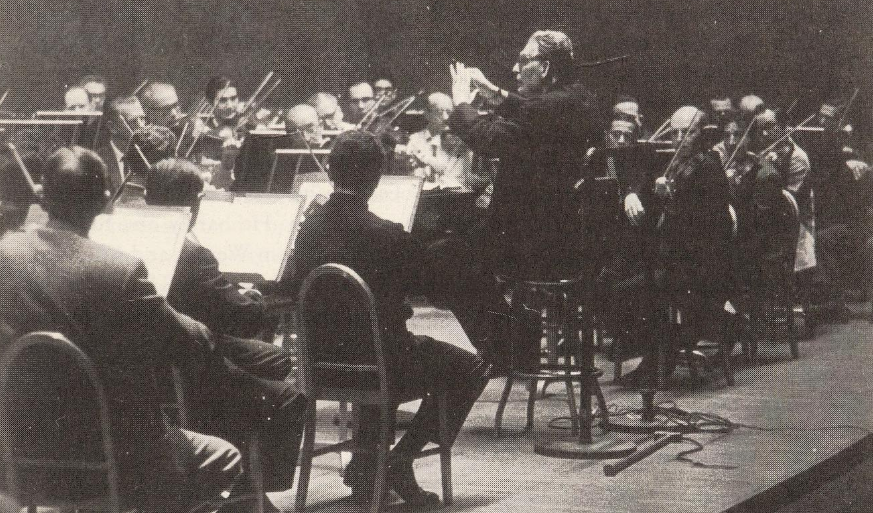
He did it his way: Otto Klemperer rehearsing the Philadelphia Orchestra, 1962.

He did it his way: Otto Klemperer rehearsing the Philadelphia Orchestra, 1962.

Otto Klemperer’s “Philadelphia Story” In Great Depression America

A large poster of Otto Klemperer, his bespectacled face clenched with intense emotion, looms over the crowds spilling out after concerts at the Hollywood Bowl, his arms jutting out as if imploring them to turn back. This likeness conveys what Raymond V. Lopez, a musical mentor of my teen years, recalled from his boyhood at Los Angeles’ old Philharmonic Hall: “Klemperer was terrifying—a giant with eyes that burned right through you.”

Although it spanned nearly 70 years, only two periods from Klemperer’s professional career are generally remembered: His brief stint as head of the Kroll Opera in Berlin, then his final years leading the Philharmonia Orchestra in London. Overlooked are the two decades in between when his life revolved, for better and worse, around the United States.

“I don’t like how the dollar always [was priority],” he said in a BBC interview in 1961. “This was not good.” Later he explained to Peter Heyworth that the preeminence of lucre in American cultural considerations chafed him, adding that while he lived in the United States he “felt in the wrong place.” He did not always think so.

“My joy, my pride, my gratitude is still stronger because it was an American university [Klemperer’s emphasis]. . . a college of my new fatherland which gave me this decoration,” he said as he accepted an honorary doctorate from Occidental College in September 1936. “You can imagine what a deep gratitude [people] like myself feel to the United States, to this great and generous country. . .” Nevertheless, foretastes of his later disenchantment emerged: “We [musicians]. . .  have to save [music] from the attacks of materialism. . . In a crude world of materialism there is, of course, no room for things making no money.” 

Klemperer’s most important position in the United States would be his six-year leadership of the Los Angeles Philharmonic. Taking the reins at the height of the Great Depression in 1933, the conductor grappled with an organization that was ailing financially. Its founder William A. Clark, Jr., heir to a mining fortune, withdrew his financial support; a year later he would be dead from a heart attack. Artur Rodziński, its rising star music director, had abruptly declared that uncertainty over the orchestra’s future forced him to seek stable work with the Cleveland Orchestra.

Into this fray stepped Klemperer, whose first concert with the Los Angeles Philharmonic was described by Bertha McCord Knisely of local weekly Saturday Night as “nothing short of astounding.” Despite this success, Klemperer had no intention of staying in Southern California. He complained to family and friends about a city which seemed to him more “an enormous village. . . an intellectual desert such as we do not know in our Europe.” His real ambitions were set on the great orchestras of the East. In 1935 Leopold Stokowski announced his resignation from the Philadelphia Orchestra. By that December, Klemperer embarked on a guest engagement to lead a series of concerts with Stoki’s band in the hopes of succeeding him. 

Initially he disliked the glossy, immaculately manicured sound that the orchestra had cultivated under its music director, though he eventually came to appreciate their virtuosic responsiveness. (Near the end of his life, Klemperer expressed great admiration for his colleague: “The Philadelphia Orchestra under Stokowski was really a giant.”) 

Edna Phillips, the orchestra’s harpist, remembered well the conductor’s “strange temperament.” She described a New Year’s Day rehearsal for one of his Beethoven concerts as a “war of wills” between recalcitrant orchestra and “imperious maestro,” with oboist Marcel Tabuteau becoming especially flustered.

“Klemperer. . . bent over to speak to the illustrious oboist. . . Tabuteau’s face turned bright red. Afterward, [principal flautist William] Kincaid [said] that throughout the first half of rehearsal Tabuteau had been making derogatory comments in French; and since Klemperer didn’t use a podium, he was close enough to hear him. Worse still, Klemperer had spoken to Tabuteau in French, letting him know that everything he said had been overheard and understood.”

Programs of Beethoven, Mahler, and Bruckner were met with acclaim by the public, if a touch of skepticism from critics. Nevertheless, polls favored him to succeed Stokowski; even his relations with the musicians had become remarkably cordial. It would come to naught—Stokowski ultimately rescinded his resignation. In 1936 he once again announced his abdication. This time it was permanent and there was more: Eugene Ormandy, then with the Minneapolis Symphony, was appointed his successor. Klemperer was livid.

“After the decision in Philadelphia, nothing will come unexpected and nothing will astonish me,” he vented to businessman Ira Hirschmann. “The superficial music will be en vogue (was and will be always).”

A quarter of a century would pass until Klemperer would again appear on the podium of Philadelphia’s Academy of Music.

(This essay will be included in the liner notes of a forthcoming Japanese reissue of Klemperer’s Philadelphia Orchestra broadcasts.)

Otto Klemperer in rehearsal at the Hollywood Bowl (circa 1933).

Otto Klemperer in rehearsal at the Hollywood Bowl (circa 1933).

Hans Knappertsbusch, Maverick Maestro

Hans Knappertsbusch has always stood apart from other great German conductors of the 20th century, a dark horse among his more glamorous (and consistent) colleagues. Non-conformist by nature, he preferred to cut his own path, even when doing so risked making matters more difficult for himself. “Kna,” as he is affectionately called by his admirers, was an unrepentant monarchist in the midst of Weimar democracy, an open skeptic of the Nazis during the Third Reich, a stubbornly persistent adherent of the bowdlerized Bruckner of Franz Schalk and Ferdinand Löwe; his surface bearing concealing an inner courtly gentlemanliness. 

In 1975, a decade after the conductor’s death, the German music critic Karl Schumann said of him: “I have never come across an artist who so impressed, so fascinated me as Hans Knappertsbusch.” Had his studio discography been all that was bequeathed to posterity, there would be little there to corroborate this generous assessment. Like others of his time and place, Knappertsbusch trusted the instincts of the moment to guide him through a performance. “Gentlemen, you know the piece, I know the piece—see you tonight,” became something of his signature phrase to orchestras before shrugging off the rehearsals he notoriously disdained. Such a spontaneous approach could potentially ignite fireworks in the concert hall. In the recording studio, however, which requires at least a degree of calculation and planning, his carefree attitude of Bavarian gemütlichkeit often worked against him. His listless Meistersinger on Decca, which would cost him the honor of leading the label’s flagship stereo Ring cycle, immediately comes to mind.

Fortunately for his posthumous legacy, a significant and seemingly ever-growing discography of live performances have survived as a bracing rejoinder to his studio work. With the gritty, sonorous power Knappertsbusch drew from orchestras being particularly well suited to Wagner, it is natural that his work in Bayreuth’s orchestra pit has become his best known. Two officially approved traversals of Parsifal have become milestones for any serious record collecting Wagnerite, but perhaps even more remarkable is his Götterdämmerung from Bayreuth’s postwar inauguration; a rendering of such volcanic impetuosity that it leaves the listener second guessing John Culshaw’s later decision to ditch Knappertsbusch in favor of the young Georg Solti.

He could be no less compelling on the concert podium, even when startlingly fallible. Eyebrows may find themselves twitching at Henri Büsser’s review of a Knappertsbusch engagement in Paris from 1956 wherein his “sobriety and precision”—neither of them qualities typically associated with this conductor—are singled out for praise. Germany, where Virgil Thomson noted conductors had traditionally cultivated a “rough” sound that contrasted markedly with American expectations of ensemble synchronization, had its tastes reshaped after World War II by the ascendance of younger conductors such as Rudolf Kempe and Herbert von Karajan (with Erich Kleiber as spiritual godfather) whose sleek exactitude owed more to Arturo Toscanini than to their own elder compatriots. Borne from an aesthetic outlook steeped in the waning, twilit Romanticism of late Wilhelmine Germany, Knappertsbusch’s postwar recordings—especially his late ones for Westminster—can sound as though the shadow of the 20th century had never darkened his existence, so thoroughly and comparatively remote did his style remain against the rapid changes of the 1950s and 1960s. 

In his overview of the Salzburg Festival during the NSDAP period, Andreas Novak pithily captured the essence of Knapperstbusch’s character when he referred to him as a “gruff humanist.” As tends to occur with strong-willed individualists, their singular vision can clash against the narrow concerns of more mundane folk. As Arthur Vogel, the music section chief of the American occupation government in Bavaria noted, “the same character of independence and pride” which had kept him aloof from the Nazis also made him difficult to work with and “reluctant to give up even a small part of his Teutonic, heavily Wagnerian bias.” Solti, who took the reins of the Bavarian State Opera from Knappertsbusch in 1946, would long chafe with resentment over the “hysterical screams of approval” that greeted his elder colleague whenever he approached the podium. “Coexisting with him was terribly difficult for me,” he recalled nearly half a century later.

A few years before, Knappertsbusch ran afoul of a detractor with far more capacity to derail his career than any young conducting upstart. 

“He with his blond hair and blue eyes was certainly a German, but unfortunately he believed that even with no ear he could with his temperament still produce good music,” Adolf Hitler privately opined. “To attend the [Bavarian State] Opera when he was conducting was a real punishment.” (Despite this and a temporary ban on performance, Knappertsbusch’s name was included among those exempt from compulsory military mobilization in the Gottbegnadeten-Liste.)

Just a little over a decade after the war’s end, Knappertsbusch drifted into his Indian summer, with he and the Munich Philharmonic (whom he maintained a close relationship with in his final decade) each settling into comfortable conservatism. On October 18, 1956 they stood before an audience in Ascona, Switzerland, which sits along the shores of Lake Maggiore, less than 5 miles from the Italian border. Whatever expectations the audience in the Aule delle Scuole may have had for conductor and orchestra on that date were likely confounded by the ruggedly idiosyncratic performances on this disc. 

In his treatise on conducting, Wagner bemoaned the condescension which musicians of his time took towards Beethoven’s Symphony No. 8: “[They] came to regard the entire symphony as a sort of accidental hors d’oeuvre of [the composer’s] muse—who after the exertions of the [Symphony No. 7] had chosen ‘to take things rather easily.’” As befits a noted Bayreuthian, Knappertsbusch’s interpretation carefully heeds the advice Wagner dispenses for conductors tackling the score. Far from being the lightweight “silly symphony” it often is depicted as, he dispatches the humor of the Beethoven Eighth with savage delivery, investing it with a sardonic tone that pointedly heightens the score’s deceptive sophistication. His pacing is deliberate; the cumulative effect massive, weighty, nearly crushing. 

Cut from the same cloth is his expansive reading of Brahms’ Symphony No. 2. Its pastoral opening movement, which emerges as if drawn out in a single breath, stands as one of the most remarkable performances in Knappertsbusch’s discography. Each note, played for its full value, tells. A bewitching illusion of having vanished the music’s pulse is cast over the listener, with the conductor coaxing a stream of Wagnerian unendliche Melodie unfettered by bar lines. Momentary instrumental lapses—and there are a number of them—are conquered by the sheer charisma of Knappertsbusch’s direction. 

Another officer (and musical academic) attached with the postwar Allied occupation of Bavaria, John Evarts, ruefully noted in his diary the “outrageous liberties” that Knappertsbusch took upon his return to the podium after a brief ban imposed by the Military Government. “[His] admirers were wildly enthusiastic about the eye-and-ear-full [sic] which they received.” Judging from the results on display in this recording at least, Kna’s supporters had ample reason for their unrestrained acclaim.

(This essay was commissioned by ATS in Japan for inclusion as liner notes in a forthcoming Knappertsbusch release.)

Uncompromising, occasionally uncouth: Hans Knappertsbusch at the podium (circa late 1950s).

Uncompromising, occasionally uncouth: Hans Knappertsbusch at the podium (circa late 1950s).

“A Master’s Hand”: George Szell and the Cleveland Orchestra in Lugano

Arguably, the most lasting musical achievement of the 1960s was the elevation of the record producer to auteur. The work of Phil Spector, Brian Wilson, George Martin, and Joe Meek among others are well known, but their use of the recording studio as an instrument in and of itself had already been thriving among the practitioners of a genre from which they drew much inspiration. By the time the Eisenhower era ended in the United States, listeners of classical music were familiar with the electronically enhanced strings of Bruno Walter’s late Columbia recordings, the shifting colors and reverb of Leopold Stokowski’s Capitol discs, and the first installment of the “theatre of the mind” that Decca promised in their epochal Ring cycle. In 1964 Glenn Gould famously and permanently forsook live performance, which he regarded as a relic of a bygone time, in favor of “acoustic orchestrations” which were realizable only via the “autocracy” of the recording studio.

It would be tempting to view the success of George Szell as merely another product of this era. Not entirely uncoincidentally, the zenith of his career happened to overlap with that of hi-fi sound recording and reproduction. The fastidious perfection he drew from the ensemble he led for the last 24 years of his life, however, was no feat of electronic sleight-of-hand. 

“The Cleveland Orchestra was a fine orchestra when I first heard it,” he recalled during his tenth anniversary as its music director. “When I took over, some of the best members had left and I made it my business to get them back. . . The orchestra today is an instrument of artistic expression ranking with the best in the world, and with certain special qualities I do not find in any other orchestra at the present moment.”

Crisp, transparent, and immaculately precise, the Szell touch proved to be rewardingly phonogenic for a growing audience of listeners, to say nothing for the record labels which profited from his art. While some conductors seemed to lose their footing before the presence of microphones, Szell came alive, understanding early on that the invention of the gramophone signified the greatest paradigm shift in musical performance and reception in history. As he would with any matter musical (and often beyond its purview), Szell was deeply involved in the recording process: From the control room right down to dictating choices for album covers. His players had become accustomed to (if not necessarily enamored with) the obsessive control of their “Papa Szell,” an appellation which not only denoted his attentiveness and even warmth for his musicians, but also the paternalistic unto quasi-omnipotent power he wielded over the Cleveland Orchestra. 

“If God wills it, I accept,” Danny Majeske responded to Szell’s offer to succeed Rafael Druian as the orchestra’s concertmaster. “God has nothing to do with it—I will it!,” the conductor shot back. 

As his eleventh season into his Cleveland tenure drew to a close, Szell prepared to show off his orchestra’s prowess to European audiences, eager to demonstrate to them the unanimity and polish which had left American critics grasping for superlatives. 

“What has developed [since Szell took over the orchestra] was a kind of empathy, an ability on the part of the players to identify so completely with the style and purpose of the music that it might almost appear as though they themselves had taken part in the composing of it,” remarked Herbert Elwell shortly before the Cleveland Orchestra’s embarked on their 1957 tour of Europe. “[They] have learned in a remarkable way to listen to one another as chamber music players do. . . The result is an enormous increase in refinement and flexibility.”

In a letter to Charlotte Flatow penned two years prior, Szell was more direct. 

“[The] Cleveland Orchestra, although a comparatively young one, is in every respect fully the equal of American orchestras heard up to now in Europe and, in some respects, even superior to them.”

Nonetheless, as the tour neared and then was underway, the conductor grew increasingly anxious. “The trip was hard on all of us but hardest on Szell,” Anshel Brusilow remembered. “In Berlin he went looking for places he remembered from his youth, when he had worked with Richard Strauss at the Berlin Opera. He found nothing he could recognize. Not just the buildings but the streets themselves were obliterated. Then he knew what World War II had done to Berlin.” His return to the continent which had nursed and developed his talents was a personally emotional experience. More importantly, however, he worried about how European audiences would judge his orchestra. With his typical sense of care and detail, he arranged for programs that highlighted the Cleveland Orchestra’s finest qualities, as well as accounting for variety. No two programs would be exactly alike. His worries would ultimately be unfounded: The European reception of the Clevelanders was rapturous. 

“Ovations without end,” reported the Spandauer Volksblatt of the orchestra’s Berlin stop. “It turned into a festival.” The New Statesman and Nation in London wrote: “It is one of the prime virtues of the Cleveland Orchestra. . . that their brilliance is entirely subordinated to musical considerations. They play with the loving spontaneity of a fine European orchestra, as well as with the discipline, blend, and unanimity characteristic of America.”

Switzerland was the tour’s pivot. From there the Cleveland Orchestra would venture to neutral Austria, then to Communist Czechoslovakia and Poland. His final Swiss concert in Lugano, preserved here on this set, is marked by a nervous tension unique in his discography. The evocative mists of Debussy’s La mer are dispelled in favor of a scrupulous clarity which properly contextualized this score as a cornerstone of musical modernity, its play of sounds sounding as if they still were freshly scored. Schumann’s Symphony No. 2—a Szell favorite—has an air of nervy energy that at moments (especially in the Scherzo) strikes the listener as an unlikely foretaste of Shostakovich. 

An anonymous critic for the Tribune de Lausanne who had attended the Lugano concert wrote that Szell “sometimes allow[ed] himself to be caught up in a frenzy of tempi which transcend the golden mean,” and had chided his selection of a work by Paul Creston (not included here). Despite that, he compared him favorably to Leopold Stokowski and Serge Koussevitzky. “What [the Lugano concert] revealed to us was that [the Cleveland Orchestra] is indisputably one of the premiere orchestras of our time,” he concluded. 

Another reviewer, this time for the Journal de Genève, added: “The technical and artistic qualities [of the orchestra] are simply extraordinary. Unnecessary to add that this judgment is partially in respect to the conductor. Extremely dynamic and colorful, animated by a fire and an irresistible pulsation, the interpretations are coordinated by a master’s hand. Szell has the gift to inflame his musicians, who are individually and collectively admirable.”

On these recordings, the careful listener will find a George Szell wholly unlike the cold and clinical stereotype that has remained stubbornly persistent among record collectors. Instead, these performances are marked by a possibly surprising sense of adventure and risk. Here is evidence, as if any more were needed, that this vertiginously daring musical high wire act, which eschewed empty virtuosic display, could thrive without the safety net of the studio; further testament of a remarkable collective partnership between orchestra and conductor whose legend seems to only burn brighter with every passing year.

(This essay will be included as liner notes in a forthcoming reissue of this concert by ATS in Japan.

George Szell going plane crazy with friends in Prague (1930s).

George Szell going plane crazy with friends in Prague (1930s).

The Lion's Swan Song: Arturo Toscanini's Final Concert

It is one of those curious twists of cosmic fate that Arturo Toscanini and Wilhelm Furtwängler, arguably the two most famous orchestral conductors of their time, both had the curtains unwillingly pulled upon their careers in the same year. The latter would die in Baden-Baden in November 1954 after a brief bout of pneumonia. Just a few months prior across the Atlantic, his rival (and grudging admirer) stood before an orchestra for the final time. Though he would live on for another few years, the frailty of the octogenarian Toscanini’s faculties could no longer bear the stresses of a career that had lasted nearly seven decades: Longer than the entire lifespans of a number of his contemporaries and rivals. 

He had, in fact, been convinced to return from retirement to head the then newly formed NBC Symphony—a formidable task at any age, but especially for a man nearing 70. Toscanini met the challenge with his characteristic drive and determination; and, as recordings gratefully preserve, the musical results evinced a vigor that betray nothing of his age. 

As the early 1950s wore on, however, it was becoming increasingly apparent that the partnership between conductor and orchestra could not go on much longer. For one thing, there was the increasing unprofitability of maintaining a full-size symphony orchestra year after year, not to mention the dwindling of the radio audience at the dawn of mass television—although David Sarnoff’s personal admiration for Toscanini staved off the machinations of NBC’s board of directors. More dire was the physical state of Toscanini himself. 

Though he was capable of summoning reserves of willpower that steeled him through increasing frailty for the sake of music, there was no escaping mortality’s inexorable grasp. Toscanini had already suffered the devastating blow of his wife Carla’s death in 1951. In those final months of his career, the remorseless grinding of time upon his body was becoming impossible to ignore. 

“I am not well, and nobody believes me, the asses, but I’m not the same as I was. . .,” he wrote to a friend in 1953. “All in all, a poor unhappy man—and [NBC has] had the bad taste to force me to accept another year of concerts. . . I’m old, very old, and can’t stand it anymore!”

More than “bad taste,” it was Toscanini’s concern for the well-being of his musicians, who would certainly be (and were) disbanded upon his retirement that goaded him into conducting one more season. 

A few months later in January 1954 while rehearsing Verdi’s Un ballo in maschera for broadcast performances, the conductor was terrified to discover that the words of this opera he had loved since boyhood were suddenly eluding his memory. Age forced him to act decisively. 

On the morning of March 25, 1954—his 87th birthday—Toscanini affixed his shaky signature to his letter of resignation from the NBC Symphony (likely drafted by his son Walter): “And now the sad time has come when I must reluctantly lay aside my baton and say goodbye to my orchestra.”

His final concert—all Wagner—shortly thereafter on April 4 was of a piece with the somewhat ramshackle mood of the occasion, the program being a relatively late switch for the Brahms Ein Deutsches Requeim which Toscanini had originally intended as his farewell. Given the events that transpired during this performance and its rehearsals, it is not surprising that it has become one of the most talked about in Toscanini’s career. 

The rehearsals themselves were marked by several lapses in the conductor’s memory, stoking the fire of his infamous temper. Things soon came to a head and he finally stormed off in a rage. The situation was concerning enough to NBC that they had clandestinely notified Erich Leinsdorf, then music director of the Rochester Philharmonic, to stand ready in the event of a Toscanini no-show at the concert. It proved a false alarm—the Maestro would show up to his final concert after all. 

Confusion was in the air on that Sunday. While the audience filled into Carnegie Hall, NBC distributed leaflets with copies of Toscanini’s resignation letter (and network general manager Sarnoff’s reply) to members of the press, listeners in attendance and tuned into the radio were not informed. Finally the curtain rose. Toscanini and the NBC Symphony began with the Act I prelude to Lohengrin, followed by the “Waldweben” from Siegfried. The conductor failed to indicate changes in meter, but the orchestra stayed on its toes, expertly navigating through the score on its own. Continuing were the “Siegfrieds Rheinfahrt” and “Trauermarsch” from Götterdämmerung, which were dispatched smoothly. Then came the Paris version of the overture to Tannhäuser—a performance which has since become the stuff of legends. 

During the “Bacchanale,” Toscanini momentarily lost track of what he was conducting. He turned pale, stopped conducting, and covered his eyes with his left hand. For a moment the ensemble slipped, unsure of what was occurring, until cellist Frank Miller began cueing entrances for his fellow players, restoring unanimity, and guiding Toscanini back into the performance. But in the moments while this was being sorted out, panic had ensued in the NBC control room. Aghast at what was happening, Guido Cantelli insisted to the radio personnel to take the concert off the air, which they promptly did. While the announcer feigned technical difficulties, the opening of the Brahms First Symphony had incongruously been interpolated. 

Despite the rough seas, both orchestra and conductor had made it to shore, finishing the piece together. Toscanini was furious with himself, nearly stomping off until Miller reminded him that there was still the prelude to Meistersinger left to play. He nodded wordlessly, motioned the upbeat, and launched into the work, only to abruptly leave while the orchestra was in mid-tutti at the coda, ignoring the clamoring of his audience to return for a bow. 

Hearing the concert today nearly 70 years later, one can hardly hear anything of the black legend that has since swirled around it. Toscanini’s late recordings can sometimes sound dry, unyielding, much too tight. None of that is discernible in this performance. Instead one finds here a sense of measure and poise, of shaping each phrase breath by breath that is often missing in the conductor’s contemporaneous recordings. Even the notorious Tannhäuser performance has a chamber-like intimacy and beguiling luminescence which reveals little of the troubles which had nearly unraveled it. Samuel Chotzinoff would later relate that “the men stopped playing and the house was engulfed in terrible silence” when Toscanini suffered his memory lapse. Aside from a brief spell of ensemble unease, the recording evinces nothing of that. What comes through instead is the NBC Symphony’s professionalism (as well as sincere affection for their conductor) in ensuring the maintenance of order. 

The fact that the broadcast has been preserved in decent early stereo only adds to the value of this document. Perhaps nowhere else can a listener more vividly hear the spectrum of color that Toscanini could draw from an orchestra. 

It is a performance that in many ways is unique in Toscanini’s discography. At times it even prefigures the much later work of Carlo Maria Giulini and Claudio Abbado. With typical self-deprecation Toscanini would later remark of it: “I conducted as if it had been a dream. It almost seemed to me that I wasn’t there.” Whether humility or humiliation provoked these words, his presence is unmistakable throughout this performance. We hear not the infallible musical demigod of American consumer mythologizing, but the vulnerable, imperfect man and artist who in his final years struggled against the dying of the light; and drew from within himself one last time to fashion beauty that defies the tragic impermanence of our existence. 

(This essay was commissioned by ATS in Japan for inclusion in their reissue of this broadcast.)

Toscanini, a few weeks before his death, speaking to (from left to right) Daniel Guilet, Emanuel Vardi, Wilfrid Pelletier.

Toscanini, a few weeks before his death, speaking to (from left to right) Daniel Guilet, Emanuel Vardi, Wilfrid Pelletier.

“He will live on in the hearts of all of us”: Bruno Walter’s final tribute to Arturo Toscanini

Late in life, Bruno Walter would muse upon the didactic value of sound recordings to Columbia Records’ Arnold Michaelis. Tellingly, he singled out the recorded legacy of one conductor as being particularly valuable to future generations: 

“I am really very happy about this idea that the disappearance of all the traces of our lives as performing musicians is not anymore to be feared. That we really. . . can live on in our best efforts. . . It is a kind of school. So it is for young conductors who can hear how Toscanini conducted this or that.”

The conducting profession has never been conducive to the forging of warm friendships among its most famous practitioners, especially during the golden age of the maestro-auteur in the early 20th century. Walter himself was aware that his mentor, Gustav Mahler, had been a fierce rival of Arturo Toscanini’s when happenstance brought both conductors to New York City during the same period. The disparity of their respective backgrounds and ages notwithstanding, a firm friendship based on mutual respect would be forged between these two conductors which would endure their entire lives. 

They first crossed paths in 1926 when Walter, then among the leading lights of the German musical world, was invited as a guest conductor to La Scala. Writing about the occasion in his memoirs, Theme and Variations, Walter recalled: “The meeting, casual though it was, made a deep and lasting impression upon me. I wished I would come to know the man better and fathom the secret of so exponential a being.”

Toscanini, though sometimes grumbling disapprovingly over his colleague’s interpretations, was nonetheless appreciative of Walter as both friend and musician

“When I see the good Bruno Walter,” he confided to his mistress, Ada Colleone Mainardi, “I really feel that I’m ten years younger than he!”

Within less than a decade of their first meeting, the lives of both conductors would be tossed asunder by the epochal winds of history about to blow through Europe. Toscanini, by the late 1930s permanently residing in America, emerged from retirement to assume the role as music director of NBC’s newly created flagship orchestra. Though prone to professional jealousies, he extended guest invitations to conductors fleeing the Old World in search of refuge and a chance to restart their careers in the New World. Among those whom he helped was Walter, who had fled the Anschluss and the imminent invasion of France, and was mourning the murder of his daughter Gretel besides. He made his first post-exile American appearance in March and April 1939 with the NBC Symphony in a five-concert series—a generous engagement reflective of Toscanini’s admiration. This was followed next season with another five-concert guest series which included, among other things, an electrifying reading of Bruckner’s Fourth Symphony which, gratefully, has been preserved. 

Curiously, Walter would not be invited to conduct the NBC Symphony again until February 1951, when he replaced Toscanini, then recovering from a knee injury. 

After Toscanini’s final retirement in April 1954, NBC disbanded what had by then essentially become “his” orchestra. Instead of walking away, the ensemble independently reconstituted as the Symphony of the Air, promoting itself as “the orchestra that refused to die.” Don Gillis, composer and former producer for the NBC Symphony’s broadcasts, cabled the ensemble’s former music director an invitation to lead their first concert. He politely, but firmly rejected the orchestra’s “touching and kind [message],” stating that his advanced age and frail health precluded any possibility of considering any conducting engagements. 

If not presiding in person, Toscanini’s spirit at least hovered over the orchestra as strong as ever, even while the man himself rapidly wasted away. By the time his former orchestra was planning its elaborate concert commemorating his ninetieth birthday, Toscanini mental faculties had deteriorated to such a degree that one wonders whether he was even aware of the forthcoming occasion. Early in the morning of January 1, 1957, Toscanini would suffer a debilitating stroke—two weeks later he was dead. 

 “I am too deeply shocked by the passing of my dear and revered friend,” Walter wrote in a memorial tribute. “In him was greatness and I am sure the memories of his glorious activities. . . will live on in the hearts of all of us.”

Walter, himself an octogenarian and not in robust health, was moved to make out his last will and testament during this time. A few weeks later, his fragile physical state forced him to decline being a pallbearer for Toscanini at his funeral in St. Patrick’s Cathedral in New York City. 

Already from the year before, when he was approaching his eightieth birthday, Walter was beginning to curtail his conducting engagements. In a letter to the New York Philharmonic’s manager, Bruno Zirato, he announced that he would not renew his regular guest appearances with the orchestra after the 1956 – 1957 season. 

“I feel the hour has struck for me to discontinue an activity which has meant so much to me,” he wrote. 

In his final years, he would cease performing live altogether, instead venturing from his Beverly Hills home only as far as a relatively short drive to Hollywood and Eagle Rock in order to conduct the pick-up Columbia Symphony Orchestra. These final recording sessions—covering repertoire ranging from Mozart to Mahler—have remained Walter’s best known, with the fire and verve of his early years mellowed (some would argue “dulled”) into agreeable geniality. 

But on February 3, 1957, as he (along with Pierre Monteux and Charles Munch) stepped before Toscanini’s old orchestra for the last time, much of that old fire returned in a triumphantly blazing performance of the Beethoven Eroica that is perhaps the finest of all Walter’s extant recordings of the symphony. 

Unsurprisingly given the occasion and ensemble, the performance has a Toscanini-like grip quite unlike Walter’s contemporary performances, be they in the studio or the concert hall. It also is a reminder of the orchestra’s reluctance to play according to Walter’s preferences. Violinist Felix Galimir remarked that members of the NBC Symphony would often “not even watch whatever [the guest conductor] was doing.” 

Replying to an admirer who had also commented on this unique aspect of this performance, Walter wrote: “I presume your impression may be explained by the fact that it was an orchestra which had played the same work under Toscanini for many years.”

The performance does not suffer in the least for all that, which is markedly superior to the stereo commercial recording he would make shortly afterwards. From the moment those twin E-flat chords pound forth, Walter’s interpretation surges with an irresistible sense of momentum tempered by subtle flexibility of line and sonority. It is tempting to wonder whether Walter’s traversal would have earned the admiration of Toscanini had he lived to hear it. Certainly it proves to not only be a fitting tribute to his recently deceased friend, but an inadvertently touching memento of the elemental power that Walter still managed to rouse from himself on occasion. 

Just over a month later, on March 7, 1957, he suffered a heart attack, the first of two that year, leaving a permanent mark on his career and performance style. The final curtain upon Bruno Walter’s career had begun to be drawn. 

Walter and Toscanini, unlikely friends, looking cozy in Leipzig during the latter’s 1930 European tour with the New York Philharmonic.

Walter and Toscanini, unlikely friends, looking cozy in Leipzig during the latter’s 1930 European tour with the New York Philharmonic.

Richard Strauss, Alpha and Omega, At Disney Hall

Richard Strauss’ late music was many things—geriatric reverie, eloquent lamentation, a hero’s retreat from the world—but foremost among them was pointed, if wounded riposte to what he regarded as the excesses of the modernist “note-placers” of the 1920s against which he often inveighed. In his twilight years, amidst the still smouldering ashes of a ruined nation, Strauss would muse that he was likely the final chapter in the history of German music. In a sense, he was right. The postwar generations, spiritual successors of the Weimar avant-garde, turned outwards for inspiration, the legacy of German music in their eyes having become compromised by its association with the horrors of World War II. 

Maybe that was why the timing for the Los Angeles Philharmonic program of Strauss’ chamber music felt a bit off. With their Weimar Republic retrospective around the corner, this would have been more fitting as a ruminative postlude. 

The Serenade, Op. 7 for winds was the only work on the program that did not come from the composer’s final years (obliquely though it did forecast his much later “workshop” sonatinas). “Mozart’s melody is the incarnation of the Platonic ideal,” Strauss would reflect towards the end of his life. “Sought after by all the philosophers, the ideal of Eros hovering between earth and heaven.” His youthful score’s sunny glint, with its lithe yet sensual strands of song, already bear witness to this lifelong adoration of his forebear, to say nothing of establishing Strauss’ own credentials for songcraft. The group consisting of members from the orchestra’s woodwinds and brass played with appropriate control, careful to balance the ardor of its still teenage composer’s lyricism with a sobriety that would have marveled his older self. 

A lifetime later he would pen his Metamorphosen; the mature master’s melodic and contrapuntal craft channeled into the fathomless heartbreak of this elegy for the passing of the entire world he had ever known, now utterly and definitively vanquished; for the very death of culture itself. It is also marked by defiant anger rare in Strauss’ music, reflective of his embitterment with the Third Reich, then later with the Allied occupiers. “Another glorious achievement of the Nazi regime,” he fulminated in his diary weeks before the premiere of Metamorphosen. “Artists are no longer judged by their abilities, but by what Americans think of their political opinions.” 

In its guise for string septet, the tragedy takes on an intimacy which becomes almost unbearable, though the Philharmonic’s string group maintained a frosty distance from its disconsolate sorrow. Polished and precise though it was, there also was a discernible sense of unease with the deeper implications of its endless melody, the ambiguous object of its memorial. Perhaps their coolness of touch bespoke of a sense of diplomacy which preferred to leave such matters unaddressed. 

In its way, the curious arrangement of the Vier Letzte Lieder that was the program’s centerpiece was of a piece; its re-coloring keeping Straussian sentiment at arm’s length from the audience. 

Spanish composer Amparo Edo Biol wrought a version of the work that compacted it into a string quintet with solo trombone substituting for the soprano. It was (possibly despite itself) a backhanded tribute to Strauss, stripping him of his say through Eichendorff and Hesse, and imbuing an unexpected clumsiness to its soaring vocal part. 

David Rejano Cantero was the excellent soloist, but no matter how fine his playing was, nothing could disguise the fact that inserting a trombone in place of a soprano was like watching an elephant attempting to mimic the delicate flight of a hummingbird. Michael Kennedy once remarked that these songs were Strauss’ final hommages to his wife, Pauline: “His long love affair with the soprano voice, her voice, is consummated in this final masterpiece.” In its stead, the trombone blustered through its flowing and florid melodies, lending an unfortunate comic tone which was bitingly accented by a handful of flubs in the opening of “Frühling.” Bereft of its shimmering orchestral raiment and even the ability to speak for itself, the result was a kind of high-brow and exceedingly pretty gebrauchsmusik. Call it a “Weimarization” of this valedictory, if you prefer.  

With typical self-deprecation, Strauss deemed his late music as having “no significance whatever for the history of music.” Judging from the outcome of her ill-fitting arrangement, it seems that Edo took his ironic quip at face value. 

The stoic “gai-tare”: James DePreist’s Bruckner in Japan

The first—and last—time I heard James DePreist conduct in person was in December 2000, an opportunity which occurred by pure chance. Franz Welser-Möst had originally been scheduled to conduct Mahler’s Symphony No. 7 with the Los Angeles Philharmonic on that date, but as had become his habit during this period (at least with his Southern California engagements), he abruptly cancelled. With relatively short notice, James DePreist was called upon to replace him and, additionally, made a surprising switch in the scheduled program: The Mahler Seventh would be swapped out for the Tenth (in the Cooke II version).

DePreist lead a performance which remains imprinted upon my memory for its serenity, at odds with the post-Bernsteinian morbidity then often heard in late Mahler. Far from being the creation of a man living in the shadow of death, DePreist seemed to find the work’s inspiration in the defiance of death proclaimed in Mahler’s Second: “O Tod! Du Allbezwinger! Nun bist du bezwungen!”

Afterwards, I ventured over to the backstage of the Dorothy Chandler Pavilion to have him autograph a CD. Though his movement was impaired by the polio that he contracted while on tour in Thailand in 1962, it only served to enhance the man’s aura of dignity emerging triumphant through adversity; his imposing figure lending him a quality of a hero wearied by the passing of time. He was kind enough to spare a few moments to speak to me, a tongue-tied eighteen-year-old, briefly. When I timidly remarked to him how the life-affirming quality of his interpretation of the Mahler Tenth had impressed me, he smiled, then took a breath. “That’s how it ought to be, young man,” DePreist replied to me. “This is a symphony about death, about love, by a man who still believed he had a lot of life to express it all.”

DePreist carved out a notable career in his homeland, gaining admiration for his longtime tenure as music director of the Oregon Symphony, as well as his teaching at The Juilliard School; and by 2005, he was awarded the National Medal of Arts from President George W. Bush. Yet his name never soared as high as that of some of his contemporaries in America’s classical music circles. Instead, it was in Europe and especially Japan where he found recognition commensurate with his artistry. It is tempting, but perhaps misleading (to say nothing of futile) to speculate over why this may have been so. He himself seemed unconcerned. “I would never want to be denied the opportunity to conduct because I'm black,” he once stated. “But neither would I want to be engaged because I'm black.”

In Scandinavia he made a number of well-received recordings of varied repertoire for the BIS and Ondine labels. Together with the several recordings he made in Oregon for Delos, DePreist left behind a sizable and distinguished legacy which continues to be admired by music-lovers. Overlooked, however, is his period at the helm of the Tokyo Metropolitan Symphony Orchestra (colloquially known by locals as the “To-kyō,” an abbreviation of the ensemble’s formal Japanese name) in the mid-2000s, a brief moment which could lay fair claim to being the most glamourous in his entire career. Not that he had an easy time of it by any means.

Though he had enjoyed a longstanding relationship with the orchestra as a guest, his engagement as music director came during difficult times for the organization. It had suffered from then Governor of Tokyo Ishihara Shintarō’s program of administrative reforms; which, among other things, sought to consolidate cultural organizations, and shutter others deemed to be redundant or financially untenable. The resulting budget cuts hit the To-kyō hard, leading to shifts in personnel, and according to some music critics, a perceptible drop in its musical standards. Compounding the orchestra’s stress was the recent loss of its music director Gary Bertini, who had died in Israel in March 2005 a few weeks after his last performances in Russia. DePreist himself was not in the best of health. Among other challenges he faced were the after-effects of a kidney transplant, which had freed him from the onerous necessity of dialysis treatment, but forced him to conduct from a wheelchair for the remainder of his life. If he was fazed by any of this, he never let on publicly. On April 20, 2005 when the To-kyō held a press conference at the ANA Intercontinental Hotel announcing DePreist as its next director, he appeared the very image of confidence and security that the organization sorely needed during this delicate time.

Over the next three seasons, DePreist enthusiastically set into his new role: Delivering highly regarded performances of Beethoven and Shostakovich symphonies, shoring up the orchestra’s technical polish, visiting local schools for To-kyō’s community outreach program, and even becoming a sort of highbrow gaitare—a person from abroad whose exotic foreignness is crucial to their celebrity appeal. In that capacity DePreist appeared as an important supporting character in the manga Nodame Cantabile, where his parts were rendered in katakana, heavily emphasizing the evocative exoticism of the other which Japanese audiences often find appealing in their resident gaikokujin. In Japan he accomplished that feat increasingly rare in classical music: Extending one’s renown beyond the boundaries of their art. Unfortunately, despite these successes, his health was becoming an increasing and significant impediment to the continuation of his work, eventually ruling out a prolonged tenure with the To-kyō. So it was with profound mutual regret that he announced his retirement in 2007, effective at the end of the orchestra’s season the following year. The reins would be handed over to Eliahu Inbal, while Koizumi Kazuhiro would step up from Principal Guest Conductor to Resident Conductor.

Echoing the Mahler that I had encountered in my youth under his command, this set of To-kyō broadcasts of DePreist’s Bruckner is marked by an embrace of life readily discernible to the listener. If not the heaven-storming symphonic essays typically heard, the moving vulnerability of these performances have their own virtues. They are long on lyrical flow and textural blend. Conductor and orchestra cajoles, caresses the music, but never forces anything from it. Music pours from these scores with the inevitability, with all the natural ease of water bubbling from a hot spring. The performances manage to be self-effacing without being faceless; distinguished without brazen ostentatiousness. It was a quality reflective of DePreist’s own hard-won worldview.

“We bring our brick to the edifice,” Antal Doráti had once told him at the start of his career. “Don't worry about putting it in front or up high." These words from his mentor, which bespoke of their mutual frustrated ambitions, resonated with DePreist for the rest of his life. “I always, always think of that,” he recalled decades later.

In these recordings, DePreist brings Bruckner down from his habitual forbidding peaks. With grace and care, he makes of these symphonies human-scaled portraits of doubts and hopes, daubed in flesh and blood; its colors tempered by the quiet stoicism which, by turns, consoled and fueled the life and art of this still underappreciated American artist.

This essay will be included in a future Tobu release of Bruckner’s Second and Ninth with the To-kyō under James DePreist.

“Nice to meet you!”: Highbrow tarento James DePreist takes the spotlight in Nodame Cantabile.

“Nice to meet you!”: Highbrow tarento James DePreist takes the spotlight in Nodame Cantabile.

“Everything Black”: Toscanini’s Final Performance of Verdi’s Requiem

“[Arturo] Toscanini. . . is a natural musician,” opined composer-critic Virgil Thomson in a 1947 essay saluting the Italian conductor on his 80th birthday. “[The] music that he makes is the plainest, the most straightforward music now available in public performance. There is little of historical evocation in it and even less of deliberate emotional appeal. It is purely auditory, just ordered sound and very little else. There is not even very much Toscanini in it.”

Slyly back-handed though Thomson’s observations were, they bear the ring of truth. Toscanini’s simplification of the musical experience, which dispensed with politico-cultural allusions, and put forward the belief that “Allegro con brio” meant only that and nothing more was an epochal revelation in America, wherein the mantra of “less is more” was already deeply ingrained in the national character long before Mies van der Rohe had even dreamed of coining the concept. No surprise, then, that Toscanini triumphed over his Wagnerian rivals who arrived on American shores, whose metaphysical mists provoked distrust in a society already wary (if often in awe) of Teutonic influence. Gustav Mahler, Willem Mengelberg, and Wilhelm Furtwängler (and by extension the cultural universe from which they emerged) all would be trod underfoot by the Italian juggernaut. 

It would be a mistake, however, to dismiss Toscanini as a one-dimensional musician who applied the same formula to any score he conducted. His live recordings of repertoire as disparate as Bruckner, Elgar, and Shostakovich are sufficient and eloquent proof of his nuanced artistry. Whether the listener agrees with its results or not, his performance practice was born from a highly disciplined sense of willpower; a self-imposed need to restrain his personal fancies, which paradoxically were channelled into the highly-charged performances that he was rightly famous for. Yet in a select few works, that rigid self-denial would with infinitesimal subtlety yield to something more personal, verging upon the Romantic. Toscanini’s performances of Verdi’s Requiem, undoubtedly, fall into this category. 

Across the span of nearly half a century, Toscanini would conduct the Requiem twenty-nine times. The first time was at La Scala on January 27, 1902 to mark the one-year anniversary of Verdi’s death. By the occasion of his last performance, 49 years later to the day, Toscanini was living in a nation and world altogether different; and the toll of his 83 years had become impossible to ignore. He was plagued with circulation problems, tooth decay, worsening vision; and was deeply concerned for his wife, Carla, who was recovering from a recent stroke. Perhaps most pressing of all in those weeks preceding his last performance of the Requiem, he was also enduring chronic leg pain that had become so acute, he was forced to cancel all his appearances during the first half of the 1950 – 1951 season of the NBC Symphony Orchestra. 

“I’m quite a mess,” he wrote to his wife while he was in Philadelphia awaiting treatment, “. . . I hope I’ll be well enough [to conduct the Requiem], but in the meantime the weeks go by and I’m forever agitated and I haven’t tried to conduct.” Later he poured out his despair over the frightening state of the postwar world to her: “My God, so much sadness! And the [Korean War]! And the atomic bomb. . . ! I see black, everything black. . . I’m very agitated, my brain is full of nasty thoughts and my heart is full of bitterness.”

Another irritant was the NBC Symphony’s ejection from its longtime home at Studio 8-H. They eventually made Carnegie Hall their new home, though Toscanini remained worried about the slashing of the Peacock Network’s investment in classical music, to say nothing of the depreciation in his prestige that would occur as a result. 

Despite these personal and professional concerns, he prepared himself mentally and physically for the Requiem. By the time of the first rehearsal on January 10, 1951, Toscanini betrayed little of the aforementioned vulnerabilities. With a splendid vocal quartet composed of Herva Nelli, Fedora Barbieri, Giuseppe di Stefano, Cesare Siepi, and an augmented Robert Shaw Chorale, Toscanini led on January 27, 1951 his final performance of Verdi’s Requiem; an event which RCA Victor was documenting for posterity. Nevertheless, he was profoundly dissatisfied with the performance. Although the orchestra had a few minor lapses in ensemble coordination and unanimity of pitch, the most glaring problems were with di Stefano and especially Nelli, who suffered a meltdown in mid-“Libera Me.”

“I did my best in order to reach a good performance worthy of the circumstance,” he wrote to an admirer who thanked him for the concert. “[Instead] I failed entirely. . . the performance of both [Requiem] and [Te Deum] failed to be as good as I hoped. . . I felt unhappy and ashamed of myself.”

Reviewing the tapes of the performance, Toscanini initially rejected them for commercial release. He later relented once RCA Victor demonstrated that faulty sections in the live performance could be patched up with sections recorded from the rehearsals. It was this modified recording that has become the best-known of Toscanini’s several recordings of the Requiem

Yet the story of this recording does not end there. Years after the conductor’s death, tapes began to circulate among collectors of the unedited live performance from 1951. Still more revelatory was the fact that another microphone aside from NBC’s had captured the performance onto a seperate set of tapes, which also had survived. It was, therefore, theoretically possible to assemble both sets of recordings into “accidental stereo.” 

Some important allowances on the part of the listener must be conceded. “Accidental stereo” is not the same as the real thing, as a cursory listening of this recording will immediately reveal. The sound can be simultaneously diffuse and congested, with the sonic perspective randomly swerving from left to right and back at various intervals. Each tape is treated to divergent production methods, resulting in a sometimes uncomfortable synchronization. Nonetheless, the opportunity vouchsafed here to gain a truer sense of what Toscanini sounded like in the flesh cannot be underestimated. 

Then there are the technical shortcomings of the performance itself. 

All of these things, ultimately, pale before the essential might of Toscanini’s—and Verdi’s—vision here. Numerous flaws notwithstanding, what remains is a performance of remarkable emotional power. Although he harbored an anti-clerical bent, Toscanini was not quite the agnostic that Verdi had been, as he confessed to intimates. He was perhaps what would much later be referred to as a “cultural Catholic”: An individual who no longer practices the religion, but remains in the sway of its imagery and traditions. Some of the residue of that deep-seated belief can possibly be heard here on this recording, especially in the terrifying din that he rouses in the “Dies Irae” and “Tuba Mirum;” which in his hands accrue, ironically, a Mahlerian grandeur. The comparative inflexibility of his phrasing and tempi in this performance imbue it with a nervy drive that approaches the unbearable. Death by this point had considerably singed the edges of Toscanini’s existential horizons. It was no longer the thing of youthful fantasy and romanticization. It was a real, dull, and onerous thing that made its presence known to him in any number of ever-increasing physical ailments, as well as in the passing of colleagues and friends. Only a few months after this performance, he would be mourning the passing of his ailing wife. 

“There’s a sadness that can’t be healed,” he wrote to his daughter Wally a short time after. 

An intimate awareness of death, as if he had come face-to-face with it, permeates this performance. Not to say that it lacks energy for all that. There is defiance, there is lamentation. But in the end, by the time the listener arrives at the final “Libera Me” there is, if not quite acceptance, then at least resignation of the inevitable by a man who understood that he was narrowing towards the end of a long road. 

A moving and humbling document from an artist who, at least in this recording, imparted very much of himself into it. 

(This essay will be included as the liner notes for a future release by ATS of Toscanini’s live 1951 Verdi Requiem.)

From 1953: A rare shot of a grandfatherly Toscanini wearing spectacles. [Wikimedia Commons]

From 1953: A rare shot of a grandfatherly Toscanini wearing spectacles. [Wikimedia Commons]

The best Recordings and Reissues of 2019

(This list arrives a trifle late as I was feeling a bit under-the-weather at last year’s close.)

We’re down to the last few days of 2019 and as often happens at this time of year, many of us enjoy reflecting upon our favorite records of the past year. 

For listeners like myself, devoted to digging about in the past, 2019 was yet another boom year for inexpensive and handsomely produced reissues and hitherto unheard archival revelations. For example, here in my hands is the entirety of Bruno Walter’s American Columbia discography—all of it available for less than $200. And this is only one among many such sets.

While the “major” labels have largely abdicated their commitment to serious music, the so-called “minor” labels have been spoiling us with splendid new recordings of repertoire well-trod and arcane. 

So without further ado, and in no particular order, here are my favorite reissues and new recordings of the past year. 

 Favorite reissues:

  • Raymond Lewenthal: The Complete RCA and Columbia Recordings [Sony]: Eccentric and erudite, a figure as much a creation of Carnegie Hall as it was of Hollywood, Lewenthal carved a niche for himself among the most unique and fascinating in music. A pianistic late bloomer, he pushed his technique to its very limits. The sheer force of will he was capable of summoning is immediately palpable in these recordings from that brief moment when his career was in the ascendent. Throughout this set one encounters the flashing color, bold rhythmic projection, and messianic zeal that keeps the listener at the edge of their seat. He was also that great rarity in a musician: A genuinely articulate, insightful, and engaging speaker on music. Like the man himself, this set demands your attention. 

  • Bruno Walter: The Complete Columbia Recordings [Sony]: Twenty-five years ago, Sony reissued about ⅔ of this material in their Bruno Walter: The Edition. Now here is the entirety of the conductor’s output for Columbia, handsomely produced and remastered, and priced cheaper than ever. His recordings from the 1940s and early 1950s, many previously unavailable on CD, with their fire and rhythmic tautness, have long been praised as being his finest work. But the final studio sessions in Los Angeles, which have their many detractors, sparkle afresh here; their warmth and generosity of spirit compelling on their own terms. 

  • Dinu Lipatti: The Last Recital [FY Solstice]: The tale of Lipatti’s final performance, eloquently retold in the liner notes by Mark Ainley, to say nothing of the performance itself is well-known to collectors. Lovingly restored in full for the first time as it is here from the original tapes, complete with the pianist’s evocative preluding, this reissue is a revelation nevertheless. A poignant tribute to an artist whose star was dimmed much too soon. 

  • Debussy’s Traces (recordings by Marius-François Gaillard, Irén Marik, Mieczysław Horszowski, Mary Garden, Claude Debussy, and Marie-Thérèse Fourneau) [Arbiter]: Debussy’s sound webs, woven together from strands as disparate as Wagner and gamelan music, are often turned soggy by many a pianist, incapable of the deft hand needed to render these delicate tapestries. Marius-François Gaillard, a champion of this music while it was still considered modern, presents here a nuanced, multifaceted Debussy wholly unlike the bland saccharine pastel often presented today. From these freshly-scrubbed shellac grooves the music sings, declaims, laughs, sobs, dreams; all of it faintly bristling with a sense of danger. Performances of Debussy by other pianistic greats fill out this compilation, but make no mistake: Gaillard is the star of the show. Superb notes by producer Allan Evans. 

  • New Music String Quartet: The Complete Columbia Album Collection [Sony]: A surprise reissue. The NMSQ didn’t have the fame of their contemporaries such as the Budapest, Amadeus, and Juilliard String Quartets, but their astonishing articulation, colorful phrasing, and adventurous programming make this a vital memento of this long overlooked ensemble.

  • Wilhelm Furtwängler: The Radio Recordings, 1939 – 1945 [Berlin Philharmonic]: These recordings are by now so famous (infamous?) that yet another reissue seems hardly warranted. But these new remasterings from the original tapes—a considerable improvement on their tinny-sounding predecessors—and the informative liner notes accompanying them will draw the eye of even the most fatigued Furtwänglerite. At their best, they capture the sort of frenzied, single-minded orchestral execution that was rare even in the conducting golden age from which these sprang forth from. Everything teems with vitality and necessity. Nothing sags, not a moment is wasted. Whether one is a neophyte or a seasoned follower of this conductor, no single set most persuasively demonstrates the spellbinding power of Furtwängler’s art better than this. 

  • Artur Rodziński: The Complete CSO Recordings [Pristine Audio]: Conductors can often be mercurial characters, but Rodziński was something else altogether. Fanatic, superstitious, and increasingly paranoid as his years wore ingloriously on, he became his own worst enemy. These recordings from his short-lived tenure at the helm of the Chicago Symphony, then, are a poignant reminder of a high-flying career that would soon crash with a thud. Not that any of that is discernible here. The energy, clarity, and edge that had made him a sought-after conductor in the 1930s and 1940s is amply evident. In a better world, a more even-tempered Rodziński would have kept on leading and recording with Chicago, perhaps avoiding driving himself into a premature death. As it is, we have only these few, but fascinating testaments of a musical partnership as artistically brilliant as it was acrimonious; plenty enough to contemplate what might have been. 

  • Mahler: Symphony No. 5 (London Symphony Orchestra/Jascha Horenstein) [Pristine Audio]: Until recently, there were no recordings of this symphony by this great Mahlerian. Now we have two, with this most recent one being the finest. Presented in fine sound, Horenstein, as usual, delivers a Mahler that is both structurally sound and dramatically incisive, illuminating this score’s dense textures with seeming effortlessness. Excellent notes by the conductor’s cousin, Misha Horenstein. 

  • Rudolf Firkušný: Bern Recital; March 16, 1976 [Weitblick]: The Czech pianist was never a glamorous A-list pianistic star. Elegant and self-effacing, he instead became something of a pianist’s pianist. The music-making on this set from Weitblick beguiles, charms, even seduces. Like his great compatriot, Ivan Moravec, Firkušný seemed incapable of playing anything less than stunningly gorgeous. This Swiss recital from the late 1970s captures him at his very best. 

  • Ustvolskaya: Young Pioneers’ Suite, Children’s Suite, Sports’ Suite, Poem (Leningrad Philharmonic Orchestra/Yevgeny Mravinsky, Arvid Jansons, Igor Borisoglebsky, Vladislav Lavrik): The enigmatic and brutal music of this withdrawn, one-time student of Shostakovich has steadily been garnering attention over the past quarter century. This budget reissue from Brilliant compiles a number of excellent recordings of her early music. Bright and boisterous, these colorful scores burn with an inner conviction that augur the uncompromising tone poet she would eventually become. 


Favorite new recordings:

  • Dupont: Complete Symphonic Works (Orchestre Philharmonique de Liège/Patrick Devin) [Fuga Libera]: The shadow of death looms over this music which also glows defiantly with life, with the resolve to create, to leave a mark upon existence against all odds. Part Franck, part Debussy, the short-lived French composer Gabriel Dupont took the various strands that influenced his work and fashioned an art that was original and deeply expressive. This gorgeous music is matched to equally gorgeous performances that captivate, leaving one admiring the force of will that wrought such beauty against the decay of illness. 

  • Ravel: Piano Concerto in G, Le Tombeau de Couperin, Alborada del gracioso (Javier Perianes; Orchestre de Paris/Josep Pons) [Harmonia Mundi]: While most pianists today seem bent on out-Horowitzing and out-Argeriching each other, the Spanish pianist Javier Perianes prefers to be himself, sensitively honing his subtle art. In this Ravel album, he conjures as much gossamer as he does glitter, daubing the sparkle with a warming glow that invites. His sound—bronze, not brass—is a joy for the ear always. 

  • Feldman: Patterns in a Chromatic Field (Mathis Mayr/Antonis Anissegos) [Wergo]: Feldman’s hypnotic and unapologetically beautiful music is among the glories of the late 20th century. This late score from 1981 finds Feldman less gauzy and more galvanized than usual. Mayr and Anissegos interact with almost conversational casualness, imbuing an earthiness into this often ethereal score, belying their feat of intense focus needed to bring off this score. Its slight technical imperfections impart a human face upon this rarefied music; this creation of an abstract Romantic, the unlikely musical grandchild of Bruckner and Sibelius, baptized by Cage. 

  • Henze: Heliogabalus Imperator, Los caprichos, Ouvertüre zu einem Theater (Anssi Karttunen; BBC Symphony Orchestra/Oliver Knussen) [Wergo]: The knotty, thorny music of Henze finds here sympathetic friends in the guise of cellist Karttunen and the late conductor Knussen. Often venomously ironic and delighting in its own invention, Henze could also be disarmingly sincere. Both soloist and conductor, with the excellent support of the BBC Symphony, cut through the music, exposing to the listener a body of work which deserves ranking among the greatest composed. 

  • Beethoven: Complete Piano Sonatas (Igor Levit) [Sony]: Levit, despite being only in his early 30s, has much to say about these works that are better than they can ever be performed. Even at his interpretively most imperfect, Levit’s fingers restlessly search out this music’s meanings, consider carefully their manifold implications. This is bracing Beethoven alive and surging with purpose, nervy, daring the listener to come to grips with it. 

  • Zimmermann: Violin Concerto, Photoptosis, Die Soldaten (Vokal-Sinfonie) (Leila Josefowicz; Anu Komsi, Jeni Packalen, Hilary Summers, Peter Tantsits, Ville Rusanen, Juha Uusitalo; Finnish Radio Symphony Orchestra/Hannu Linttu) [Finlandia]: Atonal music, so it’s often claimed, is “cerebral” art bereft of emotion, better left behind in the ash heap of the 20th century. The music of Zimmermann is a living refutation of that lame stereotype, proof positive that expressive music isn’t dependent on traditional tonality to move the listener. The “vocal symphony” he extracted from his magnum opus, Die Soldaten, is like the opera it’s based a febrile and intense thing; a writhing waking nightmare among the most potent musical statements of the last century. Joined by two other important Zimmermann scores, these performances under Hannu Lintu convey this music to the listener with superhuman virtuosity and intensity of expression that highlight its debt to Beethoven and Mahler. 

  • Ives: Symphonies Nos. 3 and 4 (San Francisco Symphony Orchestra/Michael Tilson Thomas) [SFS Media]: Over 30 years ago, Tilson Thomas made fine, if somewhat flawed recordings of these scores. Today perhaps no other living conductor better understands the crazy quilt audacity of Ives. These recordings, documenting a lifetime’s love and devotion to this music, convincingly presents their explosive balancing act between the rural and cosmopolitan, the homespun and cosmic. Tilson Thomas doesn’t smooth the roughness—like the coarse shapes of a homemade woodcut—of this music. Instead, he celebrates it; he celebrates Ives in all the inconsistency and awesomeness of his originality. In his hands, the composer is revealed as perhaps the most accurate reflection of the nation from which he emerged: Taciturn, petty, ambitious, heroic, and sentimental. 

  • Shostakovich: Symphony No. 7 (Bavarian Radio Symphony Orchestra/Mariss Jansons) [BR Klassik]: The late conductor’s final recording of Shostakovich’s wartime colossus proves to be his finest. The splendid Bavarian brass—rich-toned, but with a touch of tartness—are superb, carrying through with graceful power in the first and third movements. Jansons’ sense of pacing is natural, allowing the music room to unfurl without detriment to its drama, toning down this score’s jingoistic swagger into something Beethovenianly noble. 

  • Roussel: Le festin d’Araignée; Dukas: L'Apprenti sorcier (Orchestre National des Pays de la Loire/Pascal Rophé) [BIS]: Roussel’s late ballet, like much of his music, tends to be overlooked. A shame because as these pert and subtly colored performances demonstrate, his music—alight with mesmerizing rhythms—is among the 20th century’s finest. The fine performance of Dukas’ deathless tone poem is the icing on the cake. 

  • Bruckner: Symphony No. 9 (Pittsburgh Symphony Orchestra/Manfred Honeck) [Reference Recordings]: The partnership of Pittsburgh and Honeck seems to fly under the radar of the mainstream classical music press. Heaven knows why. Their recordings—initially with Exton, now with Reference—demonstrate the kind of hefty sound and daring sense of interpretive risk all too rare nowadays. Their conception of Bruckner’s final symphony is appropriately apocalyptic: The cyclopean opening movement thunders, the Scherzo roils with anger, and the crushing climax of the “Adagio” opens up like an awful cosmic revelation of utmost terror.